Guides
AI Trading Bots: How They Work, What They Cost, and Where They Fail

AI trading bots promise to trade for you around the clock, but what they actually do is follow rules and models that can be wrong. This guide explains how they work, what they cost, and the risks to understand before trusting one with money.
An AI trading bot is software that places buy and sell orders on your behalf, using rules or a trained model to decide when to act. Some follow simple instructions, such as buying when a price drops by a set amount; others use machine learning to look for patterns in market data. None of them can see the future, and the ones that promise steady profits are the ones to be most careful with. This guide explains how AI trading bots work, what they really cost, and how to judge one before connecting it to an account that holds real money.
The short version: a bot is a tool for executing a strategy without getting tired or emotional. It is not a source of profit by itself. If the strategy is poor, the bot carries it out faster and more consistently, and the losses arrive faster and more consistently too.
How do AI trading bots actually work?
A trading bot works in a loop of three steps: read market data, decide, and send an order. The data is usually prices, volumes and the order book from an exchange, sometimes with news headlines or social media sentiment added. The decision comes from either fixed rules written by a person or a model trained on historical data. The order goes to the exchange through an API key, a credential that lets software trade on your account without your password.
The "AI" label covers a wide range. At one end is a simple rule engine with a marketing name. At the other is a machine learning model that weighs dozens of signals and outputs a probability that the price will rise. Most retail products sit much closer to the first end than their websites suggest, and that matters, because a rule you can read is a rule you can check.

The main types of AI crypto trading bot
AI crypto trading bots fall into a handful of strategy types, and knowing which one you are looking at tells you most of what you need about its risks. The table below covers the common ones. Each of them can make money in the market conditions it was designed for and lose money in the conditions it was not.
| Bot type | What it does | Works best when | Fails when |
|---|---|---|---|
| Grid bot | Places buy and sell orders at fixed price steps | Price moves sideways in a range | Price breaks out of the range and keeps going |
| DCA bot | Buys a fixed amount on a schedule or on dips | The asset recovers over time | The asset keeps falling and never recovers |
| Trend-following bot | Buys rising assets and sells falling ones | Markets make long, clear moves | Markets chop back and forth |
| Arbitrage bot | Exploits price gaps between exchanges | Gaps are large and transfers are fast | Fees and delays eat the gap |
| Machine learning bot | Predicts price moves from patterns in past data | The future resembles its training data | Conditions change in a way the model never saw |
Notice that the last column is never empty. There is no strategy without a failure mode, and a seller who cannot tell you what conditions break their bot either does not know or does not want you to know.
What a trading bot really costs
The cost of an AI trading bot is usually larger than the subscription price on the sales page. There are four layers, and the last two are the ones people forget.
- Subscription or licence fee: a monthly charge for the platform, or a one-off price for software you run yourself.
- Profit share: some services take a percentage of gains, which sounds fair until you notice they rarely share losses.
- Trading fees: every order pays the exchange. A bot that trades often pays often.
- Slippage: the gap between the price the bot expected and the price it actually got, which grows in fast or thin markets.
Trading fees compound in a way that is easy to underestimate. As an illustration, take an exchange fee of 0.1% on each side of a trade. A round trip, buying and then selling, costs 0.2%. A grid bot that completes ten round trips a day pays roughly 2% of the traded amount daily in fees alone, before slippage. The strategy has to beat that just to break even, and in a quiet market it often does not.
Where trading bots fail
Trading bots fail most often for reasons that have nothing to do with how clever the model is. The common failures are predictable, and each one has caught out people who believed the backtest.
- Overfitting: a model tuned so closely to past data that it learned the noise, not the pattern. It looks brilliant on history and ordinary on anything new.
- Regime change: markets shift between calm and volatile, trending and ranging. A bot trained in one regime is often wrong in the next.
- Flash moves: a sudden price spike can trigger a chain of stop orders or liquidations before any human notices.
- Exchange outages: if the exchange goes down or rate-limits the API, the bot cannot exit a position that is moving against it.
- Bugs and bad settings: a misplaced decimal in an order size has emptied accounts that no market move could have touched.
The CFTC, the US derivatives regulator, put the core problem plainly in its advisory on AI trading scams: AI technology cannot predict the future. A bot can react faster than you, but it is reacting to the same uncertain market you are.
Are AI trading bots a scam?
Trading bots are not a scam as a category, but the label "AI trading bot" is one of the most common costumes investment fraud wears. Legitimate bots are tools: you keep your money on a regulated exchange, the bot trades through a limited API key, and you can switch it off and withdraw at any time. Fraudulent "bots" ask you to send money to them, show you a dashboard of invented profits, and make withdrawing difficult.
The scale of these schemes is not small. The CFTC charged Mirror Trading International and its CEO over a scheme that took in at least 29,421 bitcoin, worth more than $1.7 billion, from around 23,000 US participants, using what the defendants falsely claimed was a proprietary trading "bot". The CFTC described it as the largest fraudulent scheme involving bitcoin charged in any CFTC case. The pattern behind it is the same one covered in our guide to how a crypto scam works.
Guaranteed returns are the clearest red flag
The SEC and FINRA warn that claims of high guaranteed returns with little or no risk are classic signs of fraud, including when the pitch says an AI system "can't lose". No real trading bot can guarantee a return, because no one can guarantee what a market will do.
Other warning signs to watch for: a bot that requires you to deposit funds with the bot company rather than an exchange, profit figures that rise in a smooth line every day, pressure to recruit friends for bonuses, and a "withdrawal fee" or "tax" that must be paid before you can take money out.
How to safely use AI crypto trading bots
Using an AI crypto trading bot safely comes down to limiting what the bot can do and how much it can lose. None of these steps make a bot profitable. They make sure a bad bot, a bug or a breach costs you a small, known amount instead of everything.
- Keep funds on the exchange, never with the bot company. The bot should connect to your account, not hold your money.
- Create a dedicated API key for the bot with trading permission only. Leave withdrawal permission switched off.
- Restrict the key to the bot provider's IP addresses if the exchange allows it, so a stolen key is useless elsewhere.
- Use a sub-account with a capped balance, so the bot can only ever touch what you put there.
- Start with an amount you could lose entirely, and run it for weeks before adding more.
- Set a hard stop: a maximum loss at which you switch the bot off, decided before you start.
Never give a bot, a "support agent" or a setup guide your wallet recovery phrase. A trading bot needs an API key and nothing more. Anyone asking for a recovery phrase is asking for full, permanent control of the wallet, as our explainer on what a crypto recovery passphrase is sets out.
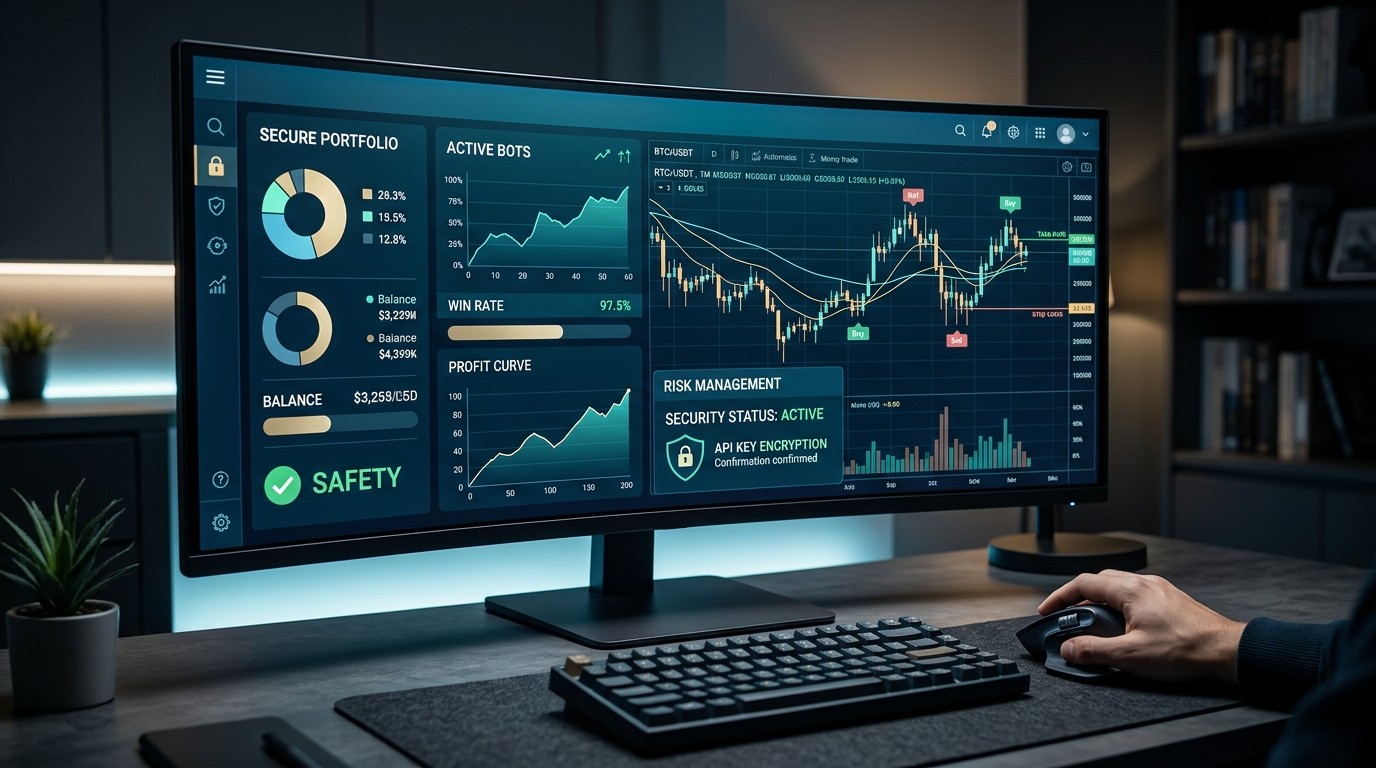
Why the trading bot API key is the part to get right
The trading bot API key is the single setting that decides how much damage a compromised bot can do. Exchanges let you choose permissions when you create a key, typically separating the right to read balances, the right to place trades and the right to withdraw funds. A key without withdrawal permission can still lose money through bad trades, but it cannot send your coins to someone else's wallet.
Treat the key like a password. Store it only in the bot platform itself, never in a chat, email or screenshot. Give each bot its own key so you can revoke one without breaking the others, and delete keys you no longer use. If a bot service announces a security incident, revoke its key immediately rather than waiting to find out whether yours was affected.
How to judge an AI trading bot before you pay
An AI trading bot worth paying for can answer specific questions about itself. Before subscribing, put these to the provider and compare the answers with the table below. Vague answers are an answer.
| Question | A reasonable answer | A warning sign |
|---|---|---|
| Where is my money held? | On your own exchange account | In our fund, pool or wallet |
| What strategy does it run? | A named strategy with its known weaknesses | Proprietary AI, too complex to explain |
| What are the returns? | Backtests and live results, including losing months | A fixed daily or monthly percentage |
| Who runs the company? | Named people and a registered business | Anonymous team, social media accounts only |
| Can I stop and withdraw at any time? | Yes, through the exchange, with no fee to the bot company | Only after a lock-up period or a fee |
For anyone offering to manage trading for others in the US, the regulators' registration databases are a useful check. The NFA's BASIC system lists firms and individuals registered with the CFTC, and an unregistered firm pooling customer money for trading is a serious red flag on its own.
Who should and should not use AI trading bots
Trading bots suit people who already understand the strategy they want to run and want it executed consistently. If you can explain why a grid bot works in a sideways market, and you have decided in advance how much you are prepared to lose, a bot can save you hours of watching charts. It is an automation tool for a plan you already have.
A bot does not suit anyone looking for income they cannot afford to lose, or anyone hoping the software will supply the plan. Without a strategy you understand, you cannot tell whether a losing week is normal variance or a broken bot, and you will tend to switch it off at the worst moment. For those goals, a bot adds risk and fees without adding an edge.
A note on who wrote this: UNC publishes this blog and builds a mobile crypto mining app. UNC does not sell, operate or earn commission from any trading bot, and nothing in this article is financial advice. The app does not trade on your behalf, ask for exchange API keys or promise returns; how it works is set out in how UNC works.
Frequently asked questions
Do AI trading bots actually make money?
Some trading bots make money in the market conditions their strategy suits, and lose money when conditions change. No bot is reliably profitable over every period. Trading fees, slippage and subscription costs mean a bot must beat the market by a margin just to break even, and published results often leave out losing months.
Are AI trading bots legal?
Using a trading bot on your own exchange account is generally legal where the exchange allows API trading. What is often illegal is a company taking customer money into a pool and trading it without registration, or promising returns it cannot deliver. Check your local rules and the exchange's terms before running one.
Should I give a trading bot withdrawal permission?
No. A trading bot needs permission to read balances and place trades, and nothing more. Leaving withdrawal permission off means that even if the bot or its provider is hacked, the attacker cannot send your funds to another wallet. Any bot that insists on withdrawal access is a reason to walk away.
How much money do I need to start with an AI trading bot?
Start with an amount you could lose completely without real harm, kept in a separate sub-account. Many exchanges have minimum order sizes, so very small balances can limit what a bot can do. Run it for several weeks on that amount and judge the results before adding more money.
How can I tell if an AI trading bot is a scam?
An AI trading bot is likely a scam if it asks you to deposit money with the bot company, promises fixed or guaranteed returns, shows profits rising smoothly every day, charges a fee before you can withdraw, or pays bonuses for recruiting others. A legitimate bot connects to your own exchange account and lets you stop anytime.
Start mining with UNC
UNC distributes coins to verified participants — no hardware, no subscription, no battery drain. Read the whitepaper for the distribution model, or check network activity in the explorer.
Get UNC on Google Play