Security
How to Spot a Crypto Giveaway Scam Before You Lose Money
Every giveaway scam relies on one impossible promise: send crypto, receive more back. Once you understand why that can never be real, the entire category becomes obvious.
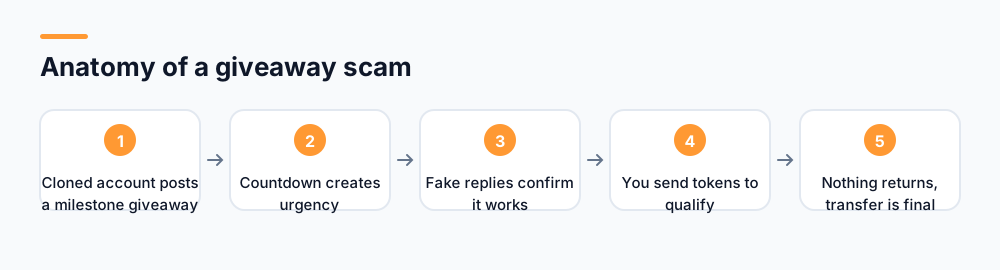
Crypto giveaway scams are among the most successful frauds on the internet, and they work not because they are clever but because they are relentless. The script barely changes: an apparently official account announces that tokens sent to an address will be returned multiplied. People send. Nothing comes back.
What makes these worth understanding properly is that a single principle defeats every variation. Once you see why the promise is structurally impossible, you stop needing to evaluate each new offer on its merits, because there are no merits to evaluate.
The one thing that makes every giveaway scam obvious
Ask what the other party gains. In a real giveaway, an organisation distributes something for free in exchange for attention, sign-ups or goodwill. It costs them and they accept that cost for the marketing benefit. Crucially, a real giveaway never requires you to send money first.
A crypto giveaway scam inverts this. You must send tokens to qualify. Consider that from the other side: they are asking you to give them cryptocurrency, and promising to give you back more than you gave. There is no business in which that transaction makes sense. Nobody profits from returning more than they receive. The only way it works for them is if they keep everything.
The rule that requires no judgement
If an offer requires you to send cryptocurrency in order to receive cryptocurrency, it is a scam. Every time, without exception, regardless of who appears to be offering it. You never need to evaluate anything else.
Blockchain transactions are also irreversible by design. There is no chargeback, no fraud department, and no authority who can claw the funds back. That property makes crypto genuinely useful for some things, and it is exactly why fraudsters prefer it over bank transfers or cards.
Eight warning signs, in order of reliability
- You must send crypto to receive crypto. This alone settles it. Nothing else needs checking.
- There is time pressure. A countdown, a limited number of slots, or "first 500 participants only". Urgency exists to stop you thinking, and real distributions do not need it.
- The account is a near-copy of a real one. A swapped letter, an added underscore, a zero for an O. Compare the handle character by character against the project's own website.
- Replies look enthusiastic but come from empty accounts. Profiles created recently, with no history, all confirming it worked. That is the same operator posting.
- A specific multiplier is promised. "Send 1, receive 2." Real airdrops do not work by multiplying what you send, because you do not send anything.
- Contact came to you unprompted. A direct message, a comment reply, an email you did not expect. Legitimate distributions are announced publicly, not whispered to individuals.
- It asks for your recovery passphrase or seed words at any point, for any stated reason. This is theft in progress, not a giveaway.
- The link is not the official domain. Look at the actual URL, not the text shown. Subtle misspellings and lookalike domains are the entire technique.
The main variations you will encounter
The impersonated founder
An account closely mimicking a well-known figure or project announces a milestone giveaway. Often it replies beneath the real account's genuine post, so it appears in the same conversation and inherits some borrowed credibility. Check the handle, not the display name and avatar, both of which are trivially copied.
The hijacked account
Sometimes a genuine account with real followers is compromised and used to post the scam. This is the hardest variation, because every verification check passes — it really is the official account. The send-to-receive rule is what saves you here, because it does not depend on identity at all.
The "you already won" message
You are told you have won a competition you never entered. To claim it, you must pay a processing fee, or connect your wallet to a claim site. The prize does not exist. The fee, or the wallet approval, is the entire objective.
The fake airdrop claim site
This one is more technical and increasingly common. A site invites you to connect a wallet to claim an airdrop. Connecting is harmless; the danger is what you approve next. The transaction you sign grants permission to move your tokens. Nothing was stolen — you authorised it, because the approval screen was described as verification.
Read what you are signing
Wallet approval prompts describe what access you are granting. If a request asks for permission to spend or transfer your tokens when you expected to receive something, reject it. Legitimate claims do not need spending authority over your balance.
The support impersonator
Not strictly a giveaway, but it targets the same people and often follows one. You ask a question publicly; someone messages you privately offering help. They request your passphrase to "restore" or "verify" your account. Real support never initiates contact and never needs your passphrase.
How to verify a distribution that might be real
Legitimate airdrops and reward programmes do exist. The difference is that they never require an inbound payment, and they are always announced through channels you can reach independently. Verification means going to the source yourself rather than following anything you were given.
- Type the project's domain into your browser directly. Never follow a link from a message, however plausible.
- Check whether the announcement appears on the official site or blog. If it exists only on social media, treat it as fake.
- Look for the same announcement across at least two official channels — website, app notification, verified account.
- Ask in the project's own public channel. Fakes get identified quickly by other users.
- Confirm the mechanism does not involve you sending anything. If it does, you are done deciding.
- Check the destination address in a blockchain explorer. Scam addresses often show many small inbound transfers and immediate outbound consolidation.
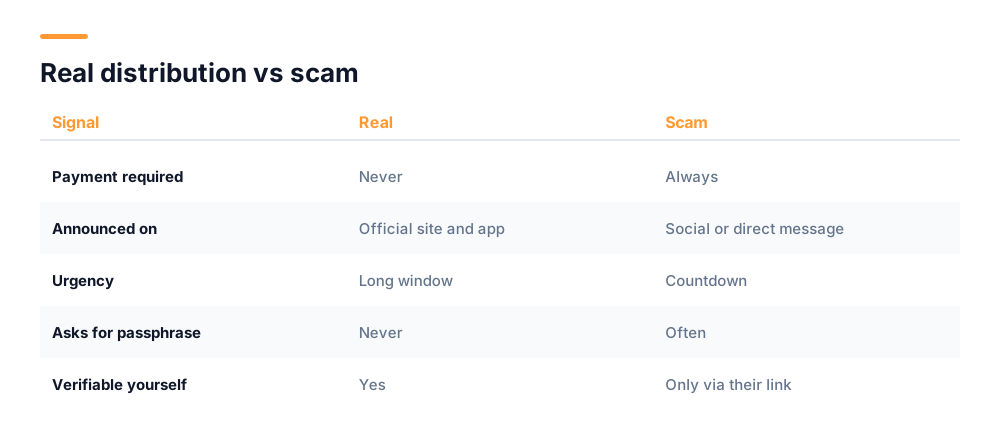
| Signal | Real distribution | Scam |
|---|---|---|
| Payment required | Never | Always, in some form |
| How announced | Official site and app | Social media or direct message |
| Urgency | Usually a long window | Countdown or limited slots |
| Asks for passphrase | Never | Frequently |
| Verifiable independently | Yes | No — only via their link |
Why intelligent people still fall for these
It is tempting to assume victims were careless. That assumption is both unkind and unhelpful, because it stops people recognising the same techniques working on them. These operations are professionally constructed and exploit ordinary psychology rather than ignorance.
Urgency is the main lever. A countdown pushes you toward a decision before you have finished evaluating it, and humans reliably make worse judgements under artificial time pressure. Nothing about a genuine token distribution requires you to act within ninety seconds, which is exactly why fakes insist that you do.
Social proof does the rest. When a dozen accounts reply saying it worked, your brain treats that as evidence, because in ordinary life it usually is. Those replies cost the operator nothing to manufacture. The apparent consensus is the product being sold to you.
Borrowed authority completes it. The branding is real, taken from the genuine project. The logo, the colour scheme, the tone of voice all check out, because they were copied wholesale. Your recognition of the brand is being used against you, which is why identity checks are a weaker defence than the send-to-receive rule.
Why one absolute rule beats good judgement
Judgement degrades under pressure, and these schemes are engineered to apply pressure. A rule you hold without exception keeps working when your judgement is compromised, which is precisely when you need it.
What to do if you already sent something
The honest and unwelcome answer first: sent cryptocurrency is almost never recoverable. Transactions are final, the receiving party is anonymous, and no intermediary exists who can reverse it. Anyone who contacts you offering recovery services is running a second scam on the same victim, which is a well-documented pattern.
What is still worth doing, quickly:
- If you entered your passphrase anywhere, assume that wallet is compromised. Create a new wallet immediately and move any remaining balance to it.
- If you approved a wallet permission, revoke it. Most chains have a token-approval tool that lists and cancels active spending permissions.
- Change the password on the affected account and any account sharing that password, and enable two-factor authentication.
- Report the account to the platform. It rarely helps you, but it shortens how long the operation runs against others.
- Report to your national fraud or cybercrime body. Recovery is unlikely, but reports feed investigations.
- Tell the project. They cannot reverse it, but they can warn other users and get impersonating accounts taken down.
One more thing worth saying plainly: being caught by one of these is not a sign of carelessness or poor judgement. These operations are professionally produced, they exploit trust in brands you have every reason to trust, and they are designed and iterated by people who do this as a full-time occupation. Embarrassment is what stops people warning others afterwards, which is precisely what the operators depend on to keep the same script working month after month.
The habits that make you a hard target
You do not need vigilance about every new scheme. You need a small number of rules held absolutely, so no story can talk you out of them.
- Never send crypto to receive crypto. No exceptions and no special cases.
- Never share your recovery passphrase with anyone, including anyone claiming to be support.
- Never follow links from unsolicited messages. Type the domain yourself.
- Treat urgency as a warning rather than a reason to hurry.
- Read wallet approval prompts before signing, and reject spending permissions you did not intend.
- Assume anyone who contacts you first about your crypto is an attacker until independently proven otherwise.
There has never been a legitimate scheme in which sending cryptocurrency returns more cryptocurrency. Not once. That single fact is enough to defeat the entire category.
For the wider set of risks facing mining app users, including permissions and fake apps, see our guide on whether mobile crypto mining is safe. UNC does not run giveaways of any kind, and official communication comes only from unctech.co addresses.
Frequently asked questions
Are any crypto giveaways real?
Legitimate airdrops and reward programmes exist, but they never require you to send cryptocurrency first, and they are always announced on the project's own website or in its app rather than only on social media. If an offer requires an inbound payment from you in any form, it is a scam.
Can I get my crypto back after a giveaway scam?
Almost never. Blockchain transactions are irreversible, the recipient is anonymous, and no intermediary can reverse them. Be aware that anyone contacting you afterwards offering recovery services is running a second scam against the same victim — a very common follow-up pattern.
How do scammers make giveaway posts look official?
They copy the display name, avatar and branding of a real account and register a handle that differs by a single character, then reply under the genuine account's posts so they appear in the same thread. Sometimes they compromise a real verified account, in which case identity checks pass entirely.
Is it safe to connect my wallet to a claim site?
Connecting alone is generally harmless. The danger is the transaction you are then asked to approve, which may grant permission to spend or transfer your tokens. Read approval prompts carefully and reject any request for spending authority when you expected only to receive something.
What should I do if I shared my recovery passphrase?
Treat that wallet as permanently compromised. Create a new wallet immediately and move any remaining balance to it. Then change the password on the associated account and any other account using the same password, and enable two-factor authentication everywhere you can.
Start mining with UNC
UNC distributes tokens to verified participants — no hardware, no subscription, no battery drain. Read the whitepaper for the distribution model, or check network activity in the explorer.
Get UNC on Google Play