Mining Basics
How Does Mobile Crypto Mining Actually Work?
If a phone cannot out-compute a warehouse full of mining rigs, what exactly is a mobile mining app doing? Here is the honest answer, including what these apps can and cannot pay you.
If you have downloaded a mobile mining app, you have probably wondered the obvious thing: how can a phone possibly mine cryptocurrency when serious mining operations run warehouses full of specialised machines? It is a fair question, and the honest answer is that most mobile mining apps are not doing what the word "mining" implies. Understanding the difference matters, because it separates the legitimate apps from the ones designed to waste your time or steal your data.
This guide explains what actually happens when you tap "start mining" on your phone, why traditional mining is impossible on mobile hardware, what the realistic earnings look like, and the specific warning signs that tell you an app is not being straight with you.
What "mining" originally meant
In Bitcoin and other proof-of-work networks, mining is a competition. Every miner on the network races to find a number that, when combined with the pending block of transactions and fed through a hashing function, produces a result below a target value. There is no clever shortcut. The only method is to guess, check, and guess again, billions of times per second. The first miner to find a valid answer gets to add the block and collect the reward.
Because it is a brute-force race, the winner is essentially whoever can make the most guesses. That created an arms race: from ordinary CPUs, to graphics cards, to purpose-built ASIC chips that do nothing but compute one specific hash function as fast as physically possible.
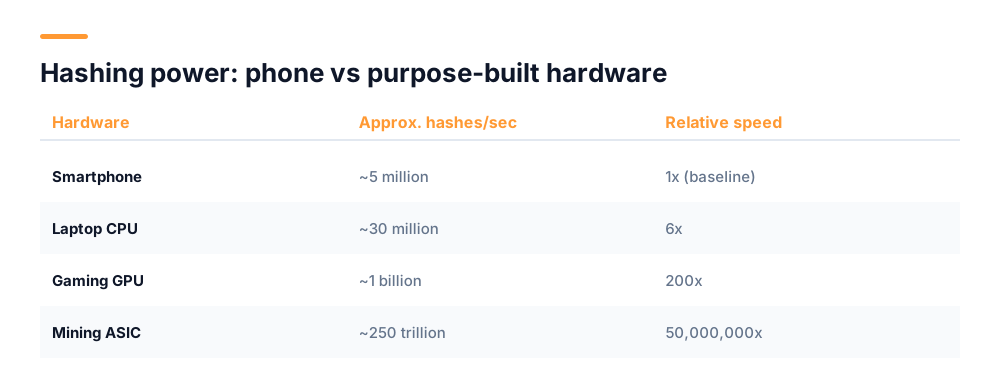
The scale of that gap is the whole story. A modern ASIC performs on the order of hundreds of trillions of hashes per second. A flagship smartphone, pushed to its absolute limit and ignoring the fact that it would overheat within minutes, manages a few million. The phone is not slightly behind. It is behind by a factor of roughly a hundred million.
The short version
Genuine proof-of-work mining on a phone would earn you a fraction of a cent per year while destroying your battery. Any app claiming to do real Bitcoin mining on your handset is either misinformed or lying.
So what are mobile mining apps actually doing?
Legitimate mobile mining apps are not running hash computations on your device. They use a completely different model, and the better ones are upfront about it. Broadly, there are four approaches, and they are not equally honest.
1. Participation-based distribution
This is the model most credible mobile mining projects use, including UNC. Rather than rewarding raw computing power, the network distributes tokens to verified participants who check in regularly. Your phone does almost no work — it simply confirms that a real, verified human is participating. Rewards are calculated server-side based on your participation, streaks, and referrals.
The word "mining" here is a metaphor. It describes earning newly distributed tokens over time, not solving cryptographic puzzles. Projects that explain this clearly are being straight with you. Projects that use mining animations and fake hash-rate counters to imply computation is happening are not.
2. Cloud mining subscriptions
Here the app is a remote control for hardware in a data centre somewhere. You pay a fee, and a share of that hardware is nominally allocated to you. Some cloud mining operations are legitimate businesses. A great many are not, and the sector has a long history of operators who simply pay early customers with later customers' deposits until the money runs out.
Be careful with anything that asks for payment upfront
If an app requires a deposit before you can earn, you are no longer mining — you are making an investment in someone else's business, with none of the protections that usually implies. Treat guaranteed-return promises as the warning sign they are.
3. Pooled mining clients
A small number of apps genuinely do run hashing on your phone, contributing to a mining pool. They are technically honest but practically pointless. The electricity you use costs more than you earn, and sustained full-load computation degrades your battery. If an app is heating your phone to earn fractions of a cent, it is not a good trade.
4. Outright fakes
Some apps mine nothing at all. They show a counter that ticks upward, serve you advertising, and make withdrawal conditional on thresholds you can never quite reach. The balance is a number in a database with nothing behind it. These are the most common category in app stores, and the next section is about spotting them.
How to tell a real project from a fake one
You do not need technical knowledge to evaluate a mobile mining app. You need to check a handful of specific things, and most fakes fail several of them immediately.
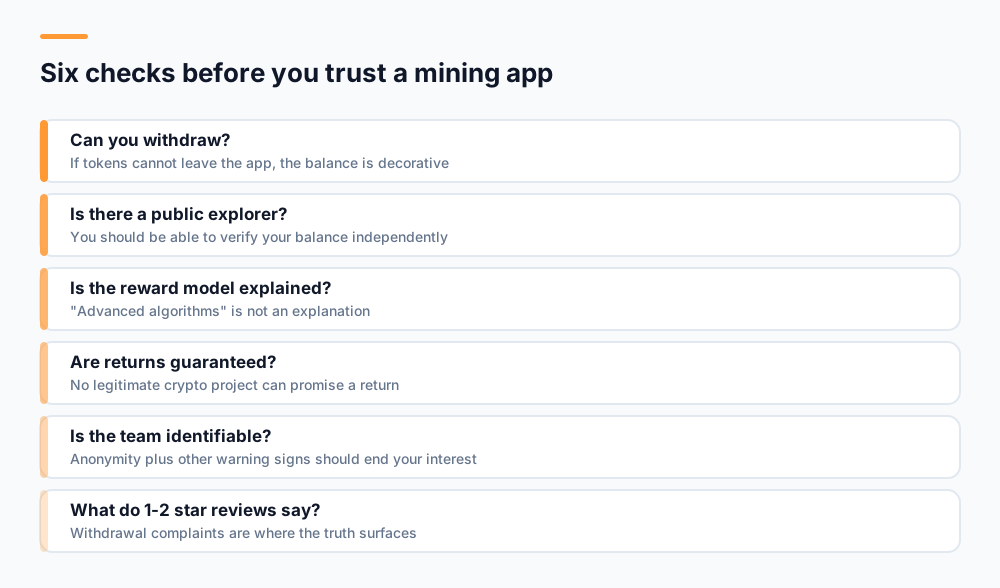
- Can you withdraw? This is the single most revealing question. If tokens cannot leave the app, or withdrawal needs a minimum you will realistically never hit, the balance is decorative.
- Is there a public blockchain explorer? A real network lets anyone inspect transactions independently. If you cannot verify your balance outside the app, you are trusting a spreadsheet.
- Does the project explain its reward mechanism? Honest projects describe how tokens are distributed. Vague talk of "advanced algorithms" is a substitute for an explanation, not an explanation.
- Does it promise fixed returns? No legitimate crypto project can guarantee a return. Anything that does is describing something other than what it claims to be.
- Is the team identifiable? Anonymity is not automatically disqualifying, but combined with other warning signs it should end your interest.
- What do the negative reviews say? Filter to one and two stars and look specifically for withdrawal complaints. That is where the truth surfaces.
What can you realistically earn?
This is where honest projects and marketing hype diverge most sharply, so it is worth being blunt. Mobile mining will not replace your income. Anyone suggesting otherwise is selling you something.
On a participation-based network, what you accumulate is a quantity of tokens. The value of those tokens depends entirely on whether the network becomes something people want to use, and that is genuinely uncertain. Early participants in successful networks have sometimes done very well. Early participants in unsuccessful networks — which is most of them — end up with a number in an app that never converts to anything.
The sensible way to think about it: you are spending a few seconds a day for a lottery ticket on a network you find interesting. If the token becomes valuable, that was a good use of your attention. If it does not, you lost very little. What you should not do is make financial decisions, buy hardware, or pay subscription fees on the assumption that a token will be worth something in future.
| Model | Your device does | Costs you | Realistic outcome |
|---|---|---|---|
| Participation-based | Almost nothing | Seconds per day | Tokens of uncertain future value |
| Cloud subscription | Nothing | Real money upfront | Frequently a total loss |
| On-device hashing | Heavy computation | Battery and electricity | Less than the electricity cost |
| Fake app | Displays ads | Your time and data | Nothing withdrawable |
Does it damage your phone or drain your battery?
For participation-based apps, no. The app makes a handful of network requests and updates a counter. Battery use is comparable to any messaging app sitting idle. There is no sustained computation, so no meaningful heat and no accelerated battery wear.
For apps genuinely hashing on your device, yes, and materially so. Sustained full-load CPU work generates heat, and heat is what degrades lithium-ion batteries. Running a hashing client for months will measurably shorten your battery's usable life. Given the earnings involved, this is a straightforwardly bad trade.
A practical test: after ten minutes of "mining", is your phone warm? Genuine participation-based mining will not warm it at all. If it is hot, something is computing, and you should ask whether the reward justifies the wear.
Protecting yourself while using mining apps
The main risk with mobile mining is not usually the mining. It is everything built around it — the account, the wallet, and the people who target users of these apps.
- Never share your recovery passphrase with anyone, for any reason. No legitimate support team will ever ask for it. Anyone who does is trying to take your balance.
- Store your passphrase offline, on paper, somewhere you will still find it in two years. Well-designed wallets cannot recover it for you, by design.
- Enable two-factor authentication and biometric unlock wherever offered.
- Be sceptical of anyone contacting you first, in any channel, about your account. Impersonation of support staff is the most common attack against crypto users.
- Ignore giveaways. There is no legitimate scheme where sending crypto returns more crypto.
- Use a unique password. Reused passwords are how most account compromises actually happen.
Is mobile mining worth your time?
It depends entirely on your expectations. If you are looking for income, no — the numbers do not work, and any app implying otherwise is misleading you. If you are curious about crypto, want to hold a position in a network you find interesting, and are comfortable that it may come to nothing, then a few seconds a day is a reasonable price for that exposure.
What matters most is choosing a project that is honest with you about the mechanism. A project willing to tell you plainly that your phone is not solving cryptographic puzzles, that rewards depend on participation rather than computation, and that the token may never be worth anything, is a project treating you as an adult. That honesty is a better signal of quality than any earnings projection.
The most useful question to ask any mining app is not "how much will I earn?" but "can I withdraw, and can I verify it independently?"
If you want to understand the network behind UNC in more depth, the whitepaper covers the distribution model and verification approach, and the explorer lets you inspect network activity yourself without taking anyone's word for it.
Frequently asked questions
Can you really mine cryptocurrency on a phone?
Not in the traditional proof-of-work sense. A phone is roughly a hundred million times slower than purpose-built mining hardware, so genuine hash-based mining would earn a negligible amount while damaging your battery. Legitimate mobile mining apps instead distribute tokens based on verified participation, which is a different mechanism that happens to share the same name.
Does mobile mining drain your battery?
Participation-based apps use very little battery, comparable to an idle messaging app, because no heavy computation happens on your device. Apps that genuinely run hashing on your phone do drain the battery significantly and generate heat, which shortens battery lifespan. If your phone gets warm while mining, real computation is happening.
How much money can you make from mobile crypto mining?
Realistically, you accumulate tokens whose future value is unknown and may be zero. Mobile mining will not replace an income, and any app promising fixed or guaranteed returns should be treated as a warning sign. Treat it as low-cost exposure to a network you find interesting, not as earnings.
How can I tell if a mining app is a scam?
Check whether you can actually withdraw tokens, whether a public blockchain explorer lets you verify balances independently, whether the reward mechanism is clearly explained, and whether the app promises guaranteed returns. Then read the one and two star reviews specifically for withdrawal complaints. Fakes typically fail several of these checks.
Is mobile crypto mining safe?
The mining itself is generally harmless on participation-based apps. The real risks are account security and social engineering: phishing, fake support staff, and giveaway scams. Never share your recovery passphrase, enable two-factor authentication, and be sceptical of anyone who contacts you first about your account.
Start mining with UNC
UNC distributes tokens to verified participants — no hardware, no subscription, no battery drain. Read the whitepaper for the distribution model, or check network activity in the explorer.
Get UNC on Google Play