Exchanges
Binance Alternatives in 2026: How US Traders Should Choose
Binance.com does not serve US residents, and its 2023 US settlements left many traders looking elsewhere. Here is how to pick a Binance alternative that is legal where you live, holds your money safely, and fits how you trade.
The best Binance alternatives for someone in the United States are exchanges that are registered to serve US residents, hold customer funds transparently, and let you withdraw without surprises. Binance.com itself does not accept US customers, so for Americans the real question is which regulated platform fits the way you trade.
This guide is for US traders and crypto-curious readers deciding where to move. It explains why people leave Binance, how safe it is today, what to check on any replacement, and which kind of platform suits futures, altcoins or a stuck withdrawal. It names categories and checks rather than a paid ranking, because a list goes out of date faster than the rules behind it.
Key takeaways
Binance.com does not serve US residents; Binance.US is a separate company with fewer coins. In November 2023 Binance pleaded guilty to US anti-money-laundering violations and agreed to pay more than $4.3 billion, and its founder stepped down as CEO. A good alternative is registered where you live, publishes proof of reserves, and states its withdrawal limits. US residents can only trade crypto futures on CFTC-registered venues. Crypto held on an exchange is not FDIC-insured.
Disclosure: UNC publishes this blog and runs its own exchange, UNC Exchange. We describe it at the end, separately from the comparison, and we do not claim it is available to US residents.
Why are people leaving Binance?
People leave Binance for three main reasons: US residents are not allowed on Binance.com, the company's 2023 criminal plea and regulatory settlements shook trust, and some users hit account reviews or withdrawal holds they could not resolve quickly. For Americans the first reason alone decides it.
The legal history is public. In November 2023 Binance pleaded guilty in the United States to violating anti-money-laundering and sanctions laws and agreed to pay more than $4.3 billion, and its founder Changpeng Zhao pleaded guilty and resigned as chief executive. On the same day the Commodity Futures Trading Commission announced that Binance and Zhao would pay $2.85 billion for offering crypto derivatives to US customers without registering.
The CFTC described how Binance kept US customers on its main platform while knowing that offering them derivatives required registration. For a trader choosing where to hold money, that history matters less as a scandal than as evidence of which venues are allowed to serve you and which are not.
Is Binance safe in 2026?
Whether Binance is safe in 2026 depends on what you mean. It remains one of the largest exchanges in the world and publishes proof-of-reserves reports, but for a US resident using Binance.com is not a safety question at all: the service is not offered to you, and getting around that breaks its terms.
Safety on any exchange comes down to three separate risks. Custody risk is whether the company actually holds your coins. Legal risk is whether it may serve you where you live. Account risk is whether your funds can be frozen while it reviews your activity. A proof-of-reserves report speaks only to the first, and only at the moment it was taken.
Binance.US is a different company from Binance.com, set up to serve American users. It lists fewer coins and has its own terms and state availability, so judge it on its own record rather than the global brand's.
What to check before you move to any Binance alternative
Before you move funds to a Binance alternative, check that it is registered to serve your state, shows proof of the assets it holds for customers, publishes its withdrawal limits and fees, and gives you a real support channel. Each takes a few minutes and avoids most of the problems people run into.
- Registration. A US exchange that transmits money must register with FinCEN as a money services business and hold licences in the states it serves. FinCEN's public MSB search lets you look a company up by name.
- Your state. Some platforms do not serve every state, and New York requires its own BitLicense. Confirm your state is supported before you deposit.
- Proof of reserves. Look for a regular, independently checked report showing customer assets are held one for one, and check its date.
- Withdrawal terms. Find the daily limits, the network fees, and how long a first withdrawal or a new address is held for review.
- Insurance claims. Crypto on an exchange is not FDIC-insured. Some exchanges hold US dollar balances at insured banks; that covers the cash, not the coins.
- Support. A ticket system with response times, not only a chat bot or a social media account.
The best Binance alternatives in 2026, by type
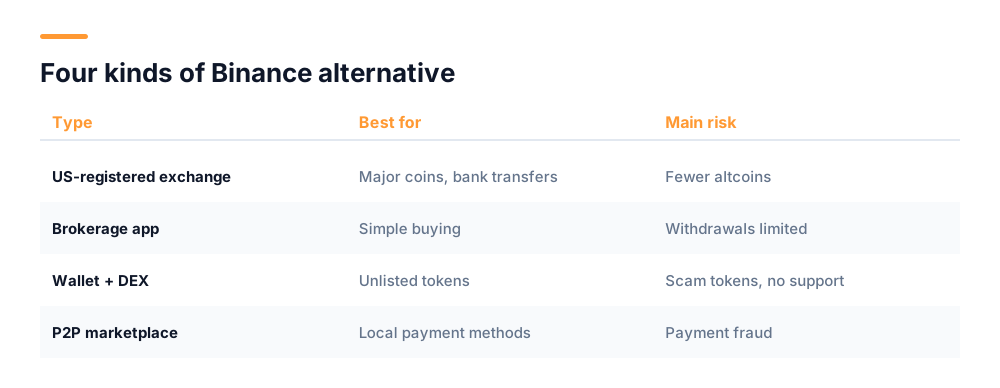
The best Binance alternatives in 2026 fall into four types: US-registered exchanges, brokerage apps that sell crypto, self-custody wallets with decentralised exchanges, and peer-to-peer marketplaces. Most people need the first type; the others solve narrower problems and carry different risks.
| Type | Examples (US) | Best for | Watch out for |
|---|---|---|---|
| US-registered exchange | Coinbase, Kraken, Gemini, Binance.US | Buying, selling and holding major coins; bank transfers in and out | Fewer altcoins than Binance.com; state availability varies |
| Brokerage app | Robinhood Crypto and similar | Simple buying alongside stocks | Withdrawing coins to your own wallet may be limited; small coin list |
| Self-custody wallet + DEX | A non-custodial wallet with an on-chain exchange | Tokens no exchange lists; full control of your keys | No support desk, irreversible mistakes, scam tokens, network fees |
| Peer-to-peer marketplace | P2P sections of larger exchanges | Paying with local methods | Counterparty and payment fraud; check escrow and dispute rules |
Coin lists, fees and state coverage change often, so confirm current details on each platform's own site before you sign up. If you trade on more than one, keep long-term holdings off the exchange in a wallet you control, and keep on the exchange only what you are actively trading.
What is the best Binance alternative for futures trading?
For a US resident, the best Binance alternative for futures trading is a venue registered with the CFTC. Offshore exchanges offering perpetual futures with very high leverage are not permitted to serve US customers, which is exactly what the CFTC's 2023 case against Binance was about.
Regulated options include bitcoin and ether futures listed on CME Group, reached through a registered futures broker, and crypto futures on Coinbase Derivatives, a CFTC-registered exchange. These products usually offer lower leverage than offshore perpetuals, and that is deliberate: leverage is how most futures traders lose their deposits.
You can confirm whether a firm is registered with the CFTC, or with the National Futures Association that registers brokers, using the CFTC's own lookup page before you send any money. The CFTC also publishes plain-language advisories on the risks of virtual currency trading.
Which Binance alternative is best for altcoins?
The best Binance alternative for altcoins depends on how small the coins are. US-registered exchanges list hundreds of tokens but fewer than Binance.com, so for mid-sized altcoins compare their coin lists; for very new or small tokens, the only route is usually a self-custody wallet and a decentralised exchange.
A smaller coin list is partly a filter. Exchanges that answer to US regulators decline many tokens because of securities and fraud risk. When you trade outside that filter on a decentralised exchange, you take on the checking yourself: confirm the token's contract address from the project's official site, never from a link in a message.
- Check the contract address against the project's official channels before buying.
- Look at trading volume and how many holders the token has; tiny, concentrated holdings are a warning.
- Test with a small amount and confirm you can sell, not only buy.
- Never approve unlimited token spending for a site you do not recognise.
Binance withdrawal problems: what to do before you switch
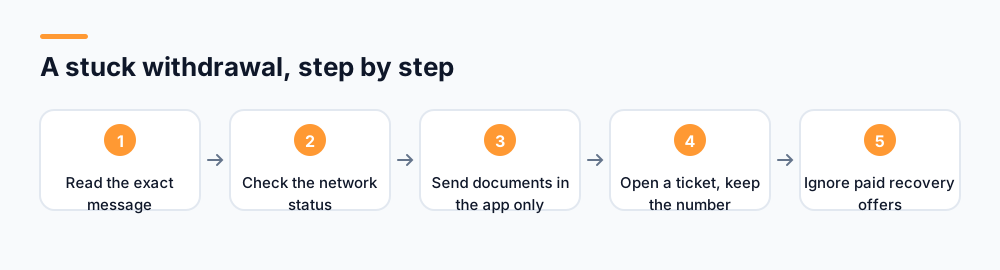
If a Binance withdrawal is stuck, first find out why: most holds come from an identity or source-of-funds review, a network that is congested or suspended, or a new address still in a security waiting period. Each has a different fix, and switching exchanges does not release funds already held.
- Read the exact message on the withdrawal or in your email. It usually names the review or the network issue.
- Check the network status page for the coin you are sending; deposits and withdrawals on a congested chain can wait hours.
- If a review asks for documents, send them only through the official app or website, never through a link someone sends you.
- Open a support ticket and keep its number. Note dates, amounts and transaction IDs.
- Be wary of anyone who contacts you offering to "recover" or "unlock" funds for a fee. That is a common scam aimed at people with stuck withdrawals.
Once the funds are out, choose the replacement on the checks above rather than on which platform had no problem this week. Every exchange runs reviews; what differs is whether it tells you the rules in advance and answers when you ask.
Where does UNC Exchange fit?
UNC Exchange is the exchange run by UNC, the company that publishes this blog. It is built around the UNC coin, which members earn through the UNC mobile app, and it offers spot markets and peer-to-peer trading. We mention it here for completeness, and the same checks above apply to us.
We are not claiming that UNC Exchange is licensed in, or available to residents of, the United States, and it is not a CFTC-registered futures venue. If you are in the US, use the registration checks above before depositing anywhere, including with us. You can read how the UNC network works, and what the UNC coin is and is not, on our site.
For background that helps with any exchange, see our guides to the difference between a coin and a token, how to use a blockchain explorer to check a transfer, and how crypto scams work.
Frequently asked questions
Can US residents use Binance?
US residents cannot use Binance.com; its terms exclude them. They can use Binance.US, a separate US company with its own licences, terms and a smaller list of coins. Availability can differ by state, so check that Binance.US supports your state before opening an account, and judge it on its own record rather than the global brand.
What is the safest Binance alternative for beginners in the US?
For beginners, the safest choice is a large US-registered exchange that supports your state, publishes proof of reserves and links to your bank directly. Start with a small amount, turn on two-factor authentication, and move anything you plan to hold long term into a wallet you control rather than leaving it on the exchange.
Is crypto on an exchange protected by FDIC insurance?
No. FDIC insurance covers deposits at insured banks, not crypto assets. Some exchanges keep customers' US dollar balances at FDIC-insured banks, which can protect that cash if the bank fails, but the coins themselves are not insured. If an exchange fails, crypto customers may wait a long time and recover only part of their funds.
Can I trade crypto futures with high leverage in the US?
Not legally on offshore exchanges. US residents may trade crypto futures only on CFTC-registered venues, such as CME Group futures through a registered broker or Coinbase Derivatives. Leverage on these is lower than on offshore perpetual futures. You can check any firm's registration on the CFTC's website before you open an account.
How do I move my crypto from Binance to another exchange?
Open and verify the new account first, then copy its deposit address for the exact coin and network. Send a small test amount from Binance, confirm it arrives, then send the rest. Choosing the wrong network can lose funds permanently, so match the network name on both sides before you confirm the withdrawal.
Start mining with UNC
UNC distributes coins to verified participants — no hardware, no subscription, no battery drain. Read the whitepaper for the distribution model, or check network activity in the explorer.
Get UNC on Google Play