Getting Started
Coin vs Token: What Is the Actual Difference?
People use the words interchangeably, but they describe genuinely different things. The distinction affects what fees you pay, what security you inherit, and what can go wrong.
In everyday conversation "coin" and "token" get used as synonyms, and for casual purposes that rarely causes problems. But they describe two structurally different things, and the difference has practical consequences: which fees you pay, whose security you are relying on, and what categories of failure can affect what you hold.
This guide explains the distinction, why it matters to you as a holder rather than as a developer, how to check which one you have, and the specific risks that attach to each.
The core distinction
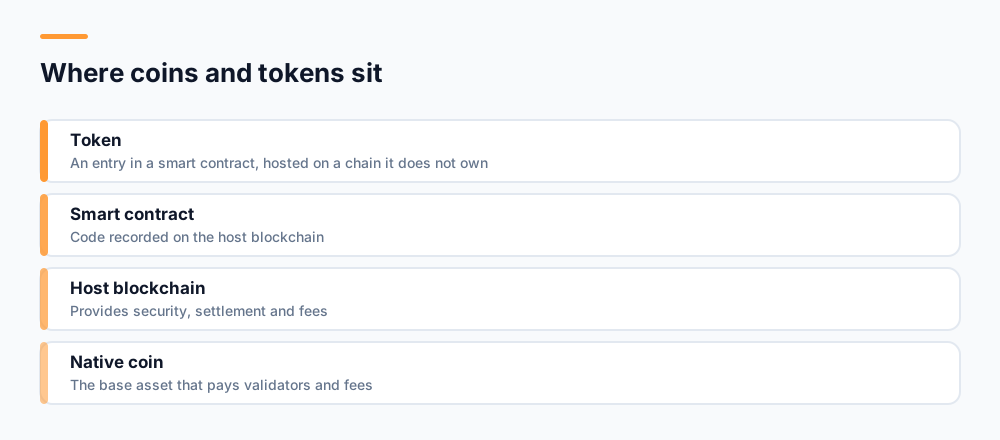
A coin is the native asset of its own blockchain. Bitcoin is the native asset of the Bitcoin network; Ether is the native asset of Ethereum. The blockchain exists to track that asset, and the asset exists to make the blockchain work — it pays the validators or miners who secure the network.
A token is an asset recorded on a blockchain it does not own. Thousands of tokens exist on Ethereum, for example. They are entries in a smart contract, and that contract is itself a record on the Ethereum blockchain. The token has no network of its own; it is a tenant on someone else's infrastructure.
A useful analogy: a coin is like a country issuing its own currency and running its own banking system. A token is like a company issuing gift vouchers denominated in someone else's currency, redeemable within that company's system. The vouchers are real and can have value, but they depend on infrastructure the company does not control.
Why the difference matters to you
You pay fees in the coin, not the token
This is the consequence that catches people most often. To move a token, you pay the transaction fee in the host chain's native coin. Sending an Ethereum-based token requires Ether to pay the fee, even though you are not sending Ether.
The practical trap: you can hold a substantial token balance and be completely unable to move it, because you hold none of the native coin needed to pay the fee. The tokens are visibly there and entirely stuck. Anyone who has held tokens without keeping a small coin balance for fees has met this problem.
Keep a little of the native coin
If you hold tokens on any chain, keep a small balance of that chain's native coin. Without it you cannot move, sell or transfer your tokens at all, no matter how much they are worth.
You inherit the host chain's security and its problems
A token has no independent security. It is exactly as secure as the chain hosting it, and no more. That can be an advantage: a token on a large, well-established chain inherits enormous accumulated security it could never build alone.
It also means inheriting problems. If the host chain becomes congested, your token transfers become slow and expensive regardless of anything the token's team does. If the chain suffers an outage, your token is frozen. Token holders are exposed to decisions and failures in a network they have no relationship with.
Different failure modes
A coin can fail if its network loses the miners or validators securing it, if a fundamental flaw is found in its protocol, or if nobody uses it. These are slow, visible failures.
A token adds an extra failure surface: the smart contract itself. A bug in that contract can freeze balances or allow them to be drained, and this has happened repeatedly and expensively. A token also frequently depends on a specific team continuing to operate; if they abandon it, the contract may keep running but nothing further happens.
| Coin | Token | |
|---|---|---|
| Has own blockchain | Yes | No |
| Pays network fees with | Itself | Host chain's coin |
| Security comes from | Its own network | The host chain |
| Extra risk | Network abandonment | Smart contract bugs |
| Cost to create | Very high | Very low |
| Examples | Bitcoin, Ether | Most stablecoins, most new projects |
Why almost everything new is a token
Creating a token is trivially easy. On a chain with smart contracts, deploying a standard token contract requires modest technical skill and a small fee. It can be done in an afternoon. This is why the number of tokens in existence runs into the hundreds of thousands.
Creating a coin means building and launching a blockchain, then attracting enough independent participants to secure it. That is a substantial undertaking requiring engineering depth, sustained funding and a community willing to run infrastructure. Very few projects manage it, and many that try end up with a network so small it is not meaningfully secure.
What this asymmetry means for you
Because tokens cost almost nothing to create, their existence proves nothing. Somebody spending an afternoon and a few dollars is not evidence of a serious project. Evaluate the team, the purpose and the code — never the mere fact that a token exists.
How to check which one you hold
This is worth knowing about anything you hold, and it takes a couple of minutes.
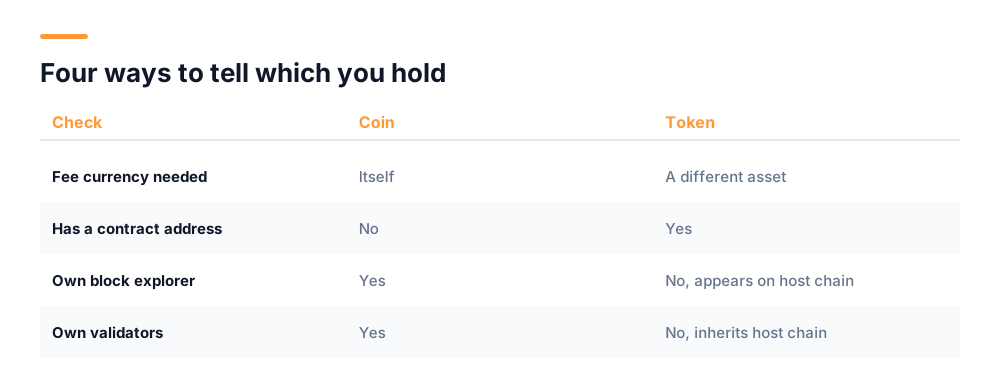
- Look it up in a block explorer. If the asset has its own explorer showing its own blocks and validators, it is a coin. If you find it as a contract address on another chain's explorer, it is a token.
- Check whether it has a contract address at all. Coins do not have one. If documentation lists a contract address, that is definitionally a token.
- See what fee currency is required to send it. If you need a different asset to pay the fee, you hold a token on that asset's chain.
- Read the project documentation for the chain it runs on. Honest projects state this plainly; evasiveness about it is itself informative.
A word of caution about contract addresses. Because anyone can deploy a token with any name, multiple contracts can claim to be the same project, and only one is genuine. Always take the contract address from the project's own website rather than from search results or a message. Fake contracts imitating well-known tokens are a standard technique.
Why the same token can exist on several chains
Here is something that confuses almost everyone at first, and it has cost people real money. A token with a familiar name may exist as separate, unrelated contracts on several different blockchains. The name and logo are identical. The contracts are not.
The practical consequence is severe. If you send a token from one chain to an address on a different chain, the funds are generally unrecoverable. The receiving side has no contract for the version you sent, so nothing arrives, and there is no support desk with the authority to undo it. This is one of the most common ways people lose crypto, and it has nothing to do with scams — it is a straightforward mistake made easy by identical branding.
Always match the network, not just the name
Before sending any token, confirm that the sending and receiving sides expect the same chain. Exchanges label this as the network or chain when you withdraw. Getting it wrong usually means the funds are gone permanently.
The same trap applies to addresses. Some chains share address formats, meaning an address is technically valid on more than one network. Your wallet will happily accept it and the transaction will succeed — on the wrong chain, where the intended recipient has no way to reach it.
Related terms you will encounter
The vocabulary sprawls, and some terms describe purpose rather than structure. A few worth recognising:
- Utility token — intended to be used for something within a system, such as paying fees or accessing a feature, rather than held as an investment.
- Governance token — grants a vote on decisions about a project. Whether those votes carry real weight varies enormously.
- Stablecoin — designed to track the value of something stable, usually a national currency. Despite the name, most are tokens, and the mechanism maintaining the peg matters a great deal.
- Altcoin — loosely, any coin that is not Bitcoin. Often applied to tokens too, which muddies the distinction this article is about.
- Wrapped token — a token on one chain representing an asset from another, allowing it to be used in places the original cannot go.
- Native token — confusingly, sometimes used to mean a coin. Context usually clarifies, but the term is a common source of muddle.
Notice that most of these describe intended use rather than technical structure. A governance token and a utility token are both tokens; the label tells you what it is for, not what it is. The coin-versus-token distinction is the structural one, and it is the one with mechanical consequences.
Is one better than the other?
Neither is inherently better; they suit different purposes. A project needing to control its own economics, transaction rules and long-term direction has reason to run its own chain. A project wanting to launch quickly and inherit an established network's security has good reason to issue a token.
What matters more than the category is whether the thing is any good. A token from a serious team solving a real problem is worth vastly more than a coin with its own chain that nobody uses and nobody secures. Plenty of projects launched their own blockchain and ended up with a network run by three machines, which is worse than being a token on a large chain in every respect.
Use the distinction as a lens for asking better questions. If it is a token, whose chain is it on, and are you comfortable depending on that chain? If it is a coin, who actually secures the network, and how many of them are there? Both questions have answers you can look up, and both are more informative than the label.
Coin or token tells you the structure, not the quality. A widely used token beats an abandoned coin every time.
If you want to look any of this up yourself, our guide to blockchain explorers covers how to read one, and the UNC whitepaper documents the network structure and distribution model behind the token.
Frequently asked questions
What is the difference between a coin and a token?
A coin is the native asset of its own blockchain, such as Bitcoin on the Bitcoin network. A token is recorded on a blockchain it does not own, existing as an entry in a smart contract on a host chain like Ethereum. Coins have their own network; tokens rely on someone else's.
Why do I need a different crypto to send my token?
Transaction fees are always paid in the host chain's native coin. Sending an Ethereum-based token requires Ether for the fee. This means you can hold a valuable token balance and be unable to move it if you have none of the native coin, which is a common and frustrating trap.
Are tokens less safe than coins?
Not necessarily, but they have an extra failure surface. A token inherits the security of its host chain, which for a large chain is substantial. However it also depends on its own smart contract, and bugs in those contracts have frozen or drained balances on multiple occasions.
How do I check whether something is a coin or a token?
The quickest test is what fee currency you need to send it — if it is a different asset, you hold a token on that asset's chain. You can also check whether it has a contract address, since coins do not have one, or look for its own block explorer showing its own blocks.
Is a stablecoin a coin or a token?
Despite the name, most stablecoins are tokens issued on host chains like Ethereum. The same stablecoin often exists as separate tokens on several different chains. What matters more than the label is the mechanism maintaining its peg and who holds the backing reserves.
Start mining with UNC
UNC distributes tokens to verified participants — no hardware, no subscription, no battery drain. Read the whitepaper for the distribution model, or check network activity in the explorer.
Get UNC on Google Play