Security Awareness
The Dangers of Early Fund Release in P2P Crypto Trades
Releasing crypto before the payment has really cleared is the single most expensive mistake in P2P trading, and it is the one every scam is built to provoke. Here is why it cannot be undone and how to know when release is safe.
The dangers of early fund release are simple to state: once a seller releases crypto from escrow, the transfer is final, and if the buyer's payment turns out to be fake, incomplete or reversible, the seller has lost both the coins and the money. No platform, bank or support team can pull a released transfer back.
Early fund release means releasing before the full payment has visibly arrived, and settled, in an account you control. This post, part of UNC's Security Awareness series, explains why it is the moment scammers aim at, the stories they use to get there, and a short checklist for knowing when release is genuinely safe.
Disclosure: UNC publishes this blog and runs the P2P market described here. Product details were checked against the UNC app's code on 8 November 2026.
What is early fund release in a P2P trade?
Early fund release is a seller releasing escrowed crypto to a buyer before confirming, in their own bank or wallet, that the buyer's payment has arrived in full and cannot easily be reversed. It is the opposite of what escrow is for. Escrow holds the coins precisely so that the seller never has to trust a buyer's word.
In a UNC P2P trade, the seller's UNC is locked from the moment the offer goes up. It cannot be sent, offered again, put on a gift card or used in a scheduled transfer while the trade is open. Only one action moves it to the buyer: the seller pressing release. That makes release the single point at which a seller can lose money, and it is the point every P2P scam is designed to reach.
The dangers of early fund release: why it cannot be undone
A released P2P transfer cannot be undone because the two halves of the trade have different finality. The crypto half is final the moment it moves: on UNC, release debits the seller's wallet, credits the buyer's and writes the transfer to the ledger. There is no reversal endpoint, and support cannot create one for a single case.
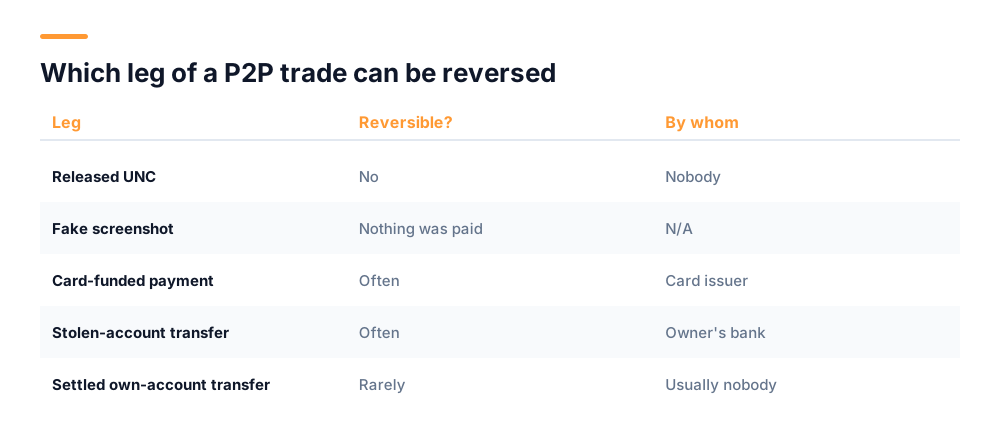
The cash half is often not final. Card payments can be disputed, some payment apps allow claims weeks later, and a bank transfer made from a hijacked account can be recalled when the real owner reports it. A payment that only existed as a screenshot was never there to begin with.
| Leg of the trade | Can it be reversed? | Who can reverse it |
|---|---|---|
| Released UNC | No | Nobody |
| Fake receipt or screenshot | Nothing was paid | Not applicable |
| Card-funded payment | Often, by chargeback | The buyer's card issuer |
| Transfer from a stolen account | Often, once reported | The account owner's bank |
| Settled transfer from the buyer's own account | Rarely | Usually nobody |
Five stories used to get a seller to release early
Scammers seeking an early release rely on a small set of stories, each designed to make waiting feel unreasonable or risky. Recognising the story is usually enough, because none of them change the one fact that matters: whether the money is in your account.
- "The bank shows it as sent, it just takes time to arrive." Then it has not arrived. Release when it does.
- "I have a screenshot of the transfer." A screenshot is an image, not a payment, and editing one takes minutes.
- "Release now or I will report you and get your account banned." Reporting a seller for not releasing an unpaid order achieves nothing; a dispute reviewer will see that no payment arrived.
- "I paid too much by mistake, please release and refund the difference." The overpayment is usually fake or reversible, and the refund is the theft.
- "UNC Support told me to ask you to release." Support acts inside the order's dispute case. It never relays instructions through the other trader.
Pressure is the signal
An honest buyer who has really paid loses nothing by waiting for you to check, because their payment is already sitting in your account. Only a buyer whose payment is not there needs you to hurry.
Waiting costs a UNC seller nothing
Waiting to release costs a UNC seller nothing, because the trade's timers never move coins on their own. When a payment window runs out, nothing is released and nothing is cancelled. UNC never cancels a trade by itself, because money may have changed hands outside the app, and only a person can weigh that.
- The payment window is 15, 30, 45 or 60 minutes, chosen by the seller when posting the offer.
- Either trader can open a dispute 5 minutes after the window ends, or 1 hour after the start if the offer had no window.
- An order marked paid but not released goes to UNC Support automatically 1 hour after the time limit.
- Any trade still open 24 hours after it started is swept to support.
- Throughout all of this, the seller's UNC stays in escrow, untouched.
The practical result is that a seller who is unsure can simply wait. The worst outcome of waiting is a slow trade and a support review. The worst outcome of releasing early is losing the full amount.
The "small trades first" pattern ends in one large early release
The small-trades-first pattern is a patient version of the early release scam. A buyer completes several small trades honestly, paying promptly each time, until the seller starts treating them as a regular. Then comes a much larger order, and a reason why the seller should release before the payment shows: "same as always, it is on its way".
The earlier trades were the cost of building trust. Their total is usually small next to the final order, which is why the method works. A history of good trades tells you how a buyer behaved when the amounts were small; it says nothing about whether this payment has arrived.
The defence is to apply the same check to every trade, regardless of who it is with. A regular counterparty who is honest will not mind, and the check takes under a minute.
Why careful sellers still release early
Careful sellers release early for ordinary reasons, not because they are naive. The most common is volume: a seller handling several orders an hour starts to trust the pattern of "marked paid, then money arrives" and stops checking each one. The scam only needs the one order where the pattern breaks.
Reputation is the second reason. Traders leave reviews after a UNC P2P trade, and sellers worry that a slow release will cost them a good rating. A buyer who has not paid has no standing to complain about a seller who waited, and a dispute reviewer will see the timeline in the order record.
The third is misreading the app. The "marked paid" status looks official because it appears inside the order, but it records only what the buyer tapped. The app's own wording to sellers is direct: "Don't release until the money is in your account."
When is it safe to release crypto in a P2P trade?
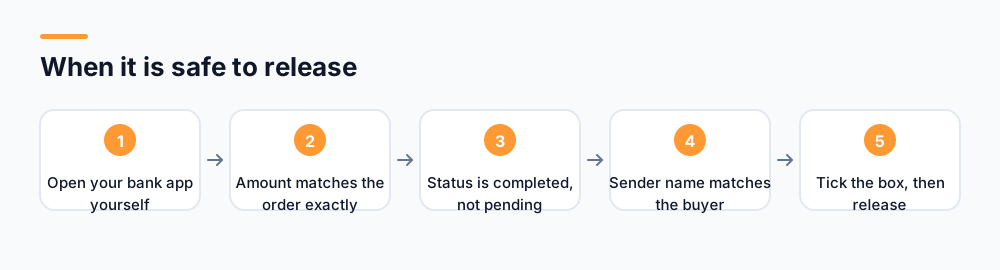
Releasing crypto in a P2P trade is safe when you can personally see the full payment, settled, in your own account, from the buyer's own name. Each of those conditions closes a specific scam, which is why all of them matter and none can be skipped.
- Open your banking or payment app yourself, not through a link and not from a notification.
- Find the incoming payment and check the amount matches the order exactly.
- Check the status is completed, not pending, processing or scheduled.
- Check the sender's name matches the buyer's verified name on the order.
- Only then tick "I checked my account and received" in the UNC app and release.
UNC builds this into the release screen. The button stays disabled until the seller ticks the confirmation box, and the screen warns, "Receipts can be faked. Open your banking or wallet app and check the money has arrived." Releasing also requires approved identity verification, so every release is tied to a verified person.
Buyers face the mirror image: paying outside escrow
Buyers face the mirror image of early fund release when they pay before an escrowed order exists, or pay to details the order does not show. A seller who says "send the money first and I will post the offer for you" is asking the buyer to give up the one protection designed for them: escrowed coins that support can release after a dispute.
UNC refuses to let a buyer mark an order paid if the seller has not added a payment method in the app, and tells the buyer not to send money to details given any other way. If you have paid through the order's listed method and the seller will not release, open a dispute when it becomes available and upload your bank record. The UNC you paid for is still held in escrow.
What to do if you released too early
If you released crypto too early and the payment never arrives or is reversed, act quickly, but be realistic: the released UNC cannot be reversed by UNC. What you can do is preserve evidence and report it, which helps investigators and can lead to action against the buyer's account.
- Do not delete the order chat. It records what the buyer said and when.
- Contact UNC Support from the order with your bank record showing no payment, or the chargeback notice.
- If a payment was reversed, respond to your bank's dispute process with the order details.
- Report the fraud to your national body. In the US that is the FBI's Internet Crime Complaint Center, which recorded about $9.3 billion in cryptocurrency-related losses in 2024.
- Ignore anyone who contacts you offering to recover the funds for a fee. Recovery offers are a well-known second scam aimed at people who have just been defrauded.
For the full set of warning signs that come before a release request, read how to identify P2P scams. For protecting the account that holds your escrowed UNC, see securing your crypto wallet.
Frequently asked questions
Can UNC reverse crypto I released too early?
No. Releasing a P2P trade moves the UNC from the seller's wallet to the buyer's and records the transfer on the ledger, and there is no reversal. Support can review the case and act against a fraudulent account, but it cannot undo a release, which is why the check before release matters so much.
What happens if I do not release before the payment window ends?
Nothing is lost. Your UNC stays in escrow, and UNC never releases or cancels a trade automatically. Either trader can open a dispute 5 minutes after the window ends, and an order marked paid but not released goes to UNC Support 1 hour after the time limit.
Is a payment screenshot enough to release crypto?
No. A screenshot is an image that can be edited or generated in minutes, and it is the most common tool in early release scams. Release only when the full amount appears as completed in your own banking or payment app, sent from a name that matches the buyer's verified name on the order.
Why does a buyer keep asking me to release early?
A buyer who has genuinely paid gains nothing from you releasing before you check, because the money is already in your account. Repeated pressure to release early, especially with threats or stories about delays, is the strongest sign that the payment is fake, incomplete or about to be reversed.
Start mining with UNC
UNC distributes coins to verified participants — no hardware, no subscription, no battery drain. Read the whitepaper for the distribution model, or check network activity in the explorer.
Get UNC on Google Play