Security Awareness
How to Identify P2P Scams Before You Release a Single Coin
Almost every P2P scam targets one moment: the seller pressing release before the money is really there. Here is how to identify P2P scams by their warning signs, and how UNC escrow and disputes are built around that moment.
Knowing how to identify P2P scams comes down to one question: has the money actually arrived in an account you control? Nearly every peer-to-peer crypto scam is an attempt to make a seller release coins before the honest answer is yes, using fake receipts, reversible payments, borrowed accounts or plain pressure.
This guide is part of UNC's Security Awareness series. It explains the warning signs, the four scam patterns behind most of them, and the specific protections the UNC P2P market has, checked against the app's own code on 8 November 2026.
Disclosure: UNC publishes this blog and runs the P2P market described here. We describe its protections as they work today, including what they cannot do for you.
What is a P2P crypto scam?
A P2P crypto scam is a peer-to-peer trade in which one side receives the other side's money or coins and gives nothing real back. In a P2P market the two traders settle the cash leg between themselves, by bank transfer or a payment app, while the platform holds the crypto leg. The scam lives in that gap.
Most P2P fraud targets sellers, because the seller holds the asset that cannot be reversed. A crypto transfer, once released, is final. A bank transfer or card payment often is not, and a payment that only exists as a screenshot was never made at all. Scammers exploit that difference in finality.
Buyers are targeted too, usually by being persuaded to pay outside the platform, to account details sent in a chat message rather than the payment method listed on the order. Once money leaves that way, no escrow or dispute system has any record of it.
How a UNC P2P trade is supposed to work
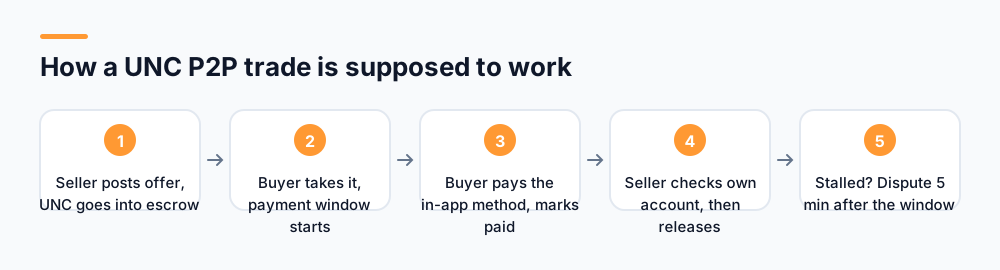
A UNC P2P trade follows five steps, and every scam on this page works by skipping or faking one of them. Knowing the honest sequence is the fastest way to notice when someone is steering you off it.
- The seller posts an offer. From that moment the UNC on offer is held in escrow and cannot be sent elsewhere, so it cannot vanish mid-trade.
- A buyer takes the offer. A payment window starts, set by the seller at 15, 30, 45 or 60 minutes.
- The buyer pays the seller's payment method as listed in the app, then taps to mark the order paid, optionally attaching a receipt.
- The seller opens their own banking or wallet app, confirms the money has arrived, ticks the confirmation box and releases the UNC.
- If either step stalls, a dispute can be opened 5 minutes after the window ends, and UNC Support reviews it.
How to identify P2P scams: nine warning signs
The warning signs of a P2P crypto scam are consistent across platforms, and any one of them is reason to slow down. They are listed roughly from most to least reliable.
- The buyer marks the order paid, but the money is not in your account. The status in the app is a claim, not a payment.
- You are sent a screenshot, PDF or "bank confirmation" and asked to release on the strength of it.
- The payment arrives from a name that does not match the buyer's verified name on the order.
- The other trader asks to move the conversation to WhatsApp, Telegram or email.
- You are given payment details in the chat that differ from the method listed on the order.
- A buyer offers a price well above market, or a seller well below it, with no reason.
- You are rushed: "my boss is waiting", "the bank is closing", "release now or I report you".
- Someone claiming to be UNC Support messages you directly about the trade. Support acts inside the order's dispute case, never by private message.
- The buyer pays more than agreed and asks you to refund the difference in crypto or by another route.
The rule that settles most cases
Release only when the full amount is visible in your own banking or wallet app, from the buyer's own name. Not in an email, not in a screenshot, not in the order status. If you cannot see it yourself, it has not arrived.
Fake payment screenshots are the most common P2P scam
A fake payment screenshot is an edited or generated image of a transfer that never happened, and it is the cheapest P2P scam to run. Banking app screens are easy to reproduce, and a convincing one takes minutes to make. The image is real; the payment behind it is not.
The scam works because a screenshot looks like evidence and arrives at the exact moment a seller is waiting for evidence. It usually comes with a story explaining why the money is not visible yet: the transfer is "pending", the bank "holds new payees for 24 hours", or the amount is "in processing".
UNC's release screen says this plainly. Before a seller can release, the app shows the warning "Do not release based only on a screenshot. Receipts can be faked," and the release button stays disabled until the seller ticks a box confirming they checked their own account. A receipt attached to an order is useful in a dispute; it is never a reason to release.
Checking takes under a minute. Close the UNC app, open your banking or payment app directly rather than through any link, and look at the incoming transactions. Confirm three things: the amount matches the order to the cent, the sender's name matches the buyer's verified name, and the payment shows as completed rather than pending or scheduled. If any of the three fails, wait.
How chargeback scams reverse a payment after you release
A chargeback scam uses a payment that really arrives and is then pulled back after the seller has released the crypto. The buyer pays with a reversible method, such as a card-funded payment app or a transfer they later report as unauthorised, and disputes it with their bank once the coins are theirs.
The seller ends up with neither the money nor the crypto. The bank reverses the cash leg; the blockchain does not reverse the crypto leg. Chargeback scams are harder to spot than fake screenshots, because at the moment of release everything checks out.
- Prefer payment methods that settle finally, such as a direct bank transfer, over ones that can be disputed weeks later.
- Check that the sender's name on the payment matches the buyer's verified name. A mismatch is the classic sign of a stolen account or card being used.
- Be wary of a new counterparty with no completed trades asking for a large amount.
- Keep the order chat and your bank record. If a chargeback arrives later, they are your evidence.
Third-party payments deserve particular suspicion. A buyer who says a friend, a relative or a company will pay on their behalf is describing exactly how stolen accounts are laundered through P2P markets. The real account holder notices the transfer, reports it as fraud, and the bank takes the money back from the seller who received it.
Moving the trade off the platform is the scam
A request to move a P2P trade off the platform is the clearest warning sign there is, because it removes every protection the platform offers. Off-app, there is no escrow holding the seller's coins, no order record, no payment window and no dispute case for support to review.
The request is usually framed as convenience: lower fees, a faster chat, a "better rate for regulars". Sometimes it is framed as safety, which is more dangerous: "the app is having problems, pay to this account instead". Either way, the effect is the same. Your money or your coins leave the one place where anyone can help you get them back.
UNC blocks part of this in the product. The app will not let a buyer mark an order paid unless the seller has added a payment method in the app, and it tells the buyer directly: "Do not send money to details given any other way." Treat any account number typed into the chat the same way.
Is P2P crypto trading safe?
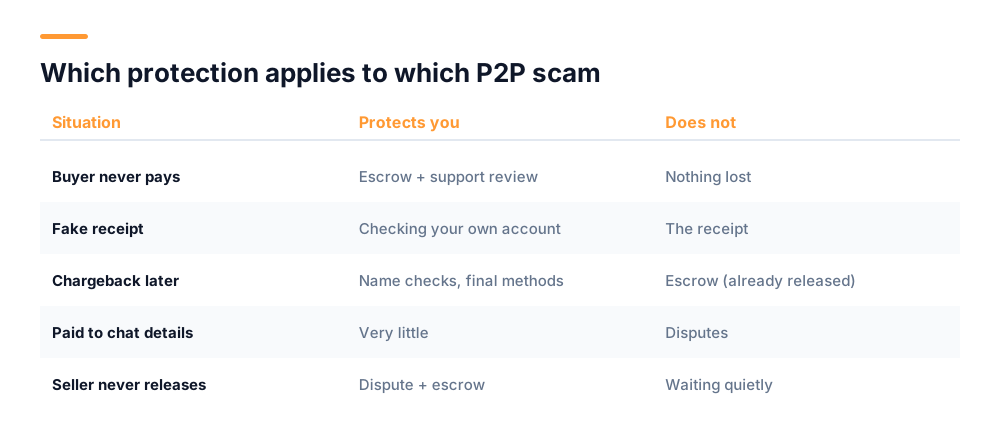
P2P crypto trading is reasonably safe when both traders stay inside the platform's escrow and dispute process, and risky the moment either one leaves it. The protections are real but narrow: they can hold coins and review evidence, and they cannot reverse a bank payment or recover anything sent off-platform.
| Situation | What protects you | What does not |
|---|---|---|
| Buyer never pays | Escrow keeps your UNC; support reviews after the window | Nothing lost if you did not release |
| Buyer sends a fake receipt | Checking your own account before release | The receipt itself |
| Payment is later charged back | Name checks and final payment methods | Escrow, which has already released |
| You paid to details from the chat | Very little | Disputes, which only see in-app methods |
| Seller never releases after you paid | Dispute with your bank proof; escrow still holds the UNC | Waiting quietly |
What to do if you think a P2P trade is a scam
If a P2P trade looks like a scam and you have not released, you have not lost anything yet. Stop, do not release, and let the trade's timers work for you. UNC never cancels a trade on its own, because money may have changed hands outside the app; a person reviews it.
- Do not release, whatever the chat says. Your UNC stays in escrow while the trade is open.
- Open a dispute once the button becomes available, 5 minutes after the payment window ends, and pick the closest category.
- Upload evidence to the dispute: your bank statement showing no payment, or the buyer's mismatched name.
- If you do nothing, the trade still goes to UNC Support 15 minutes after an unpaid window, or 1 hour after if it was marked paid but not released.
- If you already released and the payment was fake or reversed, report it to your bank and to your national fraud body, such as the FBI's IC3 in the US.
Scale matters here. The FBI's Internet Crime Complaint Center recorded 149,686 complaints involving cryptocurrency in 2024, with reported losses of about $9.3 billion. Reports feed investigations even when an individual loss cannot be recovered.
For the single most expensive mistake in P2P trading, read our companion piece on the dangers of early fund release. For how the wallet behind your trades is protected, see our guide to UNC wallets.
Frequently asked questions
How do I know if a P2P buyer really paid?
Open your own banking or payment app and look for the full amount, from a sender whose name matches the buyer's verified name on the order. A screenshot, an email or the order's "marked paid" status is not proof. If the money is not visible to you, it has not arrived, and you should not release.
Can a P2P buyer reverse a payment after I release crypto?
Yes, with some payment methods. Card-funded payments and transfers later reported as unauthorised can be pulled back by the buyer's bank, while the released crypto cannot be reversed. Prefer final payment methods, check that the sender's name matches the buyer, and keep your chat and bank records as evidence.
Should I pay a P2P seller to account details sent in the chat?
No. Pay only to the payment method listed on the order in the app. UNC will not let you mark an order paid unless the seller has added a method in the app, because money sent to details from a chat message is outside anything escrow or a dispute can see.
What happens if a UNC P2P trade is never paid?
The seller's UNC stays in escrow. Either trader can open a dispute 5 minutes after the payment window ends, and if neither does, the trade goes to UNC Support 15 minutes after the window. A person then decides; UNC never cancels a trade automatically, because money may have moved outside the app.
Does UNC Support ever message me privately about a trade?
No. UNC Support handles P2P problems inside the order's dispute case in the app. Anyone who contacts you on WhatsApp, Telegram, email or social media claiming to be support for your trade, especially one asking you to release or to pay somewhere new, is impersonating UNC.
Start mining with UNC
UNC distributes coins to verified participants — no hardware, no subscription, no battery drain. Read the whitepaper for the distribution model, or check network activity in the explorer.
Get UNC on Google Play