Collecting
Proof Coins: What They Are, What They Are Worth and How to Collect Them
Proof coins are the most carefully made coins a mint produces: hand-fed, struck at least twice from polished dies, and sold to collectors rather than spent. Here is how they are made, what drives their value, and how to buy one without overpaying.
Proof coins are coins struck specifically for collectors, using specially polished dies and hand-fed blanks, so that the finished coin has a mirror-like background and a sharp, often frosted design. They are legal tender, but they were never meant to be spent, and they are sold at a premium over face value in protective packaging.
This guide is for beginner collectors, including people who arrive from crypto and want to understand physical collecting. It covers how proofs are made, how they compare with uncirculated and everyday coins, what affects their value, and how to buy, store and handle them. Facts about minting and grading come from the United States Mint, NGC and PCGS, which are cited in the sections that use them.
What are proof coins?
Proof coins are the highest-quality coins a mint strikes: made slowly, on prepared blanks, with polished dies, and struck more than once so every detail of the design comes up fully. The word "proof" describes how the coin was made, not its condition. A proof coin that has been scratched is still a proof; it is simply a damaged one.
Mints originally struck proofs to test and show off a new design, which is where the name comes from. Today they are a collector product. In the United States, the Mint sells proof versions of circulating coins, commemoratives and bullion designs, usually in sealed cases or capsules with a certificate.
Many US proof coins, including the coins in the annual proof sets, are struck at the San Francisco Mint and carry a small "S" mint mark. For collectors in the Bay Area that is a nice detail: a large share of the country's proof coinage is made a few miles away. Other facilities, such as West Point with its "W" mark, strike proofs too.
One clarification for readers who know crypto. "Proof" in proof of work or proof of stake describes how a blockchain agrees on its records, and has nothing to do with proof coinage. This article is about physical coins only.
How is a proof coin made?
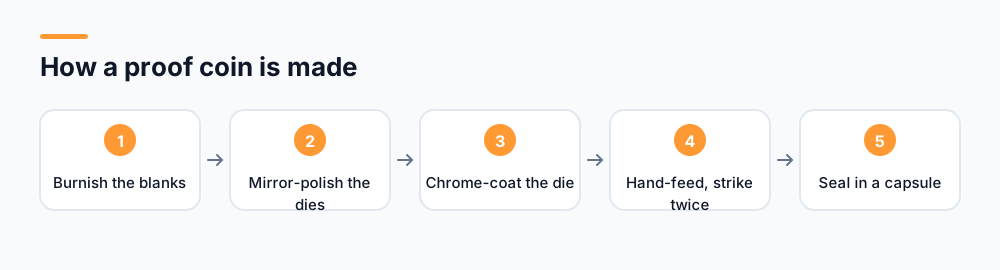
The proof coin minting process differs from ordinary coin production at every stage: the blank, the die and the strike. According to the US Mint, proof blanks are specially treated, hand-polished and cleaned, proof dies are polished to a mirror, and each proof coin is fed into the press by hand and struck at least twice.
- Preparing the blanks. Proof blanks, also called planchets, are burnished: tumbled with cleaning agents and small metal pellets until the surface is smooth and bright.
- Polishing the dies. At the San Francisco Mint, the areas of a proof die that will form the background are polished with diamond paste, while the design areas are protected and then given a frosted texture.
- Protecting the die. The finished die is coated with chrome, which helps it keep its polish through the run.
- Striking by hand. Each blank is placed into a slow press by hand and struck at least twice, which forces the metal into every corner of the design.
- Handling and packaging. Finished proofs are handled carefully and sealed into capsules or cases so the surfaces are never touched or rubbed.
Ordinary coins for circulation go the other way: blanks are fed automatically into high-speed presses and struck once, and the coins drop into bins in bulk. That difference in care is most of what you pay for when you buy a proof.
What gives proof coins their mirror-like finish?
The mirror-like coin finish of a proof comes from the polished die: the flat background areas, called fields, are struck by a mirror-polished surface and come out reflective. The raised design, called the devices, is often frosted, so it looks matte against the shiny fields. That contrast between frosted devices and mirrored fields is called cameo.
Grading services describe the strength of that contrast with a designation after the grade. NGC uses Cameo and Ultra Cameo; PCGS uses Cameo and Deep Cameo. A coin labelled PF 70 Ultra Cameo (NGC) or PR70 Deep Cameo (PCGS) is a proof at the top of the 70-point scale with the strongest contrast. NGC notes that the cameo designation is separate from the numeric grade, so a coin can be Ultra Cameo and still grade below 70.
The same mirror surface that makes a proof beautiful makes it fragile. Fingerprints, fine scratches called hairlines, and spots show far more clearly on a mirror than on a normal coin, which is why handling rules for proofs are stricter than for anything else in a collection.
Proof coin vs uncirculated coin vs circulating coin
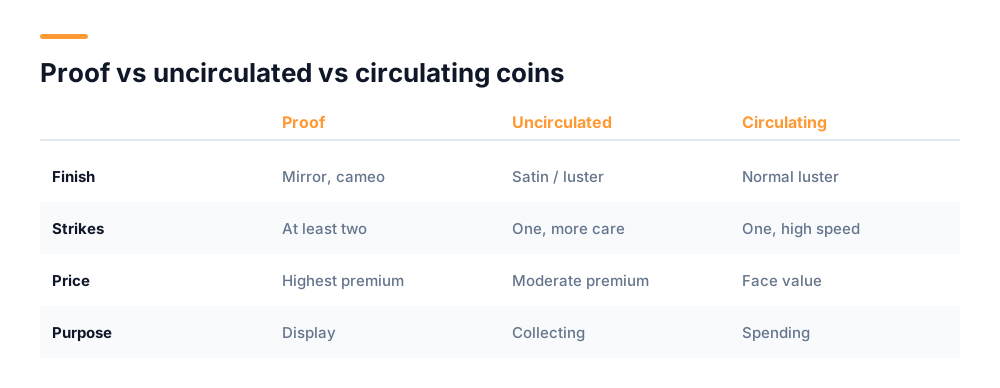
The difference between a proof coin and an uncirculated coin is how it was made, not how worn it is. A proof is struck at least twice from polished dies on hand-fed blanks. An uncirculated coin, in the US Mint's collector sense, is made for collectors with more care than a pocket coin but without the mirror finish. A circulating coin, also called a business strike, is made fast and in bulk to be spent.
| Proof | Uncirculated (collector) | Circulating (business strike) | |
|---|---|---|---|
| Finish | Mirror fields, often frosted design (cameo) | Satin or lustrous, no mirror | Normal luster, wears quickly |
| Minting | Polished dies, hand-fed, struck at least twice | Burnished blanks, more care than normal | Automatic high-speed presses, struck once |
| Price | Highest premium over face value | Moderate premium over face value | Face value |
| Purpose | Display and collecting | Collecting a coin as it left the mint | Everyday spending |
| Packaging | Sealed case or capsule, often with a certificate | Mint set packaging | None; bags and rolls |
"Uncirculated" also has a second meaning that confuses beginners. Grading services use "Mint State" for any coin that has never been in circulation, including business strikes pulled from a roll. So an ordinary coin can be uncirculated in condition while not being a collector uncirculated product. A proof is never called Mint State; proofs are graded on their own scale, written PF or PR.
What affects proof coin collecting value?
Proof coin collecting value depends on five things: grade, mintage, metal, eye appeal and completeness. A proof's value is not set by its face value, and most modern proofs are not rare. Price is decided by how many exist in top condition against how many collectors want one.
- Grade. Proofs are graded from 1 to 70 on the Sheldon scale. At the top, small differences matter a lot: a PF 70, which NGC defines as having no post-production imperfections under 5x magnification, can sell for many times the price of a PF 69 of the same coin.
- Mintage. How many were struck. Mints publish these figures, and lower-mintage issues tend to hold value better. Check the official number rather than a seller's claim.
- Metal. Silver, gold and platinum proofs carry a floor value from their metal content, which moves with metal prices. Base-metal proofs have no such floor.
- Eye appeal and cameo. Strong cameo contrast, no spots and no toning usually add value. Spotting and haze usually reduce it.
- Original packaging. For raw (ungraded) coins and sets, the original case, box and certificate of authenticity support value. Loose coins from a broken set usually sell for less.
What is in a proof coin set?
A proof coin set is a group of proofs sold together, usually one of each design struck that year. The US Mint's annual proof set contains proof versions of that year's circulating coins, and the Mint also sells themed and silver variants. Sets are the most common way beginners start, because one purchase covers a whole year in matching condition.
Are proof coins worth it?
Proof coins are worth it if you value them as collectibles, and usually a poor choice if you buy them only as an investment. Most modern proofs are made in large numbers, and the premium you pay over face value or metal value often does not come back when you sell. A coin bought for its beauty or history keeps that value whatever the market does.
The cases where proofs have done well tend to share the same features: a low mintage, a top grade with strong cameo, precious metal content, or a design collectors later turned out to want. Those features are visible before you buy, which is why grade and mintage matter more than a seller's description.
Not investment advice
Coin prices rise and fall, dealer spreads can be wide, and past auction results do not predict future ones. Buy what you would be happy to own if its price never rose, and never more than you can afford to hold.
How to buy proof coins safely
The safest way to buy proof coins is from the mint that made them, or from a reputable dealer selling coins certified by a major grading service. For a beginner, the order below keeps the risk of fakes and overpaying low.
- Buy current proofs from the US Mint. New proof sets and coins are sold at a published price directly from the Mint, so there is no question about authenticity.
- Buy older or graded coins from established dealers. Look for a physical business, a clear return policy and membership of recognised trade bodies. Avoid sellers who rush you or will not show the actual coin.
- Prefer coins certified by PCGS or NGC. These services authenticate and grade the coin and seal it in a numbered holder.
- Verify the certification number. Enter the number from the label on the grading service's website and check that the coin, date and grade match.
- Compare prices before you pay. Check recent sale prices for the same coin in the same grade, not asking prices.
One caution about step four. PCGS warns that verifying a certification number does not remove all risk, because counterfeiters sometimes copy grading labels using real certification numbers. Compare the photos on the verification page with the coin in front of you, and buy from dealers authorised by the grading service where you can.
How should you store and handle proof coins?
Proof coins should stay in their original capsule or grading holder, and if you must handle one, hold it by the edge only, ideally wearing cotton or nitrile gloves. Skin oils leave fingerprints that can later turn into permanent spots on a mirror surface.
- Keep coins in their original Mint packaging or in inert, archival holders.
- Avoid soft plastic flips containing PVC, which can leave a green residue on coins over time.
- Store them somewhere cool and dry with stable humidity, away from kitchens and bathrooms.
- Do not breathe or talk directly over an exposed proof; small drops of moisture can spot it.
Common beginner mistakes
- Cleaning a coin. Cleaning leaves hairlines on mirror fields. Grading services mark cleaned coins as damaged, which cuts the value sharply. Never clean a proof.
- Touching the surface. One fingerprint can become a permanent spot.
- Overpaying for raw coins. A seller's "perfect" or "gem" is an opinion. A certified grade can be checked.
- Trusting a deal that is too good. Fake coins and fake holders exist, and they are sold most often through marketplaces and social media.
- Breaking up sets. Removing coins from an original set usually lowers the value of both the set and the coins.
Proof coins and digital coins: what carries over
Proof coins and crypto coins are different things, but collectors moving between them can use the same habits. In both, value comes from scarcity and demand rather than face value, and in both the safest answer to "is this real?" is to check an independent record instead of trusting the seller. For a proof that record is the grading service's certification database; for a crypto coin it is a public blockchain explorer.
The words differ too. A physical coin is struck by a mint; in crypto, "coin" means the native asset of its own blockchain, as opposed to a token issued on someone else's. If that distinction is new, our explainer on the difference between a coin and a token covers it.
A disclosure, since this post appears on our site. UNC publishes this guide, and UNC is a crypto coin that people mine in a mobile app. We do not sell physical coins, proof sets or any collectible mentioned here, and nothing in this article is an offer or a recommendation to buy. UNC has no listed price, and we do not promise earnings or future value. You can read how UNC works if you want to know what the app does.
About the author: Syed Iftikhar Ali is an SEO executive at UNC. He is not a professional numismatist, and this guide is not based on handling or grading coins himself. It was researched from the published guidance of the United States Mint, NGC and PCGS, which are linked in the sections that rely on them.
Frequently asked questions
What are proof coins?
Proof coins are coins struck for collectors using hand-fed, specially prepared blanks and mirror-polished dies, struck at least twice. The result is a mirror-like background with a sharp, often frosted design. They are legal tender but sold at a premium in protective packaging and are not meant to be spent.
What is the difference between a proof coin and an uncirculated coin?
A proof is struck at least twice from polished dies and has mirror-like fields. A collector uncirculated coin is made with extra care but has a satin or normal lustrous finish, not a mirror. Proofs usually cost more. Proofs are graded on their own PF or PR scale, uncirculated coins as Mint State.
Are proof coins worth it?
Proof coins are worth buying if you enjoy them as collectibles. As investments they are often disappointing, because most modern proofs have large mintages and the premium paid over face or metal value may not be recovered on resale. Low mintage, top grades, strong cameo contrast and precious metal content help most.
Should I clean my proof coins?
No. Cleaning leaves fine scratches called hairlines that show clearly on a proof's mirror surface, and grading services mark cleaned coins as damaged, which sharply reduces their value. Keep proofs in their original capsule or holder and handle them only by the edge, ideally with cotton or nitrile gloves.
Where is the safest place to buy proof coins?
For new issues, buy directly from the US Mint at its published price. For older coins, buy from established dealers with clear return policies and prefer coins certified by PCGS or NGC. Check the certification number on the grading service's website, and compare the photos there with the coin itself.
Start mining with UNC
UNC distributes coins to verified participants — no hardware, no subscription, no battery drain. Read the whitepaper for the distribution model, or check network activity in the explorer.
Get UNC on Google Play