Earning
Staking Crypto to Earn Passive Income Daily: How It Really Works
Staking pays you for locking up crypto, but the reward is not free money and it is rarely paid the way the adverts imply. Here is where staking rewards come from, how often they arrive, what can go wrong, and how to judge a platform before you lock anything.
Staking crypto can earn passive income daily, in the sense that rewards build up every day you keep coins locked, but the payout schedule, the lock-up and the risks depend entirely on where you stake. Staking means committing coins you already own for a period of time in return for more of the same coin.
This guide explains where the rewards come from, how to work out what a rate really pays per day, how staking compares with mobile mining, and what to check before trusting a platform. It is written for beginners and does not assume you own any crypto yet.
Key takeaways
Staking rewards are paid in the coin you stake, so their value moves with that coin's price. A 12% yearly rate pays about 0.033% per day, not 12% a month. Most staking locks your coins; some networks also make you wait days or weeks to withdraw. Running your own Ethereum validator needs 32 ETH, which is why most people use a pool or an exchange. In the United States, staking rewards are taxable income when you gain control of them. No honest platform guarantees a return.
Disclosure: UNC publishes this blog and offers its own staking feature and mining app, both described below. We have included their limits alongside everyone else's.
What is staking crypto, and how does it earn passive income daily?
Crypto staking is locking coins to help a proof-of-stake blockchain confirm transactions, and being paid in new coins and fees for doing it. Proof of stake replaces the electricity-hungry computers of Bitcoin-style mining with a financial deposit: validators put coins at risk, and the network picks among them to propose and check blocks.
The rewards are not interest from a bank. They come from two places: new coins the network creates on a fixed schedule, and the fees users pay to send transactions. That matters because newly created coins dilute everyone who is not staking. Part of a staking "return" is simply keeping pace with the growth in supply.
Validators who break the rules can lose part of their deposit, a penalty called slashing. Ethereum, the largest proof-of-stake network, requires 32 ETH to run a validator yourself and warns that slashing and withdrawal delays are real risks. That entry cost is why most people stake through a pool, a wallet or an exchange that combines many small deposits.
How to earn daily rewards through crypto staking
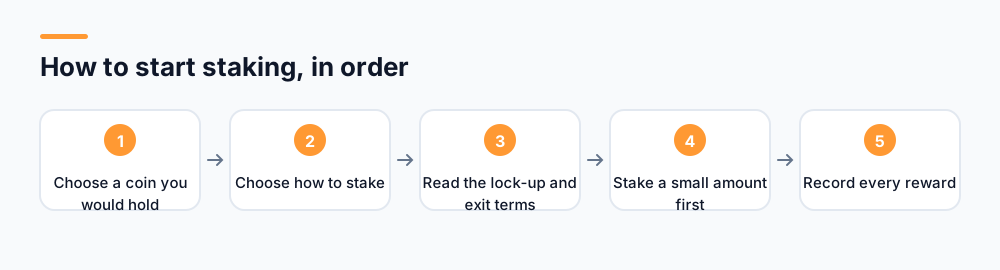
To earn daily rewards through crypto staking you need four things: a coin that supports staking, somewhere to stake it, an amount above the minimum, and the patience to leave it locked. The steps are the same on almost every platform.
- Choose a coin you would be willing to hold anyway. The reward is paid in that coin, so if its price halves, a 10% reward does not save you.
- Choose how to stake: your own validator, a staking pool, a wallet that delegates for you, or an exchange. Each trades control for convenience.
- Read the terms before you lock: the rate, the minimum, the lock-up, the wait to withdraw, and the fee the operator keeps.
- Stake a small amount first and confirm that the first reward arrives when the platform said it would.
- Record every reward with its date and value. You will need it for tax, and it is how you find out what you really earned.
Are staking rewards really paid daily?
Staking rewards accrue continuously, but they are not always paid daily. Networks pay validators every block or every epoch; pools and exchanges then pass rewards on daily, weekly or only when a fixed term ends. "Daily rewards" in an advert often means the reward is calculated daily, which is not the same as being able to withdraw it daily.
What does a staking rate actually pay per day?
A staking rate is quoted per year, so the daily amount is far smaller than the headline suggests: divide the yearly rate by 365. At 12% a year, 100 coins earn about 0.033 coins a day, or 0.99 coins in 30 days. A platform advertising 1% a day is promising 365% a year, which no real network pays.
UNC's own staking is a useful worked example because the formula is simple and we can show it exactly. It uses simple interest: amount x rate x days / 365, paid together with the amount you locked when the term ends. We calculated the figures below by applying that formula to 100 UNC in each of the three pools open on 13 November 2026.
| UNC pool | Lock | Yearly rate | Minimum | Reward on 100 UNC | Per day |
|---|---|---|---|---|---|
| 7-Day Flex | 7 days | 6% | 1 UNC | 0.1151 UNC | 0.0164 UNC |
| 30-Day Lock | 30 days | 12% | 5 UNC | 0.9863 UNC | 0.0329 UNC |
| 90-Day Lock | 90 days | 20% | 10 UNC | 4.9315 UNC | 0.0548 UNC |
Two limits apply to those UNC figures. The reward is paid in UNC, and UNC has no official market price, so we cannot tell you what it is worth in dollars. And the coins cannot be withdrawn before the term ends; there is no early exit, with or without a penalty. Rates and pools can change, and the app shows the current ones.
What are the risks of staking crypto?
The main risk of staking crypto is the price of the coin itself: a 10% reward on a coin that falls 40% is still a loss. The other risks are being unable to sell while your coins are locked, losing part of the stake through a validator's mistake, and the platform holding your coins failing or freezing withdrawals.
- Price risk. Rewards are paid in the staked coin. Staking increases how many coins you hold, not what they are worth.
- Lock-up and exit delays. Many networks make you wait after you ask to withdraw. The Cosmos Hub and Polkadot both document an unbonding period during which coins earn nothing and cannot be moved.
- Slashing. If the validator you chose goes offline or cheats, the network can destroy part of the stake, including yours.
- Platform risk. On an exchange or lending-style product, the company holds your coins. If it fails, you are a creditor, not an owner.
- Dilution. If a network creates 5% more coins a year and pays stakers 5%, a staker has only kept their share of the total.
- Scams. Fake staking sites promise fixed daily returns, show a growing balance, and then demand a fee to withdraw.
The last item deserves a rule of its own: a guaranteed return, a daily percentage, or a fee to unlock your own money are each enough to walk away. Our guide to how a crypto scam works shows the same pattern in other forms.
Mobile crypto mining vs crypto staking rewards: which suits you?
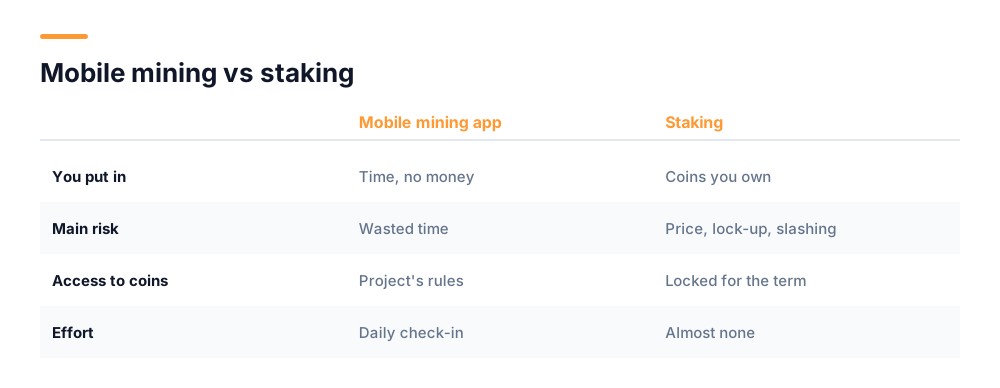
Mobile crypto mining and crypto staking rewards differ in what you put in: mining apps ask for your time and attention, while staking asks for money you already hold. If you own no crypto, staking has nothing to work with; if you own some and will not need it soon, staking pays without daily effort.
| Mobile mining app | Staking | |
|---|---|---|
| What you put in | A daily check-in; no money | Coins you already own |
| Where the reward comes from | An allocation set by the project | New coins and fees (or the platform, on fixed-term products) |
| Can you lose what you put in? | No money at stake; your time | Yes: price falls, slashing, platform failure |
| Access to your coins | Depends on the project's withdrawal rules | Locked for the term or the unbonding period |
| Effort | Small, every day | Almost none after setup |
| Best for | Starting from zero | People already holding a coin long term |
The two also work in sequence. In the UNC app, a member can mine UNC with a daily session and then lock some of what they mined in a staking pool. Phones do not do the heavy computing that the word "mining" suggests; our explainer on how mobile crypto mining works sets out what actually happens on the device.
Can you earn free cryptocurrency through daily rewards?
You can earn free cryptocurrency through daily rewards only in the sense that you do not pay money for it: mining apps, faucets and airdrops hand out small amounts in exchange for attention, tasks or sign-ups. Staking is not free in that sense, because the coins you lock are your own money at risk.
Free does not mean valuable. A coin with no market cannot be converted to cash, and a balance that cannot be withdrawn is a number on a screen. Before spending weeks on any daily-reward app, check whether the coin can leave the app and whether anyone independent can verify your balance. Our guide to free crypto mining covers those checks in detail.
How to judge the best crypto staking platforms for passive income
The best crypto staking platforms for passive income are the ones that tell you exactly who holds your coins, where the reward comes from and how you get out. A ranked list goes stale in months and is usually paid for, so use these questions instead and apply them to any platform, including ours.
- Who holds the coins? Your own wallet, a smart contract, or the company. Company custody adds the risk that the company fails.
- Where does the reward come from? Network rewards are verifiable on the chain. A reward paid from the platform's own funds lasts only as long as the platform chooses.
- What is the fee? Pools and exchanges keep a share of the reward. A quoted rate should be after fees.
- How do you exit? The lock-up, the unbonding wait, and any early-exit penalty should be stated before you deposit.
- What happens in a slashing event? Some operators cover losses; many do not.
- Is the rate plausible? Compare it with the network's own published staking rate. A platform paying several times more is taking a risk it has not told you about.
- Is the operator identifiable and regulated where you live? Rules differ by country and, in the United States, by state.
Applied to UNC's own staking, the honest answers are: UNC holds the coins; the reward is paid by UNC under fixed terms, not earned by validating a blockchain; there is no fee and no early exit; and nothing can be slashed. It is closer to a fixed-term deposit in UNC than to proof-of-stake validation, and it should be judged as one.
Are staking rewards taxed in the United States?
Staking rewards are taxable income in the United States. In Revenue Ruling 2023-14 the IRS stated that a cash-method taxpayer who receives staking rewards must include their fair market value in gross income in the year they gain dominion and control over them, meaning the point at which they can sell or transfer the coins.
In practice that means recording the date and dollar value of each reward as it becomes available to you. Selling the coins later is a separate event that can produce a capital gain or loss. Rules differ in other countries, and this is general information, not tax advice; a tax professional can apply it to your situation.
Frequently asked questions
Can you really earn passive income daily by staking crypto?
Yes, in that rewards build up every day your coins stay staked, but the amounts are small and paid in the coin itself. A 12% yearly rate is about 0.033% a day. Whether you can withdraw rewards daily depends on the platform; many pay weekly or only when a fixed term ends.
How much do I need to start staking crypto?
It depends on the method. Running your own Ethereum validator needs 32 ETH, but staking pools, wallets and exchanges accept much smaller amounts, sometimes less than a dollar's worth. UNC's staking pools start at 1 UNC. Only stake an amount you can leave locked for the full term.
Is staking crypto safe?
Staking is not risk-free. The coin's price can fall by more than the reward, your coins may be locked when you want to sell, a validator's error can cause slashing, and a platform holding your coins can fail. Staking a coin you would hold anyway, on a platform you understand, reduces those risks but does not remove them.
What is the difference between mobile crypto mining and staking?
Mobile crypto mining apps reward a daily check-in and cost you time, not money. Staking rewards you for locking coins you already own, so your money is at risk. Mining suits people starting from zero; staking suits people who already hold a coin and do not need it soon.
Can I unstake my crypto at any time?
Usually not immediately. Fixed-term products hold coins until the term ends, and many networks add an unbonding period after you ask to withdraw, during which coins earn nothing. UNC staking pools cannot be exited early at all. Always read the exit terms before you stake.
Start mining with UNC
UNC distributes coins to verified participants — no hardware, no subscription, no battery drain. Read the whitepaper for the distribution model, or check network activity in the explorer.
Get UNC on Google Play