Mining Basics
Is Mobile Crypto Mining Profitable in 2026?
The honest answer depends entirely on which of three very different things an app is doing. Two of them cannot be profitable by arithmetic. Here are the real numbers.
Ask whether mobile crypto mining is profitable in 2026 and you will get two kinds of answer, both useless. One promises steady monthly income from an app that runs while you sleep. The other dismisses the entire category as fraud. The accurate answer is more specific and more useful than either, because the phrase mobile mining covers three genuinely different mechanisms with three completely different economics.
This guide separates them, gives the realistic numbers for each, and lists the costs that rarely make it into the marketing. We build one of these apps, so the section covering our own is written as disclosure rather than a pitch, including the parts that do not flatter us.
What profitable actually means on a phone
Profit is revenue minus costs, and the mobile mining conversation almost always ignores the second half. An app paying a small amount per day is not profitable if it consumes battery capacity worth more than it returns, and it is certainly not profitable if the token it pays in cannot be sold for anything.
So the question has to be asked in two parts. First, does the app produce anything with a market value. Second, what does producing it cost you in electricity, hardware degradation, mobile data, attention and, in the worst cases, money paid upfront. An honest profitability answer needs both sides, and most articles on this search term supply neither.
The one-sentence answer
Genuine on-device mining is reliably unprofitable in 2026 and damages your handset. Cloud mining contracts sold through phone apps are usually unprofitable and frequently fraudulent. Participation apps cost you nothing but pay in tokens that may never be worth anything, which makes them a free lottery ticket rather than income.
The three things mobile mining can mean
Almost every app in the app stores falls into one of three buckets. Knowing which one you are looking at answers the profitability question before you install anything.
1. Real on-device hashing
The app genuinely runs a mining algorithm on your processor. This is the only category that is mining in the literal sense, and it is also the category with the clearest arithmetic. A modern smartphone produces on the order of five million hashes per second. A purpose-built mining machine produces hundreds of trillions. Your phone is competing against industrial hardware for the same reward, at roughly one fifty-millionth of the speed.
2. Cloud mining contracts
The app itself computes nothing. You pay upfront for a share of hashing power supposedly running in a data centre somewhere, and the app displays a balance climbing. Some of these operations are real. Many are not, and the ones that are not follow a recognisable pattern: an attractive daily return, a withdrawal threshold you approach but never quite reach, and a referral programme that pays better than the mining ever does.
3. Participation and distribution apps
The app performs no computation and asks for no money. You check in daily, the network confirms a real person is present, and tokens are allocated to your account. This is the largest category by user count and the one most often described as mining despite involving none. UNC works this way, and so do most of the well-known names in the category.
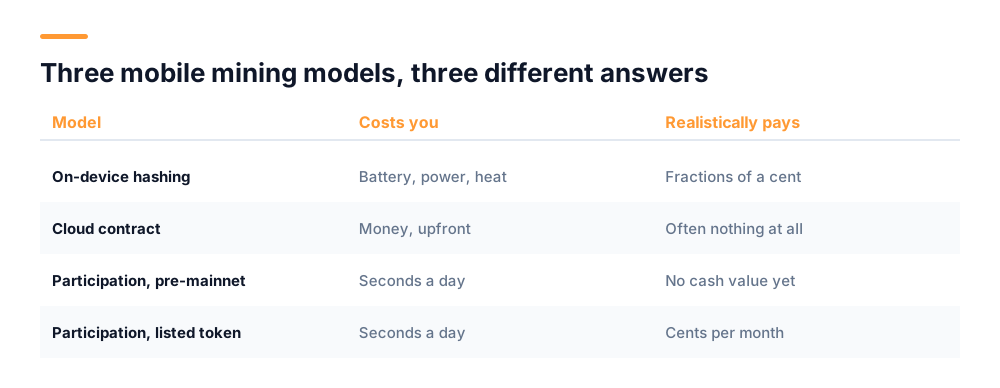
What each model actually pays in 2026
Here are the realistic figures, stated as ranges because the honest answer varies with device, region and token price rather than sitting at a single number.
| Model | Typical gross return | Net position |
|---|---|---|
| On-device hashing | Fractions of a cent per day | Negative once battery wear is counted |
| Cloud contract | Advertised 1-3% daily | Negative in most cases, total loss in fraud |
| Participation app, pre-mainnet | No cash value today | Zero cost, zero realisable income |
| Participation app, listed token | Cents to a few dollars monthly | Small but genuinely positive |
The first row is the one that surprises people. On-device hashing does produce a real, non-zero amount of cryptocurrency. It is simply so small that it is dwarfed by the cost of producing it, in exactly the way that panning a river with a teaspoon technically recovers gold.
It is worth understanding why this gap is structural rather than temporary. Mining rewards are distributed in proportion to the share of total network hashing power you contribute, and that total has grown relentlessly as specialised hardware has scaled. A phone was never competitive, and each year it falls further behind. No software optimisation closes a gap of that magnitude, so an app promising otherwise is either mistaken or misleading you.
The second row is where actual money is lost, because it is the only model that requires you to hand over funds before anything happens. A guaranteed daily percentage return is not a feature of any legitimate mining operation, since mining revenue depends on token price and network difficulty, both of which move constantly and neither of which any operator controls.
The costs that never appear in the marketing
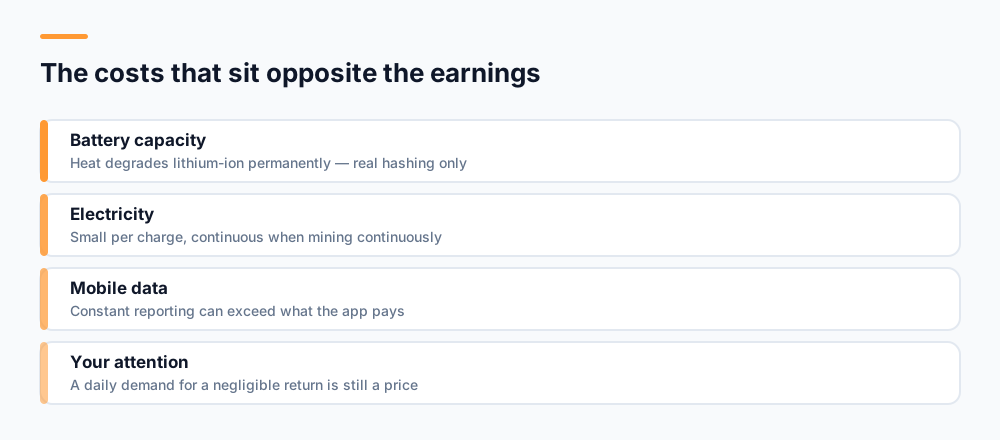
Even where an app pays something, four costs sit on the other side of the ledger. Only one of them is obvious.
- Battery capacity. Sustained full-load computation generates heat, and heat is the primary driver of lithium-ion degradation. Months of genuine on-device mining measurably shortens the life of a handset that costs far more than the mining returns.
- Electricity. Small per charge, but continuous mining means continuous charging, and the total over a year is not nothing.
- Mobile data. Apps that report constantly to a server consume data quietly. On a metered plan this alone can exceed what the app pays.
- Attention. The most underrated cost. An app demanding daily interaction for a negligible return is charging you in the one currency you cannot earn more of.
Crucially, the battery cost applies only to category one. An app that performs no computation cannot degrade your battery, because there is nothing to generate heat. This is why the question of whether an app actually mines is the single most useful thing to establish.
Where UNC sits, stated plainly
UNC is a participation app in category three, and it is pre-mainnet. Sessions cost no meaningful battery because nothing is computed on your device. There is no deposit, no subscription and no tier you can buy. On the cost side of the ledger, participation is close to free.
On the revenue side, the honest figure today is zero. Pre-mainnet UNC is a pending allocation that converts one-to-one to on-chain UNC at launch. It has no market price, cannot be sold, traded or converted to cash, and may never be worth anything. Anyone quoting you a dollar value for a pre-mainnet balance is describing a market that does not exist.
So is it profitable?
Not today, by any definition of the word that involves money you can spend. The accurate description is a free option on a project that may or may not succeed. That can be a reasonable thing to hold, since it costs you seconds a day, but calling it profitable would be false and we are not going to.
How to judge any mining app in ninety seconds
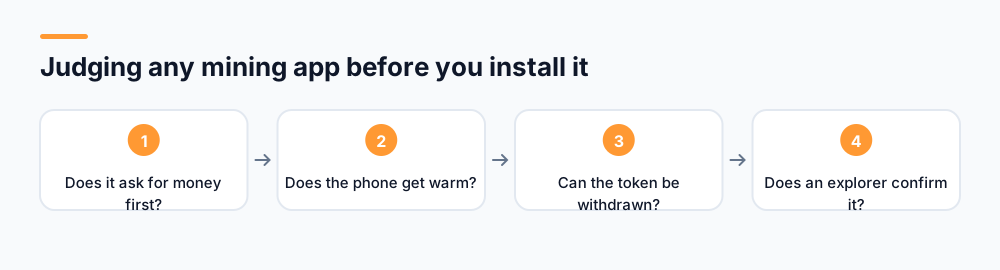
You do not need to trust anyone on this, including us. Four checks separate the categories reliably, and all four can be done before you install anything.
- Does it ask for money? If payment is required before you can earn or withdraw, treat it as category two and assume the worst until proven otherwise. Legitimate work pays you; it does not charge admission.
- Does the phone get warm? Genuine on-device hashing produces heat within minutes. If a mining app runs cool, it is not computing anything, whatever the interface implies.
- Can the token be withdrawn, and where does it trade? Find the withdrawal threshold, the method, and a public market price before investing time. An app vague about withdrawal is telling you something important.
- Does an independent explorer confirm the balance? A balance that exists only inside the app that reports it is not verifiable, and not something to rely on.
The fourth check is the one almost nobody performs, and it is the most informative. Copy your address, open the network explorer, and compare. Disagreement between the two means the app is wrong, and a project with no explorer at all has given you nothing to check.
The verdict for 2026
Mobile crypto mining is not a profitable activity in 2026, and the arithmetic behind that is not close. Real on-device mining loses money on hardware wear alone. Cloud contracts sold through apps range from marginal to outright theft. Participation apps cost nothing but pay in tokens whose future value is genuinely unknown, including ours.
What these apps can reasonably be is a free position in something speculative, held with the understanding that it may amount to nothing. That is a defensible thing to do with a few seconds a day. It is not income, it is not a strategy, and it should not displace anything that actually pays.
If the goal is money this month rather than a lottery ticket on this decade, the realistic options from a phone are ordinary ones: selling things you already own, freelancing a skill you already have, or gig work. They are less exciting than mining and they pay immeasurably better.
Whatever you choose, the safety rules do not change. No legitimate app needs your recovery passphrase, your banking password or a one-time code, and no legitimate project guarantees a return. Those two rules alone would prevent the large majority of losses in this category.
Frequently asked questions
Is mobile crypto mining profitable in 2026?
Not in any meaningful sense. Genuine on-device mining earns fractions of a cent per day while degrading a handset worth hundreds, so it is net negative. Cloud contracts require payment upfront and frequently return nothing. Participation apps cost nothing but pay in tokens that often have no market value, so there is no realisable profit today.
How much can you actually earn from a mobile mining app?
Apps running real computation produce fractions of a cent daily. Participation apps with a listed token typically amount to cents or a few dollars a month. Pre-mainnet participation apps, including UNC, pay in tokens with no market price at all, meaning the current cash value is zero regardless of the balance displayed.
Does mobile mining damage your phone?
Only if the app genuinely computes on your device. Sustained full-load processing produces heat, and heat is the main cause of lithium-ion battery degradation. Apps that perform no computation, which is most of them, generate no heat and cause no measurable wear.
Which mobile mining apps are scams?
The reliable warning signs are payment required before earning, a withdrawal threshold that rises as you approach it, guaranteed daily returns, earnings that depend mainly on recruiting others, and any request for a recovery passphrase or one-time code. Any single one of these is sufficient reason to uninstall.
Is UNC mining profitable?
Not today, and we will not claim otherwise. UNC is pre-mainnet, so accumulated balances have no market price, cannot be sold or converted to cash, and may never be worth anything. Participation costs nothing but a few seconds daily, which makes it a free speculative position rather than a source of income.
Is it better to mine on a phone or buy crypto directly?
For anyone treating this as an investment decision, buying a listed asset gives you a known quantity at a known price, whereas phone mining gives you an unpredictable trickle at real cost to your hardware. The only genuine advantage of participation apps is that they cost nothing, which is a different proposition from being profitable.
Start mining with UNC
UNC distributes tokens to verified participants — no hardware, no subscription, no battery drain. Read the whitepaper for the distribution model, or check network activity in the explorer.
Get UNC on Google Play