Mining Basics
Mobile Crypto Mining Apps: How to Choose One
There are hundreds of these apps and most reviews of them are paid placements. Here is what they actually do, how they make their money, and how to judge one yourself.
Search for a mobile crypto mining app and the results are close to useless. Listicles ranking the top ten are almost always affiliate placements, app store ratings are trivially bought, and the apps themselves describe what they do in language carefully chosen to imply more than it says. Meanwhile the category genuinely does contain both legitimate projects and outright theft, which is exactly why it is worth learning to tell them apart yourself.
This guide is not a ranked list. It explains what these apps actually do on your phone, where their money comes from, which permissions should end your interest immediately, and a short sequence of checks that separates the honest ones from the rest. We build one of these apps, so treat the section about ours as disclosure rather than a recommendation.
What a mobile crypto mining app actually does
Almost every app in this category performs no cryptographic work on your device whatsoever. This is the single most important thing to understand, and it is not a criticism — it is simply what the technology allows. A smartphone produces perhaps five million hashes per second. A purpose-built mining machine produces hundreds of trillions. An app genuinely trying to mine on your handset would compete at roughly one fifty-millionth of the speed while flattening your battery.
What these apps do instead is record that you were present. You open the app, tap a button, and a balance accrues on the project’s servers according to a rate they control. The app is a check-in mechanism with a countdown timer attached. Calling that mining is a marketing decision rather than a technical description, and the projects worth trusting are the ones that say so plainly rather than letting the word do unearned work.
The heat test
Run any mining app for ten minutes and feel the back of your phone. Real sustained computation produces noticeable heat within minutes, every time, without exception. If the phone stays cool, nothing is being computed, whatever the animated graphics in the interface suggest. This one physical check cuts through every marketing claim in the category.
The four kinds of app you will find
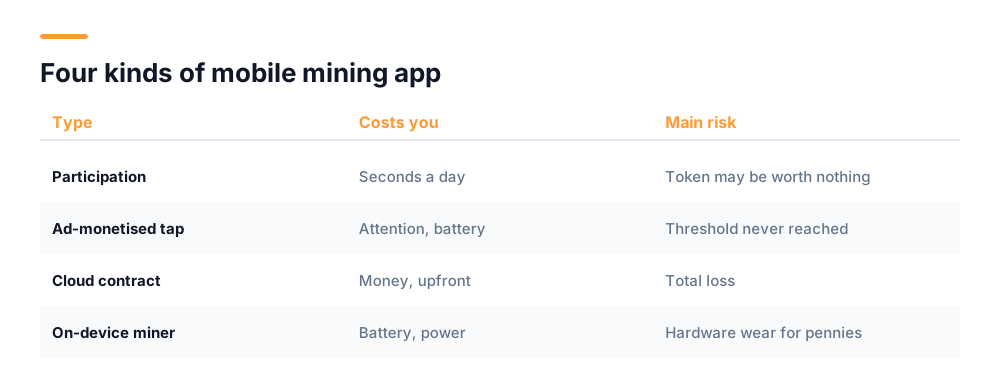
Sorting the category into four buckets makes the rest of the evaluation much faster, because each type has a different failure mode and a different question worth asking.
1. Participation apps
You check in daily, tokens accrue, nothing is computed and nothing is charged. This is the largest group by user count and includes most of the well-known names. The honest ones are transparent that the token has no market value before launch. The dishonest ones let you assume otherwise while the balance climbs encouragingly.
2. Ad-monetised tap apps
Functionally similar, but the entire product is an advertising delivery mechanism. You watch video ads to increase a counter, and payouts sit behind a withdrawal threshold that is reachable in theory and rarely in practice. These are not usually fraudulent so much as a poor trade: your attention, sold at a rate far below what the ads earn.
3. Cloud mining contracts
The app sells you a share of hashing power supposedly running in a data centre. This is the only category that requires money upfront, and consequently the only one that can leave you worse off than when you started. Some operations are real. Many are simply a deposit form with a chart on top.
4. Genuine on-device miners
Rare, and honest about what they do, but the economics do not work. Sustained full-load computation degrades your battery, and the coins produced are worth less than the electricity consumed. These apps are usually built as experiments or curiosities rather than as an income proposition.
How these apps make their money
This is the question almost no review asks, and it is the most informative one available. Every app has a business model. If you cannot identify it within a minute of looking, you are probably the product, and it is worth finding out how before you install anything.
| Revenue source | What it costs you | How to spot it |
|---|---|---|
| Advertising | Attention, and often battery | Ads gate the core loop, not just the edges |
| Selling user data | Your contacts, location, identity | Permissions far beyond what features need |
| Upfront contract sales | Money, immediately | Payment required before earning starts |
| Token treasury | Nothing directly, but dilution | Project holds a share, disclosed in a whitepaper |
| Nothing identifiable | Unknown, which is the problem | No ads, no fees, no published tokenomics |
The last row deserves emphasis. An app with no advertising, no charges and no published token allocation is not running on goodwill. It is either pre-revenue and funded by a treasury it should be willing to document, or the revenue model is something it prefers you did not know about. A project that cannot answer this question in public has answered it.
The permission audit, in ninety seconds
App store listings show requested permissions before you install. This is the highest-value minute you can spend on any app in this category, because the gap between what an app asks for and what its features could possibly require is where the real story lives.
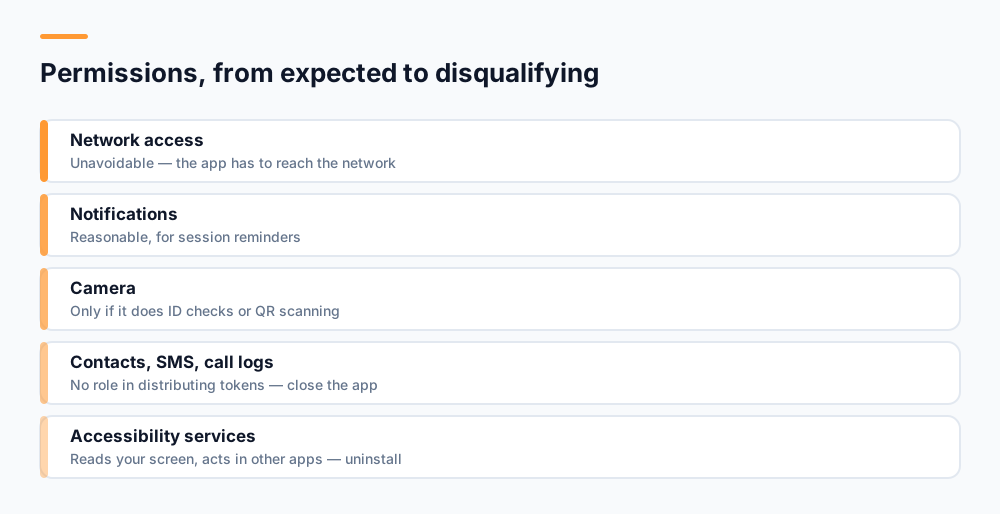
Network access is unavoidable. Notifications make sense for session reminders. Camera access is reasonable if, and only if, the app performs identity verification or scans QR codes, and you should be able to point at the feature that uses it.
Contacts, SMS, call logs and precise background location have no role in distributing tokens to someone who tapped a button. Accessibility services are the most serious of all: on Android that permission can read everything on screen and act on your behalf in other apps, which is precisely how banking malware operates. No mining app has a legitimate reason to request it, and an app that does should be uninstalled rather than reasoned with.
Judging an app before you install it
Four checks, in this order, because each one eliminates a different failure mode and the early ones are the cheapest to run.
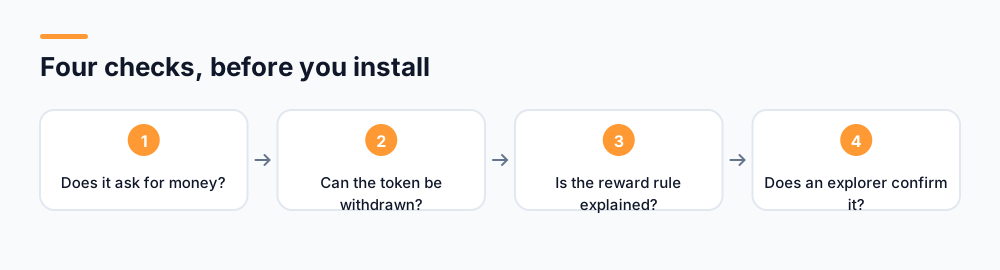
- Does it ask for money? Payment before earning is the clearest single signal in the category. Legitimate distribution does not charge admission, and no operator can guarantee a return on a deposit because token price and network difficulty are outside their control.
- Can the token be withdrawn, and where does it trade? Find the threshold, the method, and a public market price. Then search for recent reports of people actually receiving a payout, since an app that is vague about withdrawal is telling you something specific.
- Is the reward mechanism explained in checkable terms? "Proprietary algorithms" is not an explanation. You want to know what determines your rate, who can change it, and whether anything can be bought.
- Does an independent explorer confirm the balance? A number that exists only inside the app that reported it is not verifiable. A project with no explorer at all has given you nothing to check.
The fourth check is the one almost nobody performs and the most informative of the four. Copy your address, open the network explorer, paste it, and compare. If the two disagree, the app is wrong. If there is no explorer, you are being asked to take a balance entirely on trust.
Why app store reviews will not help you
Ratings in this category are close to meaningless. Five-star reviews are cheap to buy in volume, and many apps prompt for a rating at the exact moment a balance ticks up, harvesting goodwill from people who have not yet tried to withdraw anything.
The useful signal sits in the one and two star reviews, and specifically in whether they describe withdrawal problems. Sort by most recent, ignore everything about the interface, and read only the complaints about getting money out. A pattern of unanswered withdrawal complaints spanning months tells you more than any aggregate score, and it is the one thing that is genuinely hard to fake at scale.
Where UNC fits, stated plainly
UNC is a participation app in the first category. Nothing is computed on your phone, so sessions cost no meaningful battery. There is no deposit, no subscription, and no tier you can buy — rate is determined by consistency and by the active people you bring, both of which reflect participation rather than payment.
On the revenue question we would put to any other project: UNC is pre-mainnet and holds a token treasury, allocated and documented in the whitepaper rather than left vague. Your accumulated balance is a pending allocation that converts one-to-one to on-chain UNC at launch. Today it has no market price, cannot be sold, traded or converted to cash, and may never be worth anything.
We also ask for identity verification, which some people dislike, and the reason is worth stating rather than burying. A network meant to represent real people is worthless if one operator can run ten thousand accounts, and every network in this category that skipped verification has been hollowed out in exactly that way. Verification happens inside the app, never through a link sent to you in a message.
Run the same checks on us
Nothing above should be taken on our word. Feel the phone during a session. Read our whitepaper for the token allocation. Check a balance in the explorer rather than trusting the number the app shows you. A project that asks you to verify it is making a safer request than one that asks you to trust it.
The short version
- No app should charge you before you can earn or withdraw. This rule has no exceptions worth making.
- A cool phone means no computation is happening, whatever the interface implies.
- Contacts, SMS, call logs and accessibility permissions have no legitimate use here.
- If you cannot identify how the app makes money in under a minute, keep looking until you can.
- Read the one-star reviews for withdrawal complaints, and ignore the aggregate score entirely.
- A balance you cannot verify outside the app is not a balance you should rely on.
- Nobody legitimate will ever ask for your recovery passphrase, banking password or a one-time code.
Applied together, these take about five minutes and eliminate the overwhelming majority of what is harmful in this category. The apps that survive all seven are not guaranteed to succeed — no pre-mainnet project can promise that, ours included — but they are at least being honest with you about what they are, which is the only foundation on which any of the rest of it matters.
Frequently asked questions
What is the best mobile crypto mining app?
There is no defensible answer to this, and any article confidently ranking them is usually running affiliate links. What you can do is apply a consistent test: does it charge you, can the token actually be withdrawn, is the reward mechanism explained in checkable terms, and does an independent explorer confirm your balance. Apps that pass all four are worth your time regardless of where a listicle ranks them.
Do mobile crypto mining apps actually pay?
Some do, in the narrow sense that a token reaches your wallet. Whether it is worth anything is a separate question. Apps distributing an already-listed token pay small but real amounts, typically cents to a few dollars monthly. Pre-mainnet projects, including UNC, distribute tokens with no market price at all, so nothing can be converted to cash today.
Are free crypto mining apps safe to install?
Free is not the same as safe, and the risk is rarely the mining itself. It is the permissions you grant and the data they enable, plus the phishing that targets users afterwards. Check requested permissions before installing, refuse anything the app cannot justify with a visible feature, and never enter a recovery passphrase anywhere outside your own wallet app.
Which mobile mining app permissions should I refuse?
Contacts, SMS, call logs, precise background location, and above all accessibility services. None have a legitimate role in an app that distributes tokens for checking in. Accessibility in particular can read your screen and act inside other apps, which is how banking malware operates, so an app requesting it should be uninstalled rather than granted a narrower permission.
How do free mining apps make money if they charge nothing?
Usually advertising, sometimes data collection, and in the case of legitimate crypto projects a token treasury allocated at genesis and documented publicly. If an app has no ads, no fees and no published tokenomics, its revenue model is something you have not identified yet, and that is a reason to keep asking rather than to assume goodwill.
Can a mining app damage my phone?
Only if it genuinely computes on your device, which almost none do. Sustained full-load processing generates heat, and heat is the main driver of lithium-ion battery degradation. Apps that simply record a check-in produce no heat and cause no measurable wear, which is why the ten-minute heat test is such a useful first check.
Start mining with UNC
UNC distributes tokens to verified participants — no hardware, no subscription, no battery drain. Read the whitepaper for the distribution model, or check network activity in the explorer.
Get UNC on Google Play