Getting Started
Free Crypto Mining: What "Free" Actually Buys You
You can mine cryptocurrency without spending money, and the reason it costs nothing is the same reason it pays almost nothing. Here is the arithmetic for a phone against a real network, where the genuine free options are, and how to tell a free mining offer from an investment scam dressed up as one.
People searching for free crypto mining are usually asking one specific question: can I get cryptocurrency without paying for hardware, electricity or a deposit? The honest answer is yes, in several ways, and every one of them pays amounts small enough that the word "earning" oversells it. That is not a discouraging accident. It is the direct consequence of how mining works, and once you see the arithmetic you can evaluate any free mining offer in about a minute.
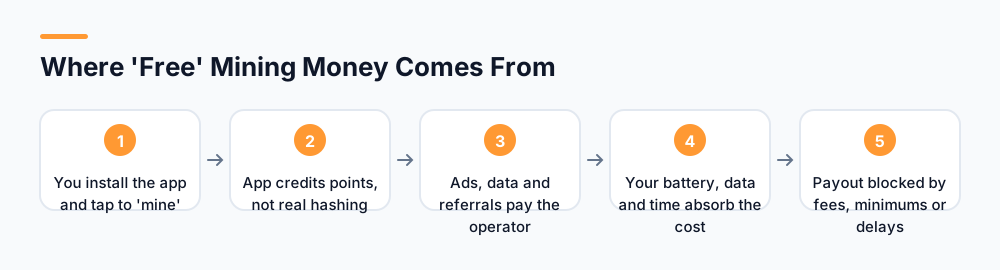
The more useful question underneath it is who pays. Mining consumes electricity and hardware, so if it is free to you, someone else is covering the cost and getting something in return — advertising impressions, your attention, a user count to show investors, or in the worst case a deposit extracted later. Knowing which of those you are dealing with tells you almost everything you need.
This guide works through the four things that get called free mining, the actual numbers for a phone against a live network, the point at which a free offer becomes fraud, and how airdrops differ from mining entirely. If you want the underlying mechanics first, our explainer on how mobile mining actually works covers the process itself.
Four different things get called free crypto mining
The phrase covers arrangements with almost nothing in common. Some are legitimate and educational, one is a genuine industrial activity where "free" means you already own the electricity, and one is a fraud category with billions of reported losses behind it. Telling them apart is the whole skill.
1. Mining with hardware you already own
This is mining in the strict sense: your device does cryptographic work, submits it to a pool, and receives a share of whatever the pool wins. It is free only in the sense that you did not buy new equipment. Electricity is still consumed, wear is still accumulated, and for a phone or laptop the value of the work produced is smaller than the value of the power consumed. The section below puts real numbers on that.
2. Apps that allocate tokens on a schedule
Most phone "mining" apps do not race SHA-256 hardware, because doing so would be pointless. They distribute a project's own pre-launch token according to a published schedule, using activity or check-ins as the trigger. This can be perfectly honest so long as the project says plainly that this is what it is doing, and does not imply the token has a price. UNC sits in this category, and we say so rather than borrowing the imagery of a mining farm.
3. Ad-funded faucets and "free hash" pages
A page shows you an advert and credits a fraction of a cent. There is no mining involved at all; the label is marketing. The ceiling here is the market price of one advert impression, which is roughly a tenth of a cent, so the payout cannot escape that band no matter which site you pick.
4. Free cloud mining trials
You are given a "free" allocation of rented hash power on someone else's farm, a dashboard shows a balance climbing, and a withdrawal requires an upgrade, a deposit or a fee. This is where the fraud concentrates, and it is the one category we would tell anyone to avoid without exception.
| Type | Who pays for it | What it realistically returns |
|---|---|---|
| Your own hardware | You, in electricity and wear | Less than the electricity on a phone; possibly positive on purpose-built rigs with cheap power |
| Scheduled token allocation | The project, in future token supply | An unpriced allocation — unknowable by definition before a listing |
| Ad-funded faucet or "free hash" | Advertisers | Fractions of a cent per interaction, capped by ad rates |
| Free cloud mining trial | Usually the next depositor | Nothing withdrawable; the upgrade prompt is the product |
The arithmetic: one phone against a real network
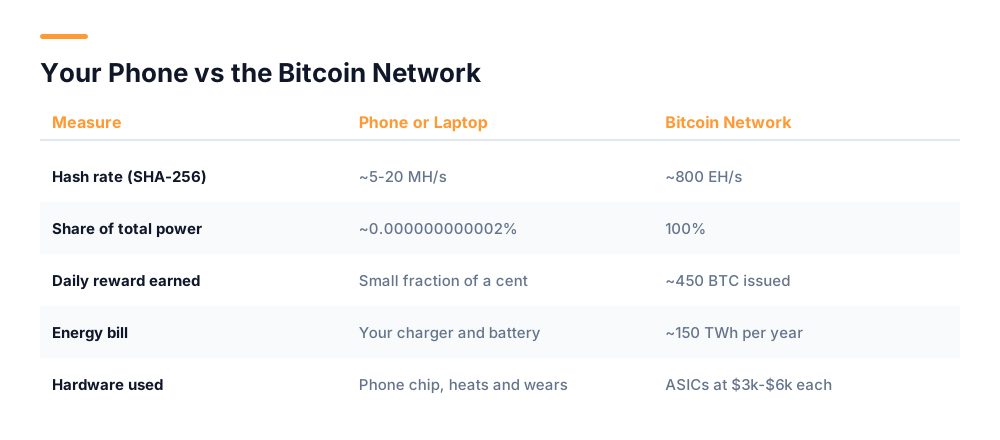
Mining rewards are shared in proportion to hash rate. Your expected income is therefore your share of the network multiplied by what the network issues. Both numbers are public, so this is a calculation anyone can do rather than a matter of opinion. Here it is for the two algorithms people actually ask about — Bitcoin's SHA-256, and Monero's RandomX, which was deliberately designed to run well on ordinary processors.
| Step | Bitcoin (SHA-256) on a phone | Monero (RandomX) on a phone |
|---|---|---|
| Phone hash rate | Around 2 MH/s at absolute best | Around 800 H/s on a good chip |
| Network hash rate | Roughly 800 EH/s | Roughly 5 GH/s |
| Your share of the network | About 1 in 400 trillion | About 1 in 6 million |
| Issued to all miners per day | About 450 BTC | About 432 XMR |
| Your expected share per day | About 0.000000000001 BTC | About 0.00007 XMR |
| Value of that per day | Roughly a hundred-thousandth of a cent | Roughly one cent |
| Electricity used per day | About 0.1 kWh, or 1.7 cents | About 0.1 kWh, or 1.7 cents |
Read the last two rows together, because that is the finding. On the algorithm specifically designed to be friendly to general-purpose processors, a phone running flat out for twenty-four hours produces about a penny of Monero and consumes about 1.7 cents of electricity at the average US residential rate. It is a small, steady loss before you count anything else. On Bitcoin the gap is not a loss you could measure — the phone's share of the network is so far below one part per trillion that the expected reward rounds to nothing on any human timescale.
This is why nobody mines Bitcoin on phones and why apps claiming to do so are not doing what they say. It is also why "free" is honest about mining in one narrow sense: at these numbers, nobody would ever charge you for it. We work through the profitability question in detail elsewhere, including what happens with purpose-built hardware and subsidised power, where the answer genuinely does change.
The costs that do not show up on the dashboard
Electricity is the cost people think of, and it is the smaller one. Sustained full-load computation on a phone means sustained heat, and lithium-ion cells lose capacity faster at elevated temperature. Apple publishes the plain version of this: operating above roughly 35°C can permanently damage battery capacity. A mining app that keeps a processor pinned is a heat source held against a battery for hours.
So the real exchange rate is not cents of electricity for cents of coin. It is a measurable fraction of a several-hundred-dollar device's useful life for a penny a day. We looked at what sustained mining does to a phone battery separately, with the cycle-count and temperature figures, because it is the cost that determines whether any of this is rational and it never appears in the app.
If an app makes your phone hot for hours, that is the price
Heat plus a full battery is the worst combination for cell longevity. An app that earns a penny a day while running your processor at full load is not free — it is billing you in hardware rather than in money.
Where a free offer becomes a crypto investment scam
The transition is always the same, and it is worth naming precisely: the offer starts free, a balance grows, and then money has to move from you to them before anything can move back. The FBI's Internet Crime Complaint Center attributed billions of dollars in reported losses to crypto investment fraud in 2023 alone, and "mining" and "liquidity mining" are two of the standard wrappers. Understanding how a crypto scam is actually structured makes the pattern obvious the moment you see it.
- A fee, upgrade or "network cost" is required before a withdrawal will process. The balance was a number in a database; the fee is the entire business.
- Returns are stated as a rate — 3% a day, 1.5% daily hash yield. Real mining income varies with difficulty and price and cannot be a fixed percentage.
- A referral tier structure pays you for recruitment. That is where the money actually comes from.
- You are asked to connect a wallet and then approve a token spending permission. Receiving something never requires you to grant spending authority.
- A stranger who contacted you first is helping you set up a mining or liquidity-mining account, often after weeks of unrelated friendly conversation.
- The withdrawal works once, for a small amount, and stops working after you deposit more. This is a deliberate confidence step, not a glitch.
- Anyone asks for your recovery words for any reason at all.
A single rule handles nearly all of it. Free means free of payment in both directions. If accessing your own supposed balance requires you to send funds, authorise a contract, or recruit someone, the balance is not yours and never was. No legitimate mining arrangement needs money from you to give money to you.
Airdrops are not mining, and the difference matters
An airdrop crypto currency distribution sends tokens to addresses that meet some criterion — having used a protocol, held an asset at a snapshot date, or bridged funds before a cut-off. No computation is involved and nothing is earned in the mining sense. The project is buying distribution and attention with its own supply, which is a legitimate strategy and also the reason the amounts are unpredictable: the issuer decides them, and thousands of people optimise for them.
The risk profile is different too. Genuine airdrops require nothing from you but an address, so the dangerous part is almost always the claim page. Fake claim sites are one of the most productive phishing formats in crypto, because the user arrives already expecting to interact with their wallet. A request for your recovery passphrase, or a signature granting unlimited spending permission, is theft regardless of how convincing the branding is.
- Only ever reach a claim page from the project's own domain, never from a message, reply or search advert.
- Unsolicited tokens appearing in your wallet are frequently bait — interacting with them is the attack.
- An airdrop that requires a deposit to "unlock" is not an airdrop.
- Amounts are set by the issuer and can be zero. Farming them is speculation, not income.
So is crypto a scam or legit?
Both parts of that question have answers, and they are different answers. The technology is legitimate in a specific, checkable sense: public blockchains work as described, anyone can independently verify the ledger, and mining economics behave exactly as the arithmetic above predicts. Nothing about that requires trust in a company. That is the point of it.
The consumer-facing market built on top is a different matter, and a large share of what is marketed to newcomers is either fraudulent or simply not worth the time. Both things are true simultaneously, which is why the useful question is never "is crypto legit" but "is this specific offer doing what it says". That one you can answer: check whether payments appear on-chain, whether the claimed rewards survive contact with published network numbers, and whether money has to leave your wallet before any arrives.
The protocol can be verified. The offer has to be checked. Confusing the two is what scams rely on.
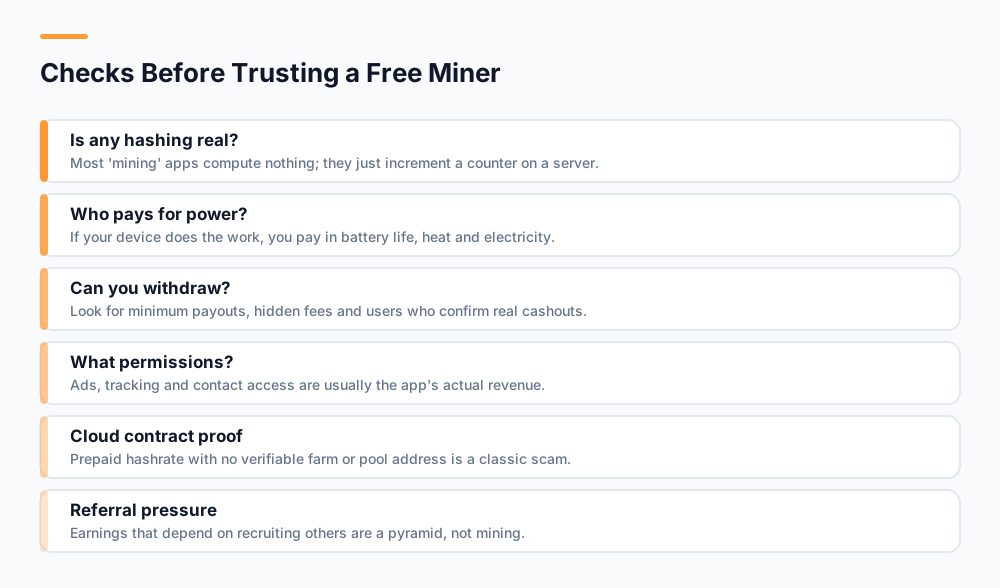
Six checks before you install a free mining app
- Ask what is actually being mined. If it names a major coin, compare the claimed output against the network numbers — the mismatch is usually enormous.
- Ask whether anything is mined at all. If the app distributes a project token on a schedule, that is fine, but it should say so in plain words.
- Check whether a price exists. A token with no exchange listing has no price, and anyone quoting a dollar figure for it is inventing one.
- Look for the withdrawal condition. Any fee, deposit or upgrade gate ends the evaluation.
- Install only from an official app store, and read what permissions are requested. Broad access unrelated to the stated function is a warning.
- Watch the device. Sustained heat and rapid drain tell you what the app is doing to your hardware regardless of what the dashboard shows.
Where UNC fits, stated plainly
UNC is free to use and there is nothing to pay, ever. It is not free hash power and it does not compete with mining farms. Allocation follows a published schedule, and how UNC works sets out that schedule together with what the app does and does not do on your device. We would rather you read that than infer it from the word mining.
The disclosure that matters most: UNC has no listed price and no exchange listing, so nobody — including us — can tell you what an allocation is worth, and we do not promise earnings, returns or future value. If you want the structural detail rather than the summary, the UNC whitepaper documents the network design and distribution model, and you can read all of it before installing anything. Our note on how to judge free crypto mining sites applies to us as much as to anyone else.
Frequently asked questions
Is free crypto mining real?
Yes, in the sense that you can mine without buying hardware or paying a fee — a phone or laptop can run mining software and receive a share of pool rewards. What is not real is the idea that this produces meaningful income. On Monero, the most CPU-friendly major coin, a phone at full load earns roughly a penny a day while consuming about 1.7 cents of electricity, before any battery wear.
Can you mine Bitcoin for free on a phone?
Not in any practical sense. A phone might reach 2 MH/s against a network of around 800 EH/s, giving it roughly one part in 400 trillion of the reward. The expected daily return is a tiny fraction of a cent, so any app claiming to mine Bitcoin on a phone is not doing what it says — it is either distributing its own token or running an advertising business.
How do I tell a mining app from a crypto investment scam?
Look for the moment money has to move toward them. Fees to withdraw, upgrade tiers, fixed daily return percentages, referral commissions and wallet spending approvals are all signs of fraud rather than mining. Genuine mining income is variable, it depends on network difficulty and price, and it never requires a deposit to release.
Is an airdrop the same as free mining?
No. An airdrop distributes a project's own tokens to qualifying addresses with no computation involved, and the amount is set by the issuer rather than earned. The main risk is the claim page: fake airdrop sites are a common phishing format. A real airdrop never needs your recovery words, a deposit, or an unlimited spending approval.
Is crypto a scam or legit?
The technology is legitimate and independently verifiable — public blockchains behave exactly as documented and require no trust in any company. A significant portion of the products marketed to newcomers is not. Treat those as separate questions and evaluate each specific offer on whether its claims survive comparison with published network data.
What is the most genuinely free thing in crypto?
Testnet faucets, which hand out deliberately worthless tokens so developers can test contracts, and reading. Verifying transactions in a block explorer, receiving a tiny payment once to see how addresses and fees work, and reading a project's documentation cost nothing and teach more than months of running a mining app.
Start mining with UNC
UNC distributes tokens to verified participants — no hardware, no subscription, no battery drain. Read the whitepaper for the distribution model, or check network activity in the explorer.
Get UNC on Google Play