Getting Started
Free Crypto Mining Site: What Are You Actually Getting?
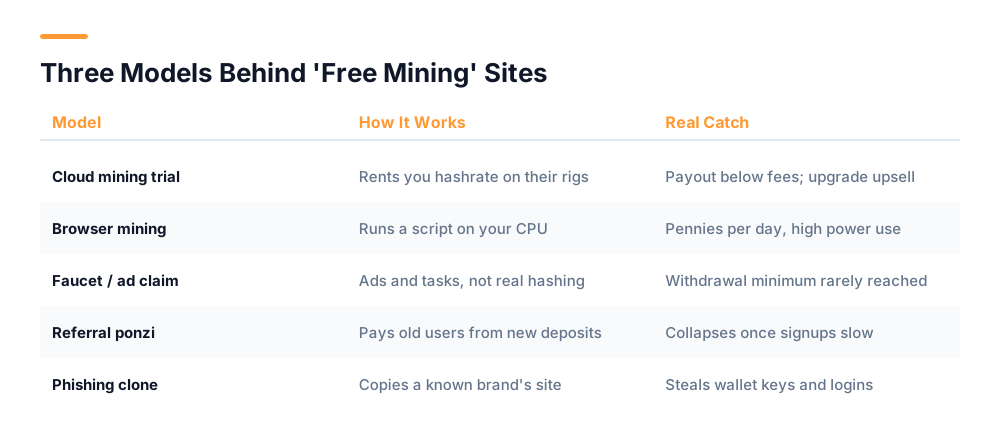
Four very different things call themselves free mining: browser hashing scripts, cloud contracts with a free tier, scheduled-allocation apps, and dashboards where no mining happens at all. Only one of them is mining in the technical sense, and it is the one that costs you real money in electricity. Here is how to tell them apart and test any of them in ten minutes.
Search for a free crypto mining site and you will land on three or four very different kinds of page wearing the same label. Some run a hashing script in your browser tab. Some sell cloud mining contracts and give you a free starter allocation to get you signed up. Some are apps or web dashboards where a number rises on a timer and no hashing happens anywhere. They all use the word "mining", and only one of them is mining in the technical sense.
The honest summary is short enough to give away now: none of these produce meaningful income, and the reason they can afford to be free is that what they generate is worth less than the resources it consumes. That is not a criticism of any particular operator — it is arithmetic that applies to all of them equally. The interesting question is not which free site pays most, because the answer is functionally zero in every case. It is which ones are honest about that and which ones are a funnel towards a deposit.
This guide works through the four models one at a time, does the actual sums on browser mining with real network numbers, explains where the free cloud tier fits into the sales process, and gives you a ten-minute test you can run on any site before you give it an email address. If you want the underlying mechanics first, our explainer on how mobile crypto mining works covers what a hash is and why phones and browsers are poor at producing them.
Four things call themselves free mining
Before anything else, work out which model you are looking at. The risks are completely different, and so is the correct response.
1. Browser miners
You open a tab, press start, and a WebAssembly script begins hashing — almost always on a CPU-friendly algorithm such as RandomX, because browsers cannot reach graphics hardware efficiently. This is genuine mining. Your machine really is submitting shares to a pool. It is also the model where you personally pay the bill, in electricity and in hardware wear, and where the bill exceeds the proceeds by a wide margin. We do the numbers in the next section.
2. Free tiers on cloud mining sites
Here the site claims to own hardware in a data centre and rents you a slice of it. The free slice is deliberately tiny — enough to make a balance tick upward, never enough to reach the withdrawal minimum. Its job is to get you familiar with the dashboard and emotionally invested in a growing number, at which point the upgrade prompts start. Some of these companies own real machines. Many own nothing at all, and the dashboard is a spreadsheet with animations.
3. Scheduled-allocation apps
These credit a balance at a fixed rate for tapping a button or keeping a session open. No hashing occurs, on your device or anywhere else, and the better ones say so. The word "mining" here is a metaphor for distribution: tokens are handed out on a published schedule rather than produced by computation. Whether that is acceptable depends entirely on whether the operator admits it. An app that shows a fake hashrate readout while doing nothing is lying about something it did not need to lie about.
4. Pure fabrications
The fourth category is a website with a balance counter, a fake activity feed, testimonials with stock photographs, and a withdrawal button that produces an error asking for a fee. Nothing is mined, nothing is held, and the balance is a number in a database that exists to justify the fee request. This is the largest category by volume, and it is the reason the search term has such a bad reputation.
| Model | Is hashing happening? | Who pays the cost | Realistic outcome for you |
|---|---|---|---|
| Browser miner | Yes, on your own CPU | You, in electricity | Net loss of roughly ten to twenty times what you earn |
| Free cloud tier | Sometimes, somewhere else | The operator, as marketing spend | A balance that never reaches the withdrawal minimum |
| Scheduled allocation | No, and honest ones say so | Nobody — it is a distribution schedule | An unpriced token balance, value unknown |
| Fabricated dashboard | No | You, once the fee request arrives | Whatever you pay to "unlock" the balance |
The arithmetic behind browser mining
Browser mining is the only model where you can check the claim yourself with public numbers, so it is worth doing properly rather than asserting that it is not worth it.
Take a reasonable laptop running a RandomX miner compiled to WebAssembly. Native RandomX on such a machine might reach 1,500 hashes per second across all cores; in a browser sandbox, with one or two threads and no large-page memory access, 300 to 500 H/s is a fair estimate. Monero's network hashrate sits in the region of 5 GH/s — five billion hashes per second. Your share of the network is therefore about 400 divided by 5,000,000,000, which is 0.00000008, or eight hundred-millionths of one percent.
The network emits roughly 432 XMR per day across its blocks. Multiply by your share and you get about 0.000035 XMR per day. At a price around $160 that is a little over half a cent — call it $0.0055 in a 24-hour period of continuous hashing.
Now the cost side. A laptop hashing flat out draws perhaps 30 watts more than it would sitting idle. Over 24 hours that is 0.72 kWh. At a US average residential rate near $0.17 per kWh, you have spent about $0.12 to earn about $0.0055. The ratio is roughly twenty-two to one against you, and that is before the pool fee, before the operator's cut of your shares, and before the fan running constantly for a year.
| Line item | Figure | Where it comes from |
|---|---|---|
| Browser hashrate | ~400 H/s | WASM RandomX, one or two threads |
| Network hashrate | ~5,000,000,000 H/s | Public Monero network statistics |
| Your share of the network | 0.00000008 | 400 divided by network hashrate |
| Network emission per day | ~432 XMR | ~0.6 XMR per block, ~720 blocks |
| Your gross per day | ~0.000035 XMR (~$0.0055) | Share multiplied by emission |
| Extra power drawn | 0.72 kWh per day | 30 W above idle, for 24 hours |
| Electricity cost per day | ~$0.12 | US average near $0.17/kWh |
| Net result | −$0.115 per day | Gross minus electricity |
Change any input you like. Halve the electricity price and you are still losing money eleven times over. Quadruple the hashrate with a desktop and the extra power draw rises with it, so the ratio barely improves. The only way the sum turns positive is if somebody else pays the power bill — which is exactly why browser mining scripts were historically injected into other people's websites without consent. On a phone the picture is worse again, because thermal throttling cuts the hashrate within minutes while the battery keeps discharging; we covered that specific trade-off in our piece on whether mining drains your phone battery.
The general rule this produces
If a site is mining with your hardware, the free part refers to the signup, not the cost. If a site is mining with somebody else's hardware and giving you the proceeds, ask what they get in return — because nobody rents out data centre capacity as a gift.
Why free cloud mining tiers exist
The free plan on a cloud mining site is a customer acquisition cost, and it is a cheap one. Crediting a new account with $0.30 of notional daily hashpower costs the operator nothing if the hardware does not exist, and very little if it does. What it buys is a user who checks a dashboard every day and watches a number grow.
The structure is consistent enough to predict. The free rate is calibrated so that the withdrawal minimum is reached in roughly four to eight months of daily logins, which is longer than most people persist. Meanwhile the upgrade tiers are priced to look like an obvious optimisation: pay $50 and the same minimum arrives in a fortnight. The moment you pay, the relationship changes from free to invested, and the operator has what it wanted. We looked at the whole category, including the handful of operators with verifiable hardware, in our guide to cloud mining contracts.
There is a specific thing to check here, and it separates the real operators from the rest quickly. A genuine mining company earns its income from a pool, which pays out on-chain. That means there is a payout address with a public history of outbound transactions to thousands of user addresses. A fabricated operation has either no address at all, or one address with a handful of transactions from launch week and nothing since.
Is crypto a scam, or just this corner of it?
Anyone who spends an afternoon looking at free crypto mining sites ends up asking some version of the question is crypto a scam, and it is a fair reaction to the evidence in front of them. The answer is that the category is not a scam, but the category also does not protect you from anything, and the sub-genre you have just been reading about is dominated by fraud in a way that most of the rest is not.
The technology underneath is boring and verifiable: a distributed ledger, a consensus rule, a public record anyone can read. Bitcoin has produced a block roughly every ten minutes since 2009 and the entire history is auditable by anyone who downloads it. That is not a scam in any meaningful sense. It is also not a promise. The ledger will faithfully record you sending your money to a fraudster, and it will do so irreversibly.
What makes the space unusually hospitable to fraud is a combination of three properties: transactions are irreversible, there is no institution with the authority to unwind one, and the subject matter is technical enough that plausible-sounding nonsense is hard for a newcomer to distinguish from plausible-sounding truth. Free mining sits at the intersection of all three, which is why it attracts the operators it attracts.
What is a crypto scam, structurally?
Ask what is a crypto scam and most answers list examples. Lists go stale, because the surface details rotate every few months. The structures do not. There are only a handful, and once you can name them you will recognise a new variant on sight.
- Advance fee. A balance you cannot touch, released only after you pay a network fee, a tax, a verification charge or an activation cost. The balance is fiction; the fee is the product. This is the dominant pattern in fake mining dashboards.
- Credential theft. A form, popup or support agent asking for your recovery words, private key or exchange password. There is no legitimate reason for any of these to be requested, ever, by anyone.
- Malicious approval. A "connect wallet" prompt that asks you to sign a token approval or a blind message. You are not receiving anything; you are granting spending authority over your balance.
- Deposit-and-vanish. A real-looking platform that accepts deposits, shows growing returns, permits one small early withdrawal to build confidence, then stops responding.
- Impersonation. A clone of a known exchange, project or person, differing by a character in the domain or handle. The underlying request is always one of the four above.
- Recovery fraud. A second approach to people who already lost money, offering to trace and return it for an upfront fee. The victim list is frequently sold between operators.
Every one of those requires you to send something — money, keys or a signature. That gives you a single defensive rule with very few exceptions: a genuine incoming payment never requires an outgoing one. If you internalise nothing else, internalise that. Our walkthrough of crypto giveaway scams shows the advance-fee structure in its purest form, and the same shape reappears in the mining dashboards with the wording changed.
The one line that ends every conversation
Nobody needs your twelve or twenty-four recovery words to send you cryptocurrency. Receiving requires only a public address. A request for the words is theft in progress regardless of how the request is framed.
A ten-minute test for any free crypto mining site
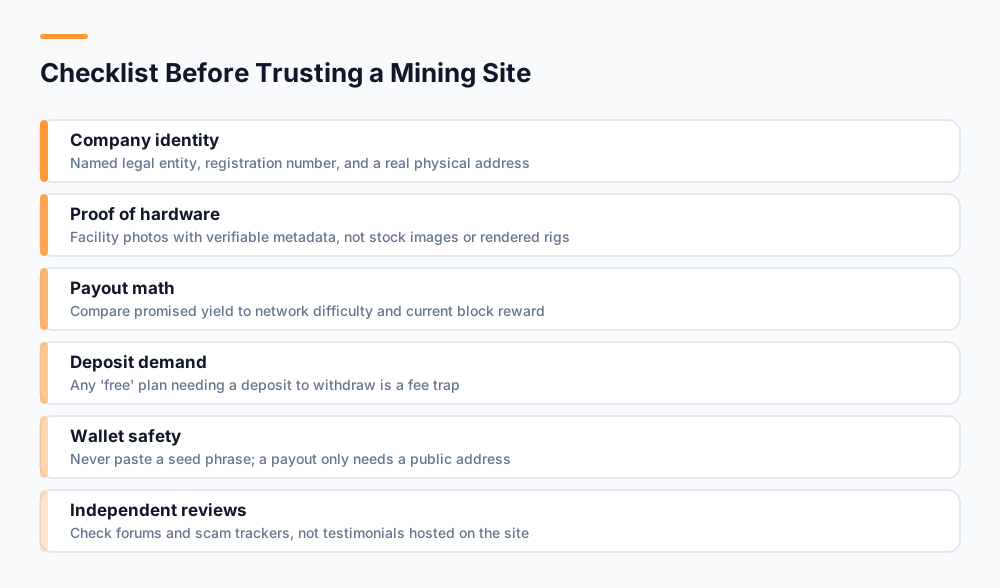
You do not need to read reviews, which go stale within months and are frequently affiliate-ordered anyway. Run these checks instead, in this order, and stop at the first failure.
- Find out whether hashing is actually happening. Open your system monitor while the site claims to be mining. If CPU usage is flat, nothing is being computed on your machine — which is fine if the site says so, and a lie if it displays a hashrate.
- Find the payout address. A real operation pays from a pool and the transactions are public. No address anywhere in the site or documentation is a serious finding in itself.
- Read the outbound history in a block explorer. You want a steady stream of small payments to many distinct addresses, with the most recent one from this week, not three transfers dated eighteen months ago.
- Calculate the implied economics. Take the advertised free rate, multiply by the claimed user count, and ask what hardware that would require. Sites advertising $1 a day to a hundred thousand users are claiming a $36 million annual payroll from nothing.
- Locate the withdrawal minimum and divide by the free daily rate. If the answer is more than a few weeks, the free tier exists to sell you the paid one.
- Search the terms of service for an inactivity clause. Many of these dashboards clear dormant balances after 30 to 90 days, which is how a balance you were slowly accumulating disappears.
- Try to withdraw at the minimum as early as possible. A platform that pays once has proven more than any testimonial page.
- Check what the site asks for. An off-store APK, broad device permissions, a seed phrase field or a signature request all end the evaluation immediately.
Step three is the one that does most of the work and it takes about two minutes once you know where to look. If you have not used one before, our guide to reading a blockchain explorer explains what the columns mean and how to distinguish money arriving from money leaving. The same technique settles the question for faucets, airdrops, staking platforms and anything else claiming to pay people on a schedule.
What "free" can honestly mean here
Strip out the fraud and the funnels and there is a narrow band of things that are genuinely free and genuinely not worth much, which is the combination you should expect. Testnet faucets hand out deliberately worthless tokens so developers can test contracts. Ad-funded faucets pay fractions of a cent for an advert impression. Distribution schedules allocate a project's own token to early users at no charge. None of these is mining, and none of them will pay for anything.
The useful thing they offer is the same in each case: a first, real, small transaction. Watching a payment confirm, seeing what an address looks like, discovering that a network fee can exceed the amount you are trying to move — those lessons cost nothing and stick better than reading about them. That is a good hour spent. The second hour, doing the same thing again for another fraction of a cent, is not.
Free mining is free in the sense that nobody charges you to start. The cost shows up later, as electricity, as attention, or as the fee that unlocks a balance that was never there.
We should state our own position rather than imply it. UNC is a scheduled-allocation app, the third model above. Your phone does not hash, the battery impact is that of a normal app session, and there is no hashrate display because there is no hashrate. The token has no listed price and no exchange listing, so nobody — including us — can tell you what an allocation is worth, and we make no promise of earnings, returns or future value. If you want to check that against the numbers rather than take our word for it, our honest assessment of mobile mining profitability works through why no phone-based scheme can produce meaningful income.
The distribution schedule, the network design and the decisions behind both are documented rather than summarised. How UNC works sets out what the app does and does not do on your device, and the whitepaper covers the structural detail. You can read all of it before installing anything, which is the order we would recommend for any site or app in this category, ours included.
Frequently asked questions
Is there a genuinely free crypto mining site that pays?
There are sites that pay small amounts and cost nothing to join, but none that pay meaningfully. Browser miners produce real hashes and real coins, yet the electricity costs roughly ten to twenty times the value produced, so you are paying to mine. Free cloud tiers pay in a balance calibrated to sit below the withdrawal minimum for months. The honest end of the category is worth cents, and any site implying otherwise is selling something.
Does browser mining actually mine anything?
Yes, technically. A WebAssembly miner really does compute hashes and submit shares to a pool, usually on RandomX because browsers cannot use graphics hardware well. The issue is scale. Around 400 hashes per second against a five-gigahash network earns roughly half a cent in 24 hours while drawing about twelve cents of electricity. The mining is genuine; the economics are not.
Are free cloud mining sites legitimate?
A minority own real hardware; most do not. The free tier is a marketing cost either way, sized so the withdrawal minimum stays months out of reach while upgrade prompts suggest paying to speed it up. The test is the payout address: a real operation is paid on-chain by a pool and its outbound transaction history is public and recent. No address, or a dead one, tells you what you need to know.
Is crypto a scam?
The underlying technology is not — a public ledger with an auditable history going back to 2009 is a verifiable thing, not a confidence trick. But the ledger offers no protection: transactions are irreversible, no institution can unwind one, and the technical surface makes convincing nonsense hard for newcomers to spot. Free mining sits at the intersection of all three properties, which is why fraud concentrates there rather than across crypto generally.
What is a crypto scam, in practical terms?
Almost all of them reduce to six structures: advance fee, credential theft, malicious token approval, deposit-and-vanish, impersonation, and recovery fraud aimed at previous victims. The surface details change constantly but the shapes do not. Every one of them requires you to send money, keys or a signature, which gives you a single rule: a genuine incoming payment never requires an outgoing one.
How do I check a mining site before signing up?
Open your system monitor to see whether any hashing is actually occurring, find the payout address, and read its outbound history in a block explorer — you want recent, frequent, small payments to many different addresses. Then divide the withdrawal minimum by the free daily rate to see how long the free tier really takes, and check the terms for an inactivity clause that clears dormant balances. Most sites fail within the first two checks.
Does UNC mine on my phone?
No. UNC allocates tokens on a published schedule rather than performing proof-of-work computation, so there is no hashing on your device and no hashrate to display. Battery use is that of an ordinary app session. The token has no listed price and no exchange listing, so we cannot and do not tell you what an allocation might be worth.
Start mining with UNC
UNC distributes tokens to verified participants — no hardware, no subscription, no battery drain. Read the whitepaper for the distribution model, or check network activity in the explorer.
Get UNC on Google Play