Getting Started
Best Crypto Faucet Sites: How to Judge Them Yourself
Most "top 10 faucet" lists are ranked by referral commission, not by payout or reliability. Since advertising revenue caps what any faucet can pay, the only ranking that means anything is which ones actually pay and stay online — and that is something you can check yourself in five minutes per site.
Type "best crypto faucet sites" into a search engine and you will get page after page of ranked lists: ten faucets, twenty faucets, a top five with star ratings and a payout column. Almost all of those lists are assembled the same way. The sites paying the largest referral commission go at the top, and the ranking is an advertising order wearing the costume of a review. That is worth knowing before you read any of them — including this one, which is why we are not going to publish a list of names.
The honest answer to the question is structural rather than a list. No faucet can pay meaningfully more than any other, for reasons that reduce to the market price of a single advert impression. What genuinely varies between faucet sites is whether they pay at all, how long they stay online, and how hard they work to extract something from you along the way. Those are the things worth ranking, and you can assess them yourself in roughly five minutes per site without trusting anybody's affiliate table.
This guide covers the economic ceiling that makes the payout column meaningless, the criteria that do separate a reliable faucet from a dead or predatory one, the four different things that get called faucets, how to verify payouts on-chain, and how to use scam reports without being misled by them. If you want the mechanics first, our explainer on what a crypto coin faucet is works through how the drip actually functions.
Why "best" is almost the wrong question
A faucet is not a mining operation and it is not charity. It is an attention business. The operator shows you an advert, gets paid by the advertiser, and hands back a slice of the proceeds as your claim. That single mechanism sets a hard ceiling on the payout, and the ceiling is the same for everyone in the business.
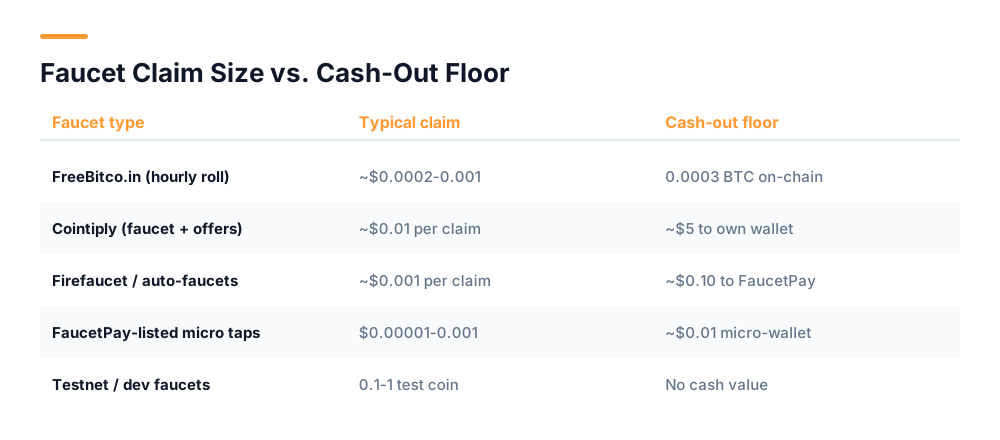
Display advertising on this kind of page is cheap inventory. Depending on your country and the format, a thousand impressions might earn the operator somewhere between roughly fifty cents and a few dollars. One page view is therefore worth around $0.0005 to $0.005 to them, before hosting, captcha services, network fees and fraud losses. Whatever reaches you is a fraction of a fraction. A faucet paying more than its ad revenue is not generous, it is temporarily subsidised or lying about the balance it shows you.
So when someone claims to have found the best crypto faucet site by payout, what they have found is a site sitting at the top of a very low band. The difference between the most and least generous honest faucet is roughly the difference between three cents an hour and a fraction of a cent an hour. Neither number changes what you should do with your afternoon.
It is also worth translating the marketing language on these sites into arithmetic, because the gap between the two is where most disappointment lives.
| What the site says | What it works out to in practice |
|---|---|
| "$0.002 per claim, every 5 minutes" | About $0.024 per hour, and only if you never miss a cooldown window |
| "Earn up to $5 a day" | Would need roughly 2,500 claims, or about 208 hours of unbroken clicking |
| "Earn 50% of your referrals' claims forever" | Half of a fraction of a cent, per referral, per claim they bother to make |
| "10x your rate with a premium account" | You deposit real money; payouts are still capped by advert revenue |
| "Instant withdrawals" | Instant once you pass the minimum, which is typically weeks of claims away |
| "Minimum withdrawal $5" | Weeks of accumulated claims held in the operator's database, not your wallet |
Notice that every advertised figure is technically true and practically useless. The rate per claim is real. The daily figure assumes a level of continuous attention nobody sustains. The referral scheme pays in the same dust. Once you accept that the payout column cannot meaningfully differ, the question changes from "which faucet pays most" to "which faucet pays anything, and what does it want in return".
What actually separates a decent faucet from a bad one
These are the criteria that vary, in rough order of how much they matter. A site failing any of the first three is not worth a single claim regardless of what it advertises.
- It pays out, verifiably, and recently — demonstrated by outbound transactions from its payout address, not by testimonials.
- It never asks for money. No activation fee, no network fee to unlock a withdrawal, no premium tier required to reach the minimum.
- It never asks for keys. No recovery words, no private key, no wallet signature on a page that is only supposed to send you something.
- The withdrawal minimum is proportionate. A threshold weeks away, combined with an inactivity clause that clears dormant balances, means your unpaid time is the product.
- It has been online long enough to have a history. A faucet three weeks old has no track record; a faucet with four years of payout transactions has one.
- Its terms say what happens to your balance if the site closes, and are honest that the answer is usually nothing.
- The claim flow is finite. If every captcha leads to another captcha and the payout page never arrives, you are generating ad impressions for free.
- It does not require an off-store app download or broad device permissions to claim.
Apply that list and most of the sites in the ranked roundups eliminate themselves, usually on the first or second criterion. What remains is a small number of long-running ad-funded sites that pay small amounts reliably, and the fact that they are reliable does not make them lucrative. Reliability and profitability are separate axes, and only one of them is available here.
Four things get called faucets, and only one is genuinely good
Testnet faucets — the actual best in class
If you want the honest answer to which faucets are best, it is the testnet ones, and it is not close. A testnet faucet hands out tokens on a test network such as Sepolia or Holesky so that developers can pay transaction fees while testing contracts. Those tokens are deliberately and permanently worthless, which is precisely what makes the faucets good: there is no advertising, no referral scheme, no withdrawal minimum and no incentive to be stingy. A typical one drips something like 0.05 test ETH per address per day, gated behind an anti-bot check such as signing in with a code-hosting account.
The best testnet faucets are the ones linked from the network's own documentation. Use those and ignore every aggregator that lists them alongside earning opportunities, because the two have nothing in common. Anyone offering to buy your testnet balance, or sell you some, is running a scam with no ambiguity about it.
Ad-funded mainnet faucets
These are what people usually mean by the term: a page that credits you a fraction of a cent in real cryptocurrency for a captcha and an advert. A handful have operated for years and pay as advertised. They are the honest end of the category, and the arithmetic above is exactly what they deliver. Treat them as a one-time demonstration of how receiving crypto works rather than as an activity.
Faucet games and multipliers
A large share of the sites in the roundups are not really faucets at all. The free claim is a funnel into a dice roll, a multiplier, or a "double your balance" wheel. The claim exists to give you a stake to gamble, and the house edge does the rest. We have written separately about how faucet games work and why the free claim is the cheapest customer acquisition in the industry; if a site has a game attached, evaluate it as gambling, because that is what it is.
Project distribution faucets
Occasionally a new project runs a faucet to get its own token into circulation, which is closer to the original purpose of the format — the first Bitcoin faucet in 2010 existed to distribute coins nobody held, not to pay anyone. The catch is that a token being given away freely by its own issuer usually has no market, so the amount you receive may be unpriceable rather than small. That is not necessarily dishonest, but it is not income either.
| Testnet faucet | Ad-funded faucet | Faucet game | Project faucet | |
|---|---|---|---|---|
| Token has market value | No, by design | Yes, tiny amounts | Yes, tiny amounts | Often none at all |
| What it wants from you | Nothing | Advert impressions | Your free stake, then a deposit | An address and often an email |
| Realistic value to you | Essential if you write code | A one-off learning exercise | Negative on average | Unknowable |
| Main risk | Almost none | Site closes holding your balance | Losing deposits to the house edge | Token never trades anywhere |
| Payment ever required | Never | Never legitimately | Yes, that is the business | Never legitimately |
How to check a faucet before you give it hours
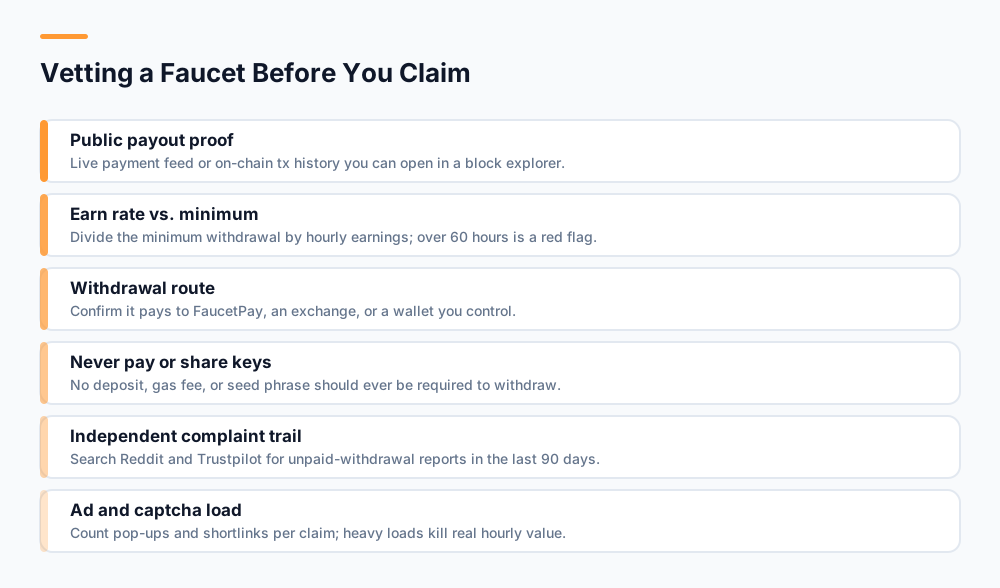
Reviews go stale within months because faucets close constantly. On-chain records do not go stale, and checking them is faster than reading a roundup.
- Find the payout address. Most faucets publish it, or you can take it from the transaction of a single small test withdrawal once you reach the minimum.
- Look the address up in a block explorer and read the outbound transaction history.
- Check the date of the most recent outbound payment. If the last one was eight months ago, the site is collecting ad revenue and paying nobody.
- Check the frequency and size. A healthy faucet shows a steady stream of small payments to many different addresses, not three transactions from launch week.
- Search the domain for a change of ownership or a sudden redesign, which often precedes a payout freeze.
- Read the terms for an inactivity clause, and note how long a dormant balance survives.
- Make one withdrawal at the minimum before accumulating anything larger. A site that pays five dollars once has proven more than any review can.
The explorer step is the one that does the work, and it takes about two minutes. If you have not used one before, our guide to reading a blockchain explorer covers what the columns mean and how to tell an inbound payment from an outbound one. The same technique answers the question for mining apps, airdrops and anything else that claims to send people money on a schedule.
Using scam reports and Reddit threads carefully
Searching the site name alongside the word scam is a reasonable second step, and a crypto scam reddit thread is often the only place a small faucet's payout freeze gets documented at all. Subreddits dedicated to scams and to beginner crypto questions tend to surface the specific complaint you need: not "is this legit" in the abstract, but "I hit the minimum in March and the withdrawal has been pending since".
Read those threads with a few caveats in mind, because the same incentives that corrupt the ranked lists operate in forums too.
- Posts promoting a faucet frequently contain a referral link. The enthusiasm is compensated.
- Accounts a few days old, with no history outside crypto threads, recommending a specific site, are marketing.
- An absence of complaints is not evidence of safety. A three-week-old faucet has not had time to fail publicly yet.
- Complaints older than a year may describe a site that has since changed hands, or a problem that was fixed.
- The useful posts are specific: dates, amounts, screenshots of a pending withdrawal, the payout address. Vague warnings and vague praise are equally worthless.
- Cross-check anything you read against the on-chain record, which cannot be astroturfed.
One pattern shows up in these threads more than any other, and it is the pay-to-withdraw demand: a large balance accumulates, then a fee is required to release it. That is the giveaway scam playbook applied to faucets, and the balance was never real in the first place. The fee is the entire product.
Where the payouts should land, and the Cash App question
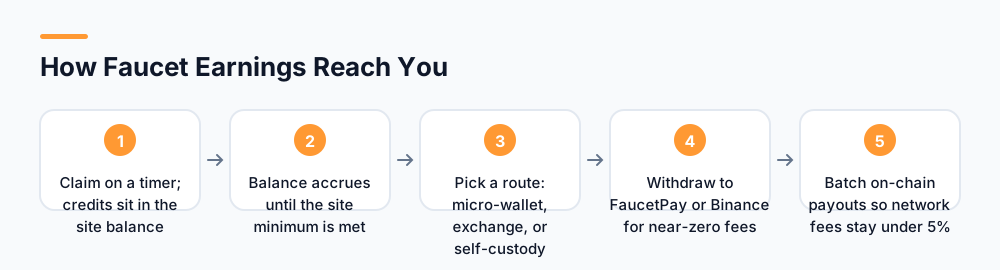
Every faucet needs somewhere to send the coins, which means you need a receiving address. Only your public address should ever leave your device — it is closer to an account number, and anyone holding it can send you funds and view your on-chain history but cannot spend anything. A self-custodial wallet is the usual choice, and for amounts this small it is also the most forgiving, because there is no account to be closed and no minimum deposit to fall below.
People often ask whether they can point a faucet at a cash app crypto wallet instead, since it is the crypto balance they already have. Mechanically it can work for Bitcoin — the app gives you a bitcoin address you can receive to — but it is a poor fit for faucet payouts for three reasons. It supports Bitcoin only, so any faucet paying a different asset is out. It is a custodial balance inside a regulated financial app tied to your verified identity, which means deposits sit in a compliance context that dust from an anonymous ad-funded website does not belong in. And on-chain network fees do not shrink to match small transfers, so a five-dollar withdrawal can be substantially eaten by the fee before it arrives. If you are unsure why identity verification matters here, our note on what KYC means in crypto explains what these platforms are required to check.
One rule overrides all of the above. No faucet, honest or otherwise, has any use for your recovery passphrase, because sending you funds only ever requires a destination address. A form asking for twelve or twenty-four words to "verify" or "connect" your wallet is theft in progress, and no version of the explanation makes it otherwise.
The red flags that end the evaluation immediately
- Any request for payment — activation, verification, network fee, premium upgrade — before a withdrawal can be processed.
- Any request for seed words, a private key, or an exchange password.
- A wallet connect prompt that then asks you to sign a token approval. You are being asked to grant spending authority, not to receive anything.
- An app distributed as a direct download rather than through an official store, particularly one requesting broad device permissions.
- Payout figures that imply meaningful hourly income, which the advertising ceiling makes arithmetically impossible.
- A balance that grows suspiciously fast while the withdrawal button stays greyed out.
- Support reachable only through a messaging app, with a "support agent" who contacts you first.
- Testnet tokens presented as having value, or offers to buy and sell them.
Most of these need no judgement call at all. Free means free, including free of fees, and a genuine incoming payment never requires you to authorise, deposit or sign anything.
So which are the best crypto faucet sites?
For developers: the testnet faucets in your network's official documentation, without qualification. They are free, they work, and they are the only faucets in this article with a clear purpose.
For everyone else: the best one is whichever long-running site you can verify still pays, and the reward for finding it is a few cents an hour. Use it once, deliberately, as a lab exercise. Receiving a real fraction of a coin teaches things reading cannot — what an address looks like, how long confirmation takes, why a fee can exceed the amount you are trying to move, and how a wallet displays a balance too small to spend. That is a genuinely worthwhile hour. The second hour is not.
Ranked faucet lists sort by referral commission. The on-chain payout history sorts by whether the site pays. Only one of those is a review.
We should be direct about our own category rather than leave it implied, since mining apps get compared to faucets constantly. Phone-based mining is not lucrative either, and our honest look at mobile mining profitability works through the numbers instead of gesturing at them. The reason to be interested in any of this is curiosity about how distribution and networks function, not a revenue expectation.
For completeness: UNC is not a faucet. There is no claim button, no advert-per-drip loop, and no dice game attached to a free credit. Allocation follows a published schedule, and how UNC works sets out that schedule alongside what the app does and does not do on your device. The token has no listed price and no exchange listing, so nobody — us included — can tell you what an allocation is worth, and we do not promise earnings, returns or future value.
If you would rather read the structural detail than the summary, the UNC whitepaper documents the network design and the distribution model, and you can read all of it before installing anything.
Frequently asked questions
What are the best crypto faucet sites in 2026?
For developers, the best faucets are the testnet ones linked from a network's own documentation, such as the Sepolia faucets — they are free, reliable and have a clear purpose. For real cryptocurrency, the best site is simply whichever long-running ad-funded faucet you can verify is still paying out on-chain. There is no faucet that pays meaningfully more than the rest, because advertising revenue caps them all at fractions of a cent per claim.
Why do all the "top 10 faucet" lists disagree with each other?
Because most of them are ordered by referral commission rather than by payout or reliability. The site paying the largest cut for each signup goes at the top. That is why the same handful of faucets appear in different orders across different lists, and why a payout column in a roundup tells you less than two minutes spent checking the faucet's payout address in a block explorer.
How do I tell if a faucet site is a scam?
Three checks eliminate almost all of them. Does it ask for money at any point — an activation fee, a network fee to unlock a withdrawal, a premium tier? Does it ask for your seed words or a token approval signature? And does its payout address show recent outbound transactions in a block explorer? A site that fails any of those is not worth a single claim, regardless of its reviews.
Can I send faucet payouts to my Cash App crypto wallet?
For Bitcoin it can work mechanically, since the app provides a bitcoin address you can receive to, but it is a poor destination for faucet dust. It supports Bitcoin only, it is a custodial balance tied to your verified identity inside a regulated app, and on-chain network fees do not shrink to match small transfers, so a minimum withdrawal can be largely consumed by the fee. A self-custodial wallet is usually the better place for amounts this small.
Are Reddit scam threads a reliable way to check a faucet?
They are useful as a second step, not a first one. Specific posts with dates, amounts and a pending withdrawal screenshot are genuinely informative, and forums are often the only place a small faucet's payout freeze gets documented. But promotional posts frequently carry referral links, new accounts recommending a single site are marketing, and an absence of complaints only means a site has not had time to fail publicly. Always cross-check against the on-chain record.
How much can you realistically earn from the best faucet?
At the generous end, around two to three cents per hour of continuous clicking, which means roughly 200 hours to reach a typical five-dollar withdrawal minimum. Most faucets pay considerably less. The ceiling is set by what one advert impression is worth to the operator, so no faucet can escape it, and any site implying meaningful daily income is either counting referral recruitment or making it up.
Start mining with UNC
UNC distributes tokens to verified participants — no hardware, no subscription, no battery drain. Read the whitepaper for the distribution model, or check network activity in the explorer.
Get UNC on Google Play