Getting Started
Crypto Faucet Game: How the Payouts Actually Work
A crypto faucet game wraps a faucet in a spin wheel, an arcade round or a tap-to-mine simulator. The game part is real; the earnings part is capped by what an advert is worth. Here is the arithmetic, the formats you will meet, and the scam pipeline that ends at a cash kiosk.
A crypto faucet game is a website or mobile app that gives out very small amounts of cryptocurrency for playing something — spinning a wheel, tapping a screen, clearing a puzzle round, running an idle mining simulator. It is the same mechanism as an ordinary faucet with a layer of entertainment bolted on top, and the entertainment exists for a specific commercial reason: it keeps you on the page long enough to see more adverts.
That is not a criticism. Plenty of these games are perfectly honest about being ad-funded, and some of them are genuinely fun for ten minutes. But the format is routinely marketed as a way to earn, and the arithmetic behind it is almost never shown. This guide shows it: what the formats are, what each realistically pays per hour, why an advertising ceiling makes bigger payouts impossible, and how the fake versions separate people from money — including the specific pipeline that ends with someone standing at a cash kiosk.
What a crypto faucet game actually is
The plain version of the idea has been around since 2010. A crypto currency faucet is a page that drips out fractions of a coin in exchange for a click and a captcha, funded by the adverts shown alongside. The drip is small because the advert is cheap. If you want the full history and the underlying model, our explainer on what a crypto coin faucet is works through where the format came from and why payouts collapsed as prices rose.
The game version changes one variable. A plain faucet gets one page view per claim, and claims are throttled by a cooldown timer, so the operator can only sell your attention once every five or ten minutes. Wrap it in a game and you get engagement in between: more screens, more ad slots, more rewarded video placements, and a much better chance you come back tomorrow. The player-facing story is "play and earn". The operator-facing story is retention.
Understanding that inversion is the single most useful thing on this page. You are not the customer of a faucet game and you are not really its worker either. You are the inventory. Everything about how much it pays, how long the cooldowns run, and why the withdrawal minimum sits just out of reach follows from that one fact.
The four formats you will actually meet
Timed claim with a spin wheel
The oldest and simplest. A countdown runs, you claim, and a wheel or dice roll decides whether you get the base amount or a rare multiplier. The randomness is the whole design: variable rewards keep people clicking far longer than a fixed payout would, which is the same psychology used in slot machines. The expected value is set by the operator, and it is a fraction of a cent regardless of how the wheel feels.
Arcade and HTML5 rounds
A short playable round — a runner, a match-three, a shooter — with points converted to satoshis or a project coin at a published rate. These typically show an interstitial advert between rounds. Some are genuinely well made. The conversion rate is where the honesty lives: read it before you play, and convert it into money per hour yourself rather than trusting the leaderboard numbers.
Idle and tap mining simulators
These imitate a mining rig: a counter ticks up, you tap to boost it, and you watch rewarded video adverts to unlock multipliers. Nothing is being mined. No hashing occurs, no block is found, and the "hashrate" is a number in a database. That is worth saying plainly because these apps borrow mining vocabulary so heavily that people genuinely believe their phone is computing something.
Play-to-earn with a buy-in
The odd one out, and the one that costs people money rather than time. You buy an NFT character, a starter pack or a quantity of the game coin before you can earn. Rewards are then paid in that same coin. If the only sustained demand for the coin comes from new players buying in, the structure is a queue rather than a game, and the people at the back fund the people at the front. A faucet game that requires payment before you can play is not a faucet at all.
A faucet that charges an entry fee is not a faucet
The defining property of the format is that it costs you nothing but attention. Any buy-in, activation fee, premium tier or "unlock withdrawals" payment inverts the model and puts your money at risk instead of the operator's ad budget.
The economics: what an advert is worth, and what that caps
Every honest faucet game pays you out of advertising revenue, so the payout ceiling is simply the value of the adverts you consume, minus the operator's costs and margin. Nothing else funds it. Once you can estimate that number, the payout figures stop looking arbitrary and start looking inevitable.
Banner and interstitial adverts on this kind of property are cheap. A thousand impressions might earn the operator somewhere between fifty cents and a few dollars in a US audience, so a single view is worth roughly $0.0005 to $0.005. Rewarded video — the "watch an advert to double your reward" prompt — is the most valuable format in mobile gaming and can run considerably higher, perhaps one to three cents per completed view in a good US market. That is the top of the range, and it is the entire pot.
So take the best case honestly. Suppose you watch twenty rewarded videos in a day, which is roughly the point where fill rates and your own patience both give out. At two cents each, the operator grosses about forty cents from you. After ad network fees, hosting, withdrawal transaction fees and any margin, passing on a quarter of that would be generous — call it ten cents for maybe half an hour of tapping. That is the ceiling of the honest case, not the typical case.
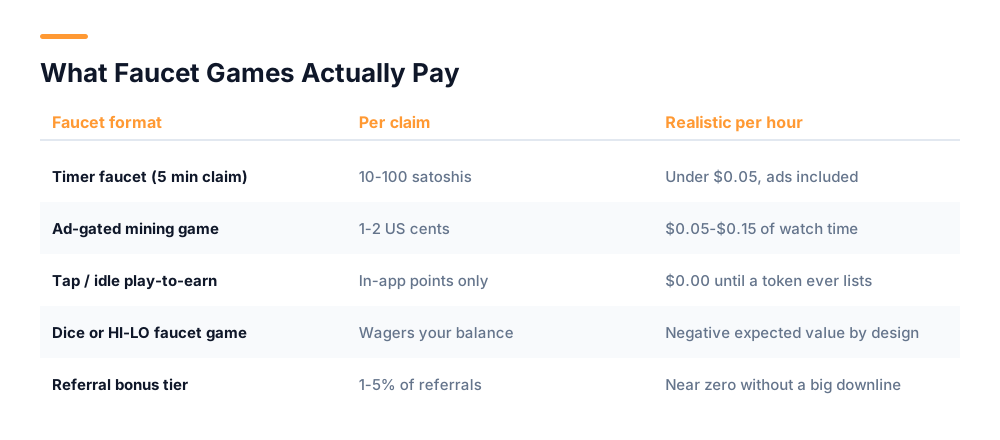
Here is what that looks like across the formats, with the last column being the one that matters — how long it takes to reach a withdrawal minimum you can actually collect.
| Format | What you do | Realistic payout | Time cost | To reach a $10 minimum |
|---|---|---|---|---|
| Timed claim + spin wheel | Click, captcha, view a banner | $0.0003–$0.001 per claim | 5–10 min cooldown | 10,000–33,000 claims |
| Arcade / HTML5 round | Play a round, watch an interstitial | $0.0005–$0.002 per round | 2–5 min per round | 5,000–20,000 rounds |
| Idle / tap mining sim | Tap, then watch rewarded videos | $0.02–$0.10 per active day | 15–30 min per day | 100–500 days |
| Play-to-earn with buy-in | Pay first, then play | Depends on new players joining | Ongoing | Frequently never |
Run the arcade row properly. At $0.001 per round and three minutes a round, that is twenty rounds an hour and two cents an hour. Reaching ten dollars takes roughly five hundred hours of active play. Five hundred hours at the US federal minimum wage is about $3,600. You would be trading three and a half thousand dollars of time for ten, and that is the optimistic end of the range, assuming the site is still paying when you get there.
The idle row looks better because it is less demanding, but the number to hold onto is still $0.02 to $0.10 a day at the generous end. Over a full year of never missing a session, that is roughly seven to thirty-six dollars, and it assumes the app survives the year, the coin holds whatever value it had, and the withdrawal actually processes. Three assumptions, each of which fails routinely.
The withdrawal minimum is doing real work
Faucet games credit a database number, not a blockchain transaction, because a payout worth $0.001 cannot cover a network fee of thirty cents. Batching is genuinely necessary. It also means every player who quits before the threshold generated ad revenue and cost the operator nothing.
You do not have to take anyone's word for whether a game pays. Most publish the address they send withdrawals from, and a blockchain explorer will show you every outbound transfer that address has ever made, including the date the payments stopped. Two minutes of checking beats a page of five-star reviews, all of which can be bought.
What is a web3 wallet, and why does the game want your address?
Every faucet game has to ask where to send the coins, which raises a question worth answering properly rather than skipping: what is web3 wallet software actually doing? A web3 wallet stores your private keys, uses them to sign transactions, and provides a connection layer so websites and apps can ask you to sign things.
The word "wallet" misleads people. Your coins are not inside it. They are entries on a blockchain, and the wallet holds the cryptographic keys that prove you are entitled to move those entries. Reinstalling the app is survivable. Losing the keys is not, and no support desk anywhere can reverse it.
Two things a game might ask for, and the difference between them is the whole of your security. Your public address is safe to share — it works like an account number, letting anyone send you funds and view your on-chain history without being able to spend anything. Your private key and the seed words that generate it authorise spending. Handing those over is not a risk of loss; it is the loss.
No legitimate game, faucet or exchange has any technical use for your recovery passphrase, because sending you funds only ever requires a destination address. A form asking for twelve or twenty-four words to "sync", "verify" or "restore" your balance is theft in progress, and there is no framing that makes it otherwise.
There is also a difference between connecting a wallet and approving a transaction. Connecting reveals your address and little else. The danger is the prompt that follows: if a claim screen asks you to sign something granting permission to transfer your coins, reject it. Receiving a payment never requires you to authorise anything.
How fake faucet games take money
The category attracts fraud because its audience self-selects: people who want crypto but do not want to pay for it, which usually means beginners. The schemes are built for exactly that. Most of them are recognisable in a few seconds once you know the shapes.
- Seed phrase harvesting — a "connect your wallet" form that asks for your recovery words instead of your address. The most damaging variant and the easiest to spot.
- Unlock fees — a large balance accumulates suspiciously fast, then withdrawal requires a network fee, activation payment or verification deposit. The balance was never real; the fee is the product.
- Approval drainers — a claim button that prompts a coin approval signature, granting spending authority over what you already hold.
- The endless captcha — the withdrawal page never quite loads, but the ad impressions keep counting. You are working for free rather than being robbed.
- Off-store installs — a mining or faucet game distributed as a direct APK download with broad device permissions. Treat anything outside an official store as hostile.
- Referral pyramids — payouts that only become meaningful once you recruit, meaning players fund each other while the operator funds nobody.
- Fake in-game upgrades — paying real crypto for a multiplier that increases a number in a database you do not control.
One rule disposes of most of them without any judgement call. If you are asked to send crypto before you can receive crypto, the answer is no, every time. That is the same playbook as crypto giveaway scams, where the promise of a large payout is used to extract a small "verification" payment first.
When it escalates: the crypto ATM scam
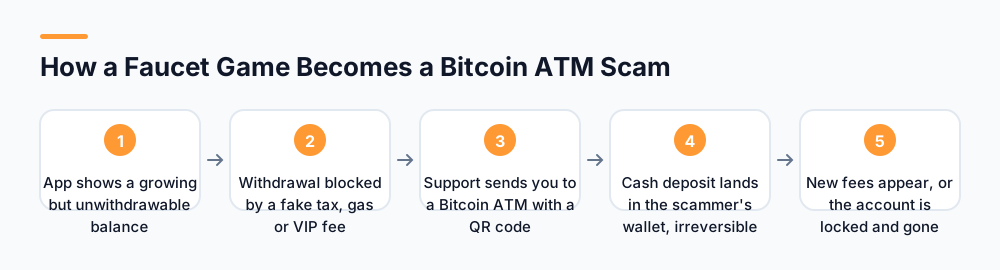
This is the part of the pipeline most faucet game guides never mention, and it is where the real money is lost. A crypto ATM scam begins when someone — a support agent from the game, a stranger from a chat group, a voice on the phone — tells you to deposit cash at a cryptocurrency kiosk in a shop or petrol station, scan a QR code they provide, and send the funds to "activate", "verify" or "release" your balance.
Kiosks are attractive to fraudsters for structural reasons. The deposit is cash, so there is no card issuer to charge back. The transaction is a blockchain transfer, so it is irreversible the moment it confirms. The QR code hides the destination address behind an image, so the victim never reads where the money is going. And the machine is in a physical location, which lends the whole thing an air of officialdom it has not earned.
US authorities have repeatedly warned about this channel, and reported losses through kiosk-based fraud run into the hundreds of millions of dollars a year. The same script is used for romance fraud, fake tech support, false arrest warrants and impersonated government agencies. The faucet game version is simply one entry point among many into the same funnel.
Nobody legitimate will ever send you to a crypto ATM
No government agency, police force, utility, employer, exchange or game support desk will ask you to deposit cash at a kiosk. If someone gives you a QR code and directions to a machine, the conversation is a scam in progress regardless of how plausible everything before it sounded.
Kiosks do have a legitimate use — buying a small amount of crypto with cash for yourself — but the economics are poor. Fees and the exchange rate spread commonly total ten to twenty per cent, which is many times what an ordinary exchange charges. If you are using one at all, it should be your idea, on your own schedule, with a destination address you typed and checked yourself.
A five-minute check before you play anything
- Find the withdrawal minimum and the payout rate, then divide. Convert the game's own numbers into dollars per hour before you invest any time; if the rate is not published, that itself is the answer.
- Look up the payout address in a block explorer and check that outbound payments are recent and regular, not stopped four months ago.
- Install only from an official app store, and read the permissions. A tapping game has no legitimate need for your contacts, SMS or accessibility services.
- Create a fresh wallet with nothing in it for faucet games and airdrops. If a connection or approval goes wrong, there is nothing at that address to take.
- Search the name alongside "not paying" and "withdrawal" rather than "review". Complaint threads carry more signal than affiliate rankings.
- Assume any accumulated balance can vanish. Faucet games appear and disappear constantly, and there is no deposit protection of any kind.
So is a crypto faucet game worth playing?
As a way to earn money, no, and the arithmetic is not a matter of opinion. Two cents an hour with a withdrawal threshold hundreds of hours away is not an activity that rewards optimisation. If the game is fun, play it for the game. If it stops being fun and you keep going because of the balance, the retention mechanics have done exactly what they were designed to do.
As a way to learn, one session has real value. Receiving an actual fraction of a coin teaches things reading cannot: what an address looks like, how long a confirmation takes, why a network fee can exceed the amount being sent, and what a balance too small to move feels like in a wallet. That is a worthwhile hour and it costs nothing but attention.
A faucet game sells your attention and returns a slice of the proceeds. Attention is cheap, so the slice is small. That is not a flaw in any particular game — it is the entire mechanism.
It would be inconsistent to make that argument and then exempt our own category, so we will not. Phone-based mining is not lucrative either, and our honest look at mobile mining profitability works through the numbers rather than gesturing at them. The reason to be interested in any of this is curiosity about how distribution and networks function, not an income expectation.
For completeness: UNC is not a faucet game. There is no spin wheel, no rewarded video loop, no multiplier to buy and no referral commission tier. Allocation follows a published schedule, and how UNC works sets out that schedule alongside what the app does and does not do on your device.
We should also be plain about the limits. UNC has no listed price and no exchange listing, so nobody — us included — can tell you what an allocation is worth, and we do not promise earnings, returns or future value. If you want the structural detail rather than the summary, the UNC whitepaper documents the network design and distribution model, and it is there to read before you install anything.
Frequently asked questions
What is a crypto faucet game?
A crypto faucet game is a website or app that gives out very small amounts of cryptocurrency for playing something — a spin wheel, a short arcade round, or a tap-to-mine simulator. It is an ordinary faucet with entertainment added to increase the number of adverts you see. The game is real; the earnings are capped by advertising revenue.
How much can you actually earn from a crypto faucet game?
Realistically a fraction of a cent per round, or a few cents a day from an idle app with rewarded video adverts. An arcade-style game paying $0.001 per three-minute round earns about two cents an hour, meaning roughly 500 hours of play to reach a $10 withdrawal minimum. No faucet game provides meaningful income.
Are crypto faucet games legitimate?
Some pay as advertised and many do not. The reliable warning signs are a required buy-in, a fee to unlock withdrawals, a request for your recovery words, or a coin approval prompt on a claim page. You can check whether a game still pays by looking up its published payout address in a block explorer and seeing whether outbound transfers are recent.
What is a web3 wallet and do I need one to play?
A web3 wallet is software that stores your private keys, signs transactions and lets you connect to on-chain applications. Your coins live on the blockchain, not inside the app. You need one to receive payouts, but you only ever share your public address — never the private key or the seed words, which no legitimate service requires.
What is a crypto ATM scam and how does it start?
A crypto ATM scam is when someone directs you to deposit cash at a cryptocurrency kiosk and scan a QR code they supply, usually to "verify" or "release" a balance. Cash deposits cannot be charged back, blockchain transfers cannot be reversed, and the QR code hides the destination address. No legitimate organisation ever asks you to use a kiosk this way.
Is a tap-to-mine game the same as real crypto mining?
No. Idle and tap mining simulators do no hashing at all; the hashrate is a number in a database and the rewards come from advertising. Real mining involves computation that secures a network. Both mobile mining apps and faucet games distribute small allocations, and neither is a route to meaningful income.
Start mining with UNC
UNC distributes coins to verified participants — no hardware, no subscription, no battery drain. Read the whitepaper for the distribution model, or check network activity in the explorer.
Get UNC on Google Play