Getting Started
What Is a Crypto Coin Faucet? An Honest Look at Free Crypto
A crypto coin faucet drips out fractions of a cent in exchange for your attention. That makes it a useful way to see how wallets and transactions work, and a terrible way to earn money. Here is the arithmetic, plus the difference between a mainnet faucet, a testnet faucet, and a fake one.
A crypto coin faucet is a website or app that hands out very small amounts of cryptocurrency for free, usually in return for watching an advert, solving a captcha, or clicking a button once an hour. The name comes from the image of a dripping tap: what comes out arrives one drop at a time.
Faucets have a genuine and interesting history, a real technical purpose, and an economic ceiling that almost nobody explains clearly. This guide covers all three, works through the actual arithmetic of what a faucet can pay, separates the developer version from the consumer version, and lists the specific ways fake faucets take money from people who came looking for free crypto.
What a crypto coin faucet actually is
You will see the phrase written both ways in search results — crypto faucet and faucet crypto — and they refer to the same idea. But two very different things share the label, and conflating them causes most of the confusion around the topic.
The first kind is a mainnet faucet. It distributes real cryptocurrency on a live network, in amounts measured in fractions of a cent. It is funded by advertising, referral commissions, or sometimes by a project trying to get its token into circulation. The coins are real; the quantities are tiny.
The second kind is a testnet faucet. It distributes coins on a test network, and those coins are deliberately, permanently worthless. They exist so developers can deploy and test contracts without spending real money. A testnet faucet is a piece of infrastructure, not an offer.
The two kinds are not interchangeable
Test coins cannot be converted to real ones, sold, or bridged to a live network. If anyone offers to buy your testnet balance or sell you some, that is a scam with no ambiguity about it.
Where faucets came from, and why the payouts collapsed
The original was the Bitcoin Faucet, launched in mid-2010 by an early Bitcoin developer. It gave five whole bitcoin to every visitor who asked. At the time this was not extravagant, because bitcoin had barely any market price and the problem facing the network was the opposite of scarcity: almost nobody held any, so almost nobody could experiment with sending it.
That is the important point about the first faucet. Its purpose was distribution, not income. Getting coins into the hands of curious people meant more wallets installed, more transactions broadcast, and more eyes on whether the thing worked at all. The giveaway was a bootstrapping cost.
As prices rose, that model became impossible. Five bitcoin per visitor stopped being a rounding error and became a fortune, so payouts were cut, then cut again, then denominated in ever smaller fractions. What survived was the format without the generosity: a page that gives you something, funded by showing you adverts. Every modern faucet is a descendant of that shift, and the shift is why the numbers look the way they do today.
The economics: why faucet payouts are structurally tiny
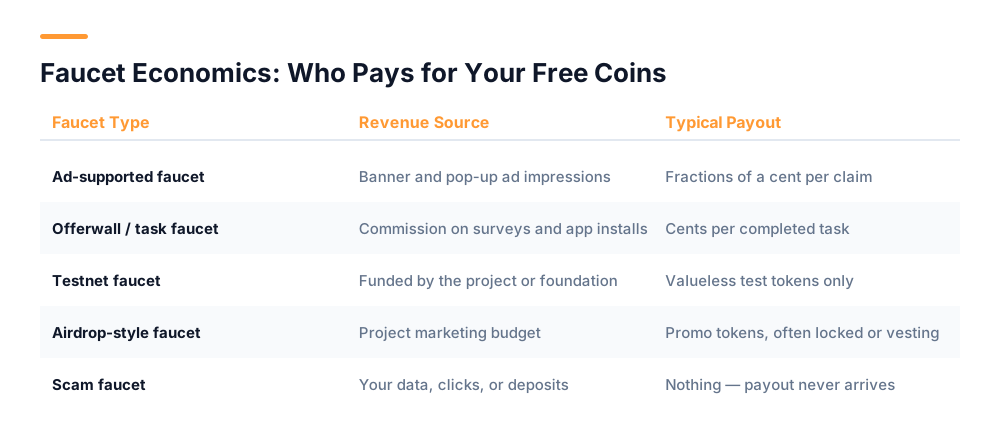
A faucet is not charity and it is not a mining operation. It is an attention business. The operator sells your page view to an advertiser and gives you back a slice of the proceeds. That single fact sets a hard ceiling on what any honest faucet can ever pay you.
Display advertising on this kind of site is not valuable. Depending on your country and the ad format, a thousand impressions might earn the operator somewhere between roughly fifty cents and a few dollars. That means one page view is worth perhaps $0.0005 to $0.005 to them. To stay in business they must pay you less than that, after their own costs. So the payout is capped not by the operator's generosity but by the market price of one advert shown to one person, which is a fraction of a cent.
Once you see that, the payout figures stop looking arbitrary. Here is what the arithmetic looks like across the range of faucets you will actually encounter.
| Faucet type | Per claim | Claims per hour | Earned per hour | Claims to reach a $5 minimum |
|---|---|---|---|---|
| Generous | $0.002 | 12 (5-minute cooldown) | $0.024 | 2,500 |
| Typical | $0.0005 | 6 (10-minute cooldown) | $0.003 | 10,000 |
| Low-payout | $0.0001 | 4 (15-minute cooldown) | $0.0004 | 50,000 |
Read the right-hand column carefully, because it is the one that matters. In the generous case you would need 2,500 claims to reach a five-dollar withdrawal minimum. At twelve claims an hour, sitting at the screen and clicking through every cooldown, that is roughly 208 hours of continuous attention — about five full working weeks — for five dollars. In the typical case it is closer to 1,600 hours. In the low-payout case the answer is over 12,000 hours, which is not a realistic activity, it is a hypothetical.
And these figures are optimistic. They assume you never miss a cooldown window, that the captcha resolves first time, that the ad loads, and that the faucet is still operating months later. In practice, faucet sites appear and vanish constantly, and an accumulated balance on a site that closes is simply gone.
Nobody earns a living from faucets
Any site, video or referral link claiming meaningful daily income from faucets is either counting referral commissions from people they recruited, or making it up. The advertising ceiling makes real income arithmetically impossible.
Minimum withdrawals, dust, and the fee problem
Faucets do not send you a blockchain transaction every time you claim. They credit a number in their own database and hold it until you reach a minimum withdrawal amount. This is often described as if it were a restriction imposed for the operator's convenience, and partly it is — but there is also a real technical reason.
Sending cryptocurrency costs a network fee, and that fee does not shrink to match the amount you are sending. If a transfer costs thirty cents in fees, it is physically impossible to pay out a claim worth $0.0005; the fee would be six hundred times the payment. Amounts too small to move economically are called dust, and every faucet payout on its own is dust. Batching claims into one larger withdrawal is the only way the transfer makes sense at all.
The threshold also does convenient business work. Every user who abandons the site before reaching the minimum costs the operator nothing while still having generated ad revenue. Some faucets add inactivity clauses that clear balances after a period of no visits, which converts abandonment into pure margin. That is not necessarily fraud, but it should inform how much unpaid time you are willing to bank with any single site.
Before you invest hours, check whether payouts actually happen. Most faucets publish the address they pay from, and a blockchain explorer will show you every transfer that address has ever made — including whether the outbound payments stopped six months ago. This takes two minutes and settles the question better than any review site.
Testnet faucets: the version that is genuinely useful
If you write code that touches a blockchain, faucets are not a curiosity but a daily tool. Ethereum test networks such as Sepolia mirror the real network closely enough to be useful for development, and you need the test network's native coin to pay for transactions on it. A testnet faucet supplies that coin.
Because test coins have no value, testnet faucets have no incentive to be stingy — they typically drip something like 0.05 test ETH per address per day. Their problem is abuse rather than cost: bots draining the supply. So most gate access behind something a bot finds awkward, such as signing in with a code-hosting account, or holding a small balance on the real network to prove the address is not freshly created.
The typical process is short:
- Install a wallet and switch it to the test network you need. The network usually has to be selected explicitly, since wallets default to mainnet.
- Copy your public address from the wallet. This is the string beginning 0x on Ethereum-style networks.
- Paste it into the faucet, complete whatever anti-bot check it uses, and submit the request.
- Wait for the transaction to confirm, usually within a minute or two.
- Verify the balance in a testnet block explorer rather than trusting the faucet's success message, since a queued request is not the same as a completed one.
Test coins are worth exactly nothing
This is by design, not an oversight. It is what makes them safe to experiment with. Test networks are also periodically retired, which wipes the balances — another reason nobody should treat them as an asset.
What is a web3 wallet, and why does a faucet want your address?
Every faucet asks where to send the coins, which means you need somewhere to receive them. That raises a question worth answering properly, because it underpins almost everything else in crypto: what is a web3 wallet?
A web3 wallet is software that stores your private keys and uses them to sign transactions, plus a connection layer that lets websites and applications ask you to sign things. The word "wallet" is slightly misleading. Your coins are not inside it. They are entries on a blockchain, and the wallet holds the cryptographic keys that prove you are allowed to move those entries. Losing the wallet app is recoverable; losing the keys is not.
Web3 wallet versus exchange account
An exchange account is custodial: the exchange holds the keys and your balance is a claim against the company, much like a bank balance. A web3 wallet is self-custodial: you hold the keys, nobody can freeze your funds, and equally nobody can restore your access if you lose them. Both arrangements are legitimate, but they fail in opposite directions, and it is worth being deliberate about which one you are using for what.
Public address safe, private key never
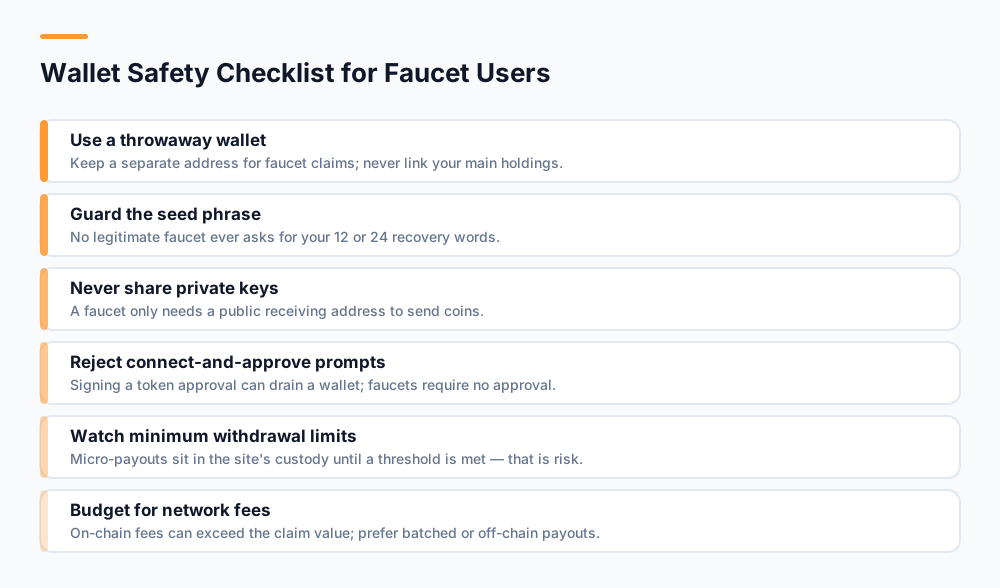
A wallet gives you two things you might be asked for, and the difference is everything. Your public address is safe to hand out — it is closer to an account number, and anyone who has it can send you funds and view your on-chain history, but cannot spend anything. Your private key, and the seed words that generate it, authorise spending. Giving those away is not a risk of loss; it is the loss itself.
No faucet, legitimate or otherwise, has any use for your recovery passphrase. There is no technical circumstance in which a site needs it to send you funds, because sending only ever requires the destination address. A request for those words is theft in progress, and there is no version of the story that makes it otherwise.
Connecting versus approving
Some faucet-style sites ask you to connect a wallet rather than paste an address. Connecting by itself reveals your address and little else. The danger is the next prompt. If a site asks you to sign a transaction granting permission to spend or transfer your coins, and you expected only to receive something, reject it. A genuine incoming payment never requires you to authorise anything at all.
How fake faucets take money from people looking for free crypto
The faucet category attracts fraud precisely because its audience is, by definition, people who want crypto but do not want to pay for it. That is a self-selecting group of beginners, and the schemes are built for them.
- Seed phrase harvesting — a form asking for your twelve or twenty-four recovery words to "verify your wallet" or "connect your balance". This is the single most damaging variant and the easiest to recognise.
- Unlock fees — you accumulate a large-looking balance, then discover a network fee, activation fee or verification deposit is required before withdrawal. The balance was never real; the fee is the entire product.
- Approval drainers — a claim page that asks you to sign a coin approval. You are not receiving anything; you are granting spending authority over your existing balance.
- Endless captchas — the payout page never arrives, but the ad impressions keep counting. You are working for free, which is a mild scam rather than a catastrophic one.
- Off-store app installs — a mining or faucet app distributed as a direct download, requesting broad device permissions. Treat any app not obtained from an official store as hostile.
- Data harvesting — an email address, a wallet address and an IP, collected and resold. The consequence arrives later as targeted phishing that knows what you hold.
- Referral pyramids — payouts that only become meaningful if you recruit others, which means the participants are funding each other rather than the operator funding anyone.
One rule dispatches most of these without any judgement call. Any site that asks you to send crypto first, pay to unlock a withdrawal, or buy a premium tier for higher payouts is running the standard playbook, and the outcome is known in advance. Free means free, including free of fees.
Faucets compared with the alternatives
Faucets are frequently discussed alongside airdrops and mining apps, as though they were competing routes to the same destination. They are not really comparable, and the table makes clear why.
| Mainnet faucet | Testnet faucet | Airdrop | Mining app | |
|---|---|---|---|---|
| Coin has market value | Yes, but tiny amounts | No, by design | Sometimes | Depends entirely on the project |
| What you provide | Attention, via adverts | Nothing | Prior activity or eligibility | Phone time and some battery |
| Payment ever required | Never legitimately | Never | Never legitimately | Never legitimately |
| Typical scale | Fractions of a cent per claim | Not applicable | Highly variable, often zero | Highly variable, often zero |
| Main risk | Fake sites, unpaid balances | Almost none | Impersonation and drainers | Fake apps, excess permissions |
A faucet asks for your attention right now and pays immediately in something small. That is closer to how a mobile mining app distributes coins than it looks at first, in that both trade a small ongoing input for a scheduled allocation — but a mining app runs in the background over months rather than demanding a click every ten minutes, and the coin it allocates may have no market at all.
We should be direct about our own category here rather than leave it implied. Phone-based mining is not lucrative either, and we have published an honest assessment of mobile mining profitability that works through the numbers instead of gesturing at them. The reason to be interested in either activity is curiosity about how distribution and networks function, not a revenue expectation.
So is a crypto coin faucet worth your time?
As a source of income, no, and the arithmetic above is not a matter of opinion. Two and a half cents an hour in the best realistic case, with a withdrawal threshold weeks away, is not an activity worth optimising.
As a learning tool, a faucet is genuinely useful once, and the value is educational rather than financial. Receiving a real fraction of a coin teaches you things that reading cannot: what an address looks like, how long confirmation takes, what a pending transaction feels like, why a fee can exceed the amount you are trying to send, and how a wallet displays a balance too small to move. That is a worthwhile hour, and it costs nothing except attention.
If you are a developer, testnet faucets are not optional and there is nothing to weigh up. Use them, use the official ones linked from the network's own documentation, and ignore anything that treats test coins as though they had value.
A faucet sells your attention and gives you back a slice. Attention is cheap, so the slice is small. That is not a flaw in any particular faucet — it is the whole mechanism.
For completeness: UNC is not a faucet. There is no claim button, no advert-per-drip loop, and no referral commission structure. Allocation follows a published schedule, and how UNC works sets out that schedule along with what the app does and does not do on your device.
We should also be plain about what UNC is not. The coin has no listed price and no exchange listing, so nobody — including us — can tell you what an allocation is worth, and we do not promise earnings, returns or future value. If you want the structural detail rather than the summary, the UNC whitepaper documents the network design and distribution model, and you can read it before installing anything.
Frequently asked questions
What is a crypto coin faucet?
A crypto coin faucet is a website or app that gives out very small amounts of cryptocurrency for free, usually in exchange for viewing adverts or solving a captcha. It is funded by advertising rather than by generosity, which is why payouts are measured in fractions of a cent. The name refers to a dripping tap.
How much can you actually earn from a crypto faucet?
Realistically, a fraction of a cent per claim. A generous faucet paying $0.002 every five minutes yields about two and a half cents per hour of continuous clicking, meaning roughly 208 hours to reach a typical five-dollar withdrawal minimum. Most faucets pay considerably less than that, and no faucet provides meaningful income.
Are crypto faucets safe or legitimate?
Some pay as advertised and some do not, but the category attracts fraud because its audience is beginners. Never enter your recovery words, never pay a fee to unlock a withdrawal, and never sign a coin approval on a claim page. You can verify whether a faucet still pays by looking up its payout address in a block explorer.
What is a web3 wallet, and do I need one to use a faucet?
A web3 wallet is software that stores your private keys, signs transactions, and lets you connect to on-chain applications. Your coins live on the blockchain, not inside the app; the wallet holds the keys that authorise moving them. You need one to receive faucet payouts, but you only ever share your public address, never the keys or seed words.
What is a testnet faucet and how is it different?
A testnet faucet supplies coins on a test network such as Sepolia so developers can pay transaction fees while testing. Those coins are intentionally and permanently worthless, cannot be sold or bridged to a live network, and disappear when a test network is retired. Anyone offering to buy or sell testnet coins is running a scam.
Is mobile crypto mining the same thing as a faucet?
They are different mechanisms with a similar honest conclusion. A faucet pays a tiny amount immediately in exchange for an advert impression; a mobile mining app allocates coins on a published schedule while running in the background. Neither is lucrative, and any app or site promising otherwise is not being straight with you.
Start mining with UNC
UNC distributes coins to verified participants — no hardware, no subscription, no battery drain. Read the whitepaper for the distribution model, or check network activity in the explorer.
Get UNC on Google Play