Mining
Crypto Mining Cloud: How Cloud Mining Contracts Actually Work
Cloud mining lets you pay for someone else's mining hardware and keep the coins it produces. The concept is real, the industry around it is largely not, and the arithmetic is unkind even when the provider is honest. Here is a worked contract, the fee clause that ends most of them, and the checks worth doing before you send anyone money.
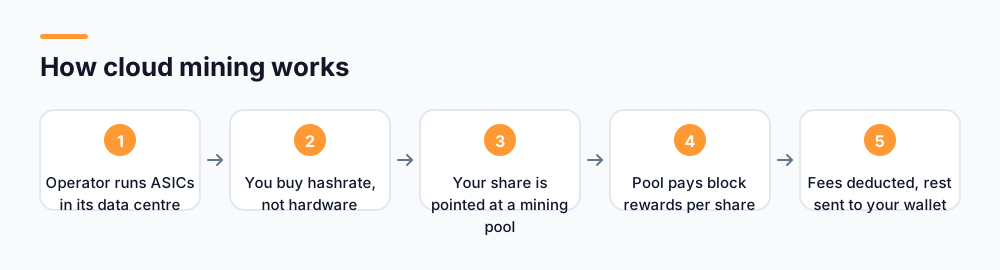
A crypto mining cloud service sells you the output of mining hardware you never touch. The provider owns the machines, houses them somewhere with cheap electricity, and rents you a slice of their computing power for a fixed period. Whatever coins your slice earns, minus fees, gets credited to your account.
That is a perfectly coherent business idea, and a handful of firms run it legitimately. It is also the single most heavily impersonated product in crypto, because it lets an operator take an upfront payment and then show you a dashboard number instead of a real machine. This guide separates the mechanism from the marketing, works through a full twelve-month contract with real figures, and explains the clause that quietly terminates most contracts before they finish.
What cloud mining actually is
Mining is a competition to produce a valid block. Each machine contributes hashes per second — hashrate — and the network pays out roughly in proportion to the share of total hashrate you contribute. Nothing about that requires the machine to be yours, or in your house. It only requires that someone can prove your share of the work and route the resulting payout to you.
Cloud crypto mining exists because industrial mining has enormous economies of scale that individuals cannot reach. A warehouse in a low-tariff region buys electricity at a fraction of a UK domestic rate, buys hardware by the pallet, and employs people to keep the fans clean. A single machine in a British spare room competes against that on every axis and loses on all of them. Selling slices of the warehouse is a rational response to that gap.
Three genuinely different products get sold under the same label, and knowing which one you are being offered matters more than the price:
- Hosted mining — you buy or supply an actual machine, and the provider racks it, powers it and maintains it for a monthly fee. You own an identifiable asset with a serial number, and you can usually have it shipped to you.
- Hashrate contracts — you buy a quantity of hashrate, say 100 TH/s, for a fixed term. No machine is assigned to you. You hold a claim on a share of output, and a daily maintenance fee is deducted from it.
- Deposit schemes dressed as mining — you send money and are promised a fixed daily percentage. There is no mining. Real mining revenue changes hourly with network difficulty and coin price, so a guaranteed daily return is a mathematical impossibility, not an unusually good deal.
Fixed daily percentages are the tell
No mining operation on earth can promise 1% or 2% per day, because nobody controls difficulty or price. Any cloud mining crypto product quoting a fixed daily or monthly return is paying early depositors with later deposits, and it ends the way those always end.
A worked contract, start to finish
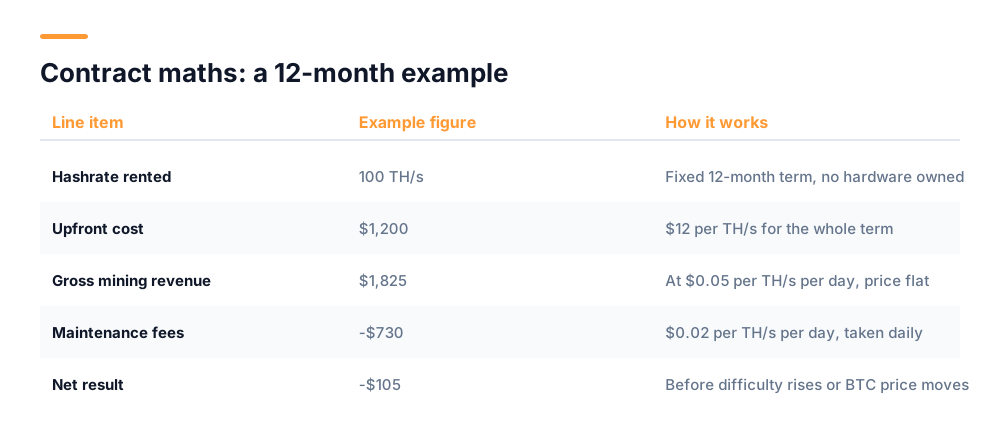
Marketing pages quote hashrate and price. Neither number tells you anything on its own. What matters is revenue per unit of hashrate per day — miners call it hashprice — set against the fee, the term, and what the same money would have done if you had simply bought the coin instead.
Take an illustrative Bitcoin contract: 100 TH/s for twelve months, £1,200 upfront, plus a maintenance fee of £0.60 per day. Assume hashprice starts at roughly £0.035 per TH/s per day, which is in the range seen across recent years, and that network difficulty keeps climbing at about 3% a month, which is conservative by historical standards. Difficulty growth alone erodes your revenue by about 30% over the year even if the coin price never moves.
The figures below are rounded and simplified — mining revenue is not purely price-linked, since difficulty itself responds to profitability — but the shape of the result is what matters, not the third decimal place.
| Coin price over the year | Gross mining revenue | Maintenance fees | Net after fees | Result on the £1,200 contract | Same £1,200 spent buying the coin |
|---|---|---|---|---|---|
| Down 30% | £763 | £219 | £544 | −£656 | −£360 |
| Flat | £1,090 | £219 | £871 | −£329 | £0 |
| Up 50% | £1,635 | £219 | £1,416 | +£216 | +£600 |
| Up 100% | £2,180 | £219 | £1,961 | +£761 | +£1,200 |
Read the last two columns together, because that comparison is the whole argument. In this illustration the contract loses money unless the coin price rises substantially, and even when it doubles, simply having bought the coin outright would have returned more. You took on counterparty risk, hardware risk, difficulty risk and a fee, and were paid less than the person who did nothing but hold.
That is not an accident or a badly chosen example. The provider knows the hardware cost, the electricity tariff and the depreciation curve precisely. You know none of them. They set the contract price, so they set it above their expected cost of delivering it — otherwise there would be no reason to sell contracts rather than mine for their own account. The premium you pay is the price of skipping the hardware, and it comes out of exactly the same revenue you were hoping to collect.
The clause that ends most contracts early
Almost every hashrate contract contains a version of this term: if your daily mining revenue falls below your daily maintenance fee for some number of consecutive days, the contract is suspended or terminated, and there is no refund of the unused term.
Apply it to the example above. The fee is £0.60 per day for 100 TH/s, which is £0.006 per TH/s per day. Revenue starts at £0.035, so the contract survives comfortably at first. It dies if hashprice falls by about 83%. That sounds remote until you remember two things that push in the same direction: difficulty only ratchets upwards over time, and a halving cuts the block subsidy in half overnight.
A halving is scheduled, public and unavoidable. If your contract term spans one, your revenue per TH/s roughly halves on that date while the fee stays exactly where it is. Any multi-year contract sold across a halving is being priced on pre-halving revenue and delivered largely on post-halving revenue, and the buyer absorbs the entire difference.
Work out the kill point before you buy
Divide the daily fee by your hashrate to get the fee per unit, then compare it with current hashprice. The gap between the two is your entire margin for error, and it narrows every month as difficulty climbs.
How to check whether a provider mines anything at all
The uncomfortable structural feature of crypto mining cloud services is that a dashboard showing an accumulating balance costs nothing to build. A convincing fake is cheaper to produce than a single mining rig. So the only useful checks are the ones that look outside the provider's own website.
- Ask which mining pool they use and for the payout address. A real operation of any size has both. Then look that address up in a blockchain explorer and see whether payments actually arrive, and at what scale.
- Compare their claimed total hashrate with the pools' published figures. If a provider claims a share of the network larger than anything visible on public pool dashboards, the claim is false.
- Find the facility. Legitimate hosts name a country, often a site, and frequently publish photographs and power arrangements. "Our global data centres" with stock imagery is not a location.
- Read the termination and fee clauses before the marketing copy. If they are absent, that is worse than if they are harsh.
- Search for the withdrawal experience, not the sign-up experience. Complaints cluster at the point of withdrawal, because that is where a fake operation has to either pay out or stall.
- Check whether new deposits are needed to unlock old earnings. Any requirement to top up, upgrade a tier, or pay a fee to release a withdrawal means the balance was never real.
That last point is worth dwelling on, because it is the mechanism behind most losses in this category. It is the same giveaway scam playbook applied to a more respectable-sounding product: manufacture a large on-screen balance, then charge a fee to release it. The balance is the bait and the fee is the entire business.
The verification step that settles the most arguments is the on-chain one, and it takes about five minutes. If you have not used one before, our guide to reading a blockchain explorer covers how to inspect an address's payment history, which is the difference between a provider that mines and a provider that renders numbers in a browser.
Two things UK buyers should know
First, protection. A mining contract is not a regulated investment product, so you should assume there is no Financial Services Compensation Scheme cover, no Financial Ombudsman route and no recourse if the provider stops answering emails. Some crypto promotions to UK consumers fall under the FCA financial promotions regime, but that governs how something is advertised, not whether the underlying deal is sound or the company solvent.
Second, tax. HMRC generally treats coins received from mining as taxable income at the point of receipt, valued in pounds on that day, with a later disposal potentially creating a capital gain or loss on top. That means you can owe income tax on coins whose value subsequently falls. Record the date, quantity and sterling value of every credit as it happens, and check current HMRC guidance or speak to an accountant rather than relying on a blog post.
Cloud mining compared with the other ways in
People researching cloud mining crypto contracts are usually asking a broader question: what is the cheapest way to end up holding some crypto without buying industrial hardware? The realistic options behave very differently, and the comparison is more useful than any single provider review.
| Cloud mining contract | Buying the coin | Airdrop | Mobile mining app | |
|---|---|---|---|---|
| Upfront payment | Yes, often substantial | Yes, whatever you choose | Never legitimately | Never legitimately |
| Ongoing fees | Daily maintenance fee | None once held | None | None |
| What you supply | Money and trust | Money | Prior activity or eligibility | Phone time and battery |
| Counterparty risk | High — provider holds everything | Only at the exchange | Impersonation and drainers | App permissions and app store |
| Realistic outcome | Break-even at best in most scenarios | Tracks the coin, nothing more | Frequently nothing | Very small amounts, often unpriced |
| Main failure mode | Provider stops paying or terminates | Price falls | Fake claim site steals your wallet | Fake app harvests data |
The airdrop crypto route deserves a specific warning, since it is the one most often suggested as the free alternative. Genuine airdrops distribute coins to addresses that already did something — used a protocol, held an asset, tested a network — and they never require a payment or a signature that grants spending permission. The fake ones exist almost entirely to harvest recovery phrases and coin approvals from people who arrived hoping for something free.
Mobile mining sits at the opposite end of the scale from a cloud contract. There is no hardware to rent and nothing to pay, because a phone contributes essentially nothing to a proof-of-work network; what these apps actually run is a scheduled distribution rather than a hashrate market. Our explainer on how mobile mining works is blunt about that distinction, and it is the reason the two products should not be compared on yield.
Where UNC fits, and where it does not
UNC is a mobile mining app, not a crypto mining cloud provider. We do not sell hashrate, we have no contracts, no maintenance fees, no tiers and no upfront payment of any kind. There is nothing to buy, which also means there is nothing for a fee clause to terminate. If you ever see a page charging for UNC hashrate or promising a daily percentage, it is not us.
We should be equally plain about the limits of what we do offer. Allocation follows a published schedule, the amounts are small, and mining on a phone is not lucrative — our honest assessment of mobile mining profitability works through those numbers rather than gesturing at them. The reason to be interested is curiosity about how distribution and networks function.
The UNC coin has no listed price and no exchange listing, so nobody — us included — can tell you what an allocation is worth, and we do not promise earnings, returns or future value. If you want the structural detail, the UNC whitepaper documents the network design and the distribution model, and it is worth reading before you install anything.
A cloud mining contract converts an unknowable future revenue stream into a known payment today. The person who knows the hardware economics sets that payment, and it is not you.
The honest verdict
Hosted mining, where you own an identifiable machine and pay a transparent monthly fee for rack space and power, is a real service with a defensible use case for someone who genuinely wants to mine and cannot get cheap electricity. It is the closest thing to a sound version of the idea.
Hashrate contracts sold to retail buyers are a much harder case to make. Once you subtract the maintenance fee, allow for difficulty growth over the term, and compare the result with simply holding the coin, the contract needs a strong price rally just to match doing nothing. And in the scenario where the rally arrives, holding usually still wins.
Anything offering a guaranteed daily return is not cloud mining at all, whatever the website says. That distinction is worth more than any comparison table, because it separates a poor deal from a total loss. If you take one thing from this page: work out the fee per unit of hashrate, compare it with current hashprice, and then check the payout address on-chain. If the provider cannot survive those three checks, no discount code fixes it.
If you would rather see how a no-payment, no-contract distribution model is structured before deciding anything, how UNC works sets out what the app does on your device, what it does not do, and what the schedule actually allocates.
Frequently asked questions
What is cloud mining in crypto?
Cloud mining is paying a provider for the output of mining hardware they own and operate. You buy either hosting for a machine you own, or a quantity of hashrate for a fixed term, and the coins your share earns are credited to you minus a daily maintenance fee. You never handle the equipment.
Is cloud mining profitable?
Rarely, once you do the full arithmetic. In a typical twelve-month contract the maintenance fee, the contract premium and rising network difficulty together mean the coin price usually has to rise substantially just to break even — and in that scenario, simply buying the same value of coin outright would often have returned more with less risk.
How can I tell if a cloud mining site is a scam?
Two signals settle most cases. A fixed daily or monthly percentage return is impossible for real mining, because difficulty and price change constantly. And any requirement to deposit more, upgrade a tier or pay a fee before withdrawing means the on-screen balance was never real. Beyond that, ask for the pool payout address and check it in a block explorer.
Why do cloud mining contracts get terminated early?
Most contracts state that if daily mining revenue falls below the daily maintenance fee for a set number of days, the contract is suspended with no refund of the remaining term. Network difficulty rises over time and a halving cuts block rewards in half on a scheduled date, so revenue trends downwards while the fee stays fixed.
Do I pay UK tax on cloud mining earnings?
Generally yes. HMRC usually treats coins received from mining as taxable income at their sterling value on the day of receipt, with a possible capital gain or loss when you later dispose of them. Keep a record of every credit as it happens, and check current HMRC guidance or an accountant rather than relying on a provider's claims.
Is mobile mining the same as cloud mining?
No. Cloud mining sells you a share of real hardware output for an upfront payment plus fees. A mobile mining app charges nothing and contributes essentially no hashrate; it runs a scheduled coin distribution instead. Neither is lucrative, and any version of either that asks you to pay first should be treated as a scam.
Start mining with UNC
UNC distributes coins to verified participants — no hardware, no subscription, no battery drain. Read the whitepaper for the distribution model, or check network activity in the explorer.
Get UNC on Google Play