Security
Crypto Scam News: How to Read It Without Being Misled
Scam news is history by definition: a story exists because a scheme has already collapsed or prosecutors have finished enough of an investigation to charge someone. The schemes taking money next month are unreported — and they are reruns of about five formats. Here is how to read the news for the pattern instead of the names, and what to check on your own holdings today.
Searching for crypto scam news usually means one of two things has happened. Either you read a headline about a multi-hundred-million-dollar fraud and want to know whether you are exposed, or something you are already using has started to feel wrong and you are looking for confirmation. The genre serves both purposes, but only if you read it for structure rather than for names.
Scam reporting is, by definition, history. A story exists because a scheme has already collapsed, or because prosecutors have finished enough of an investigation to file charges. The operation that will take money from people next month is currently unreported, and when it surfaces it will not be novel — it will be one of roughly five formats rerun with a new domain, a new logo and a new set of testimonials. The format is the part of the news that transfers to your own decisions. The defendant's name is not.
This article covers why arrests lag the crime by years, the recurring story formats and what each one teaches, what a prosecution actually does for victims, which primary sources are worth reading instead of aggregators, and the checks you can run in a few minutes on anything you currently have money in. If you want the mechanics of the deception itself first, our breakdown of how a crypto scam actually works walks through the stages in order.
Why the news is always two to four years behind
The single most useful thing to understand about this genre is its lag. Between the money leaving a victim and a press release naming a defendant, there is usually a gap measured in years, and occasionally close to a decade. That gap is not incompetence. It is what cross-border financial investigation costs.
Consider HashFlare, which sold contracts for a share of a supposed mining operation. According to the Department of Justice, the scheme ran from 2015 to 2019 and took in more than $575 million from hundreds of thousands of customers, while the mining capacity it claimed to operate largely did not exist. Two Estonian nationals were arrested in November 2022, extradited to the United States afterwards, and guilty pleas followed in 2025. A customer who had doubts in 2017 would have waited five years for the first headline confirming them.
The pattern repeats. Mining Capital Coin sold "Mining Packages" with promised daily returns; prosecutors indicted its chief executive in January 2022 over an alleged $62 million fraud in which, they said, the advertised mining was mostly fictitious and payouts came from later deposits. Confidence-scam networks — the ones usually described as pig butchering — moved billions before a single large seizure was announced in mid-2025.
| Case (as described in DOJ filings) | Scheme active | First public enforcement action | Rough gap |
|---|---|---|---|
| HashFlare cloud mining contracts | 2015–2019 | Arrests, November 2022 | 3–7 years |
| Mining Capital Coin "Mining Packages" | roughly 2018–2021 | Indictment, January 2022 | 1–4 years |
| Confidence-scam ("pig butchering") networks | ongoing since ~2020 | Large civil forfeiture action, June 2025 | 5 years and counting |
Why so slow? The proceeds move through chains, bridges, mixers and offshore exchanges, and each hop needs subpoenas or mutual legal assistance requests to unpick. Victims are spread across dozens of countries, so someone has to be identified who is both harmed and within a court's jurisdiction. Operators frequently live somewhere with no extradition arrangement. And prosecutors file when the evidence is strong enough to survive trial, not when a journalist first notices something.
A headline is not a warning list
By the time a scheme is in the news, it has usually stopped taking deposits. Reading scam coverage as a blocklist of names gives you a false sense of safety: the names that matter to you are not published yet. Read for the mechanism instead.
The five stories that keep repeating
Strip the branding off a few years of coverage and almost everything reduces to five formats. Each has a promise, a mechanism that makes the promise impossible, and a tell you can check without any technical skill.
| Format | The promise | What is really happening | The tell |
|---|---|---|---|
| Yield or mining contract | Fixed daily or monthly return on a deposit | Later deposits pay earlier depositors; the advertised hardware is unverifiable | A guaranteed rate at all — real mining revenue varies with price and difficulty |
| Approval phishing / drainer | A free token distribution you must connect a wallet to claim | The signature you approve grants spending authority over your balance | Receiving anything requires only your address, never a signature |
| Relationship investment scam | A private trading platform that shows steady gains | The dashboard is a web page; deposits are gone on arrival | Withdrawal requires a fee, a tax payment, or a larger balance first |
| Fake platform or clone app | An exchange or wallet with better rates and no KYC friction | Credentials and deposits are harvested; the app is sideloaded | Distributed outside official app stores, or via a link in a message |
| Recovery service | We can trace and return the funds you already lost | A second fraud aimed at people confirmed to be losable | Upfront fee, contacted you first, knows about your loss somehow |
Two of those formats generate most of the headlines people arrive here after reading, and both are worth unpacking properly, because in each case the fraud sits in a place non-technical readers are not looking.
Airdrop stories: the signature is the theft
A legitimate token distribution sends assets to addresses that already met some condition. The recipient does nothing. So when a site tells you to connect a wallet and approve a transaction to collect a crypto coins airdrop, the interesting question is not whether the token is real — it is what, exactly, you are being asked to sign.
The technique is called approval phishing, and it exploits a normal feature of smart contract chains. Token standards let you grant another address permission to spend your tokens, which is how decentralised exchanges work. A drainer site presents that permission request behind a "claim" button. You are not authorising a receipt; you are authorising a withdrawal, often an unlimited one, executable at any point in the future. Chainalysis traced roughly a billion dollars to this pattern over a little more than two years, and noted that the wallets doing the draining frequently sit idle for weeks before emptying an account — which makes the connection between the click and the loss hard for victims to see.
The related format is the impersonated distribution: a well-known project's name and logo attached to a domain registered last week, promoted through compromised social accounts. That is the same machinery behind giveaway scams, where the ask is a "verification" deposit rather than a signature. In both cases the branding is free to copy and proves nothing at all.
Receiving never requires permission
To send you tokens, someone needs your public address and nothing else. Any page that requires a wallet connection, a signature, or a token approval before it will "release" a distribution is asking for spending rights, not delivery details. Revoke old approvals you no longer use.
Cloud mining stories: the hashrate nobody can see
The other format that dominates enforcement news is the hosted mining contract. Selling cloud mining crypto currency services is not inherently fraudulent — real data centres do rent out hashrate — but the product has a structural problem that makes it the single most attractive wrapper for a Ponzi scheme: the customer cannot verify that any machine exists. You send money and receive a number on a dashboard. Everything between those two events is a claim.
That is what both of the cases above have in common. In each, prosecutors alleged that the mining capacity was far smaller than advertised or absent entirely, and that the "returns" shown to customers were funded by incoming deposits. Notice that neither scheme needed to break any cryptography. It needed a plausible dashboard, a referral programme, and a fixed daily percentage — a figure that real mining cannot offer, because revenue moves with coin price, network difficulty and electricity cost, none of which the operator controls.
If you are evaluating an offer in this category, our longer piece on cloud mining contracts sets out the questions worth asking: where the facility is, what the electricity price is, whether the payout formula is expressed in hashrate rather than currency, and what happens when the contract becomes unprofitable. An operator who cannot answer the first three, or who guarantees a return regardless of the fourth, has told you what you needed to know.
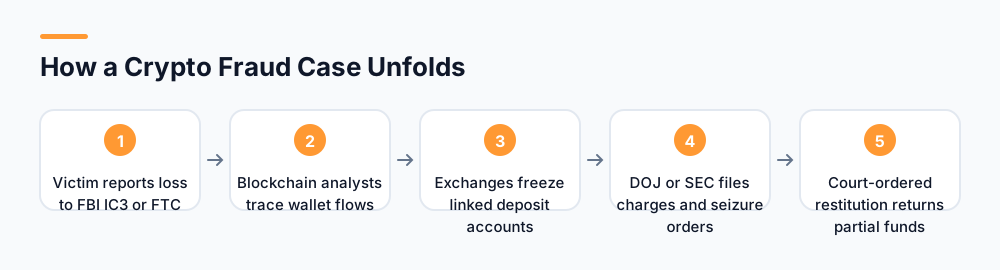
What a crypto scam arrest actually changes
It is easy to read a crypto scam arrest as the end of a story, and for the defendant it may be. For the people whose money is gone, it usually is not. Charges are not recovery, seizures are not repayment, and the distance between the headline figure and what reaches victims is large enough that it deserves stating plainly.
Three separate things get conflated in coverage. An indictment is an allegation, and the case may take years to reach trial or a plea. A seizure or forfeiture means the government has taken control of specific assets it can trace and reach — which is a fraction of what was stolen, because the rest has been spent, moved through jurisdictions that will not cooperate, or converted to cash years ago. Restitution is a separate court process that distributes recovered funds pro rata among identified victims, which means claim deadlines, paperwork, and often a payout measured in cents on the dollar arriving long after the news cycle ends.
The scale numbers are worth holding in mind alongside this. The FBI's Internet Crime Complaint Center recorded around $9.3 billion in reported cryptocurrency-related fraud losses in 2024 alone, and reported losses are always an undercount because many people never file. Against that, the largest single forfeiture actions are in the hundreds of millions. Enforcement is real and it matters, but arithmetic says it cannot function as a safety net.
News coverage attracts a second wave of fraud
When a scheme collapses publicly, "asset recovery" operators appear within days, contacting victims by email or messaging app and asking for an upfront fee. They are working from the same leaked or scraped lists the first scam used. No legitimate recovery process charges you to join a court-supervised restitution pool.
Turning a news story into a check you can run today
The productive way to finish reading a scam story is to spend five minutes on something you already hold. Here is a sequence that works regardless of which format the headline described.
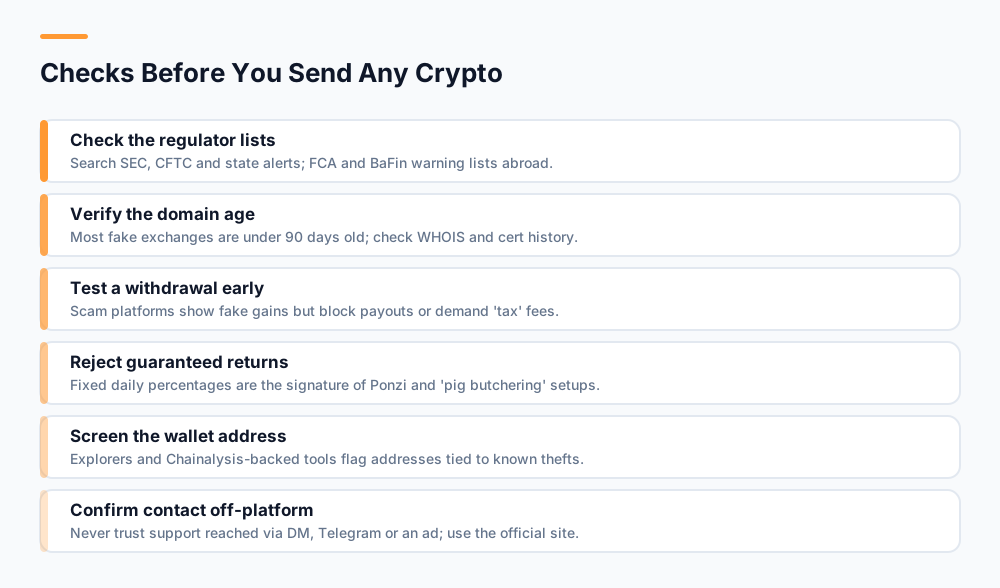
- List everywhere you currently have crypto or a crypto-linked balance, including apps you signed up to once and forgot.
- For each, write down the single sentence that explains where the money comes from. If you cannot, that is the finding.
- Check whether any of them advertises a fixed return. Guaranteed percentages and variable mining or trading revenue cannot coexist.
- Check whether withdrawals work — not whether the button exists, but whether a small one completes. Do this before the balance is large.
- Review the token approvals on any wallet you have connected to a site, and revoke the ones you no longer need.
- Search each name alongside terms like "indictment", "litigation release" and "warning" on regulator sites rather than in general search results.
- Confirm every app on your phone came from an official store listing, and check what device permissions it holds.
- Write down, once, that no legitimate service will ever ask for your recovery words — then treat any request as an answer, not a question.
Step four is the one that does most of the work, and step five is the one most people skip. For anything that claims to pay out on-chain, a block explorer settles in two minutes what a reviews page cannot settle at all: whether the payout address has sent anything recently, to how many different addresses, and in what amounts. Three transactions from launch week and nothing since is a complete answer.
And the absolute rule, which covers a large share of the losses in every annual report: your recovery passphrase is the wallet. It is not a login, not a verification step, and not something a support agent can legitimately need. A form or a chat asking for twelve or twenty-four words is theft in progress, and no explanation offered alongside the request changes that.
Where to read crypto scam news
Aggregated crypto news sites are fine for spotting that something has happened, but they are a poor place to work out what actually happened. Many of them publish sponsored posts that are indistinguishable in layout from editorial, and some of those sponsored posts have promoted the exact category of scheme the site reports on elsewhere. The primary documents are free, more specific, and no harder to read.
- Department of Justice press releases and the charging documents they link to — these name the mechanism, not just the amount.
- SEC litigation releases and CFTC enforcement actions, which cover unregistered offerings and commodity fraud respectively.
- The FTC's consumer protection data spotlights, which are the best source on how victims were first contacted.
- The FBI IC3 annual reports, for scale and for which formats are growing.
- Your own national or state regulator's warning list — the UK FCA, for example, publishes unauthorised firm warnings continuously.
- Blockchain analytics firms' annual crime reports, for on-chain flow estimates, read with the awareness that they sell services to the same industry.
When you do read a secondary article, check two things: whether it links to a primary source, and whether the figure in the headline is an allegation, a seizure, or a loss estimate. Those three numbers get used interchangeably and they mean completely different things.
Read scam news for the mechanism, not the name. The name is already in custody; the mechanism is being redeployed this week under different branding.
Where we sit, stated plainly
It would be odd to publish a piece on mining-related fraud from a mining app without saying what we are. So: UNC is a mobile app, and mining on a phone is not lucrative. A phone is thermally and electrically tiny next to purpose-built hardware, and no software arrangement changes that. Anyone in this category telling you otherwise is describing a marketing plan rather than a physical process.
We also do not sell hashrate contracts, we do not offer a fixed daily percentage, and there is no deposit. The UNC token has no listed price and no exchange listing, which means nobody — including us — can tell you what an allocation is worth, and we do not promise earnings, returns or future value. If you have seen a page claiming to sell UNC at a price, that page is not ours.
If you want the specifics rather than the assurance, how UNC works sets out what the app does on your device and how allocation is scheduled, and the whitepaper documents the network design and distribution model. Both are readable before you install anything, which is the order we would suggest.
The honest summary of the whole genre is this. Scam news is a record of formats that worked, published after they stopped working. It is genuinely useful reading, because the formats recur almost unchanged, and because it teaches you which questions have answers you can check. It is not a defence system. The defence is the five minutes you spend on your own accounts, and the willingness to accept a boring answer about where money comes from.
Frequently asked questions
Why does crypto scam news always seem to be about schemes that already collapsed?
Because enforcement takes years. Proceeds move through multiple chains, bridges and offshore exchanges, each hop requiring subpoenas or international legal assistance; victims are spread across many jurisdictions; and operators often live somewhere without extradition arrangements. In the HashFlare case the scheme ran from 2015 to 2019 and arrests came in November 2022, with guilty pleas in 2025. So the reporting is a catalogue of formats that worked, not a live list of dangerous names.
Does a crypto scam arrest mean victims get their money back?
Rarely in full, and usually not quickly. An indictment is an allegation; a seizure covers only assets investigators can trace and reach; restitution is a separate court process that distributes recovered funds pro rata among identified victims, often years later and at cents on the dollar. The FBI recorded around $9.3 billion in reported crypto fraud losses in 2024 alone, while the largest single forfeiture actions are in the hundreds of millions — the arithmetic means enforcement cannot serve as a safety net.
How can I tell a real token distribution from an airdrop scam?
By what it asks you to do. Receiving tokens requires only your public address, so a genuine distribution needs nothing from you. If a page requires a wallet connection and a signature before it will release a claim, you are almost certainly approving spending permission over your existing balance — the technique known as approval phishing, which Chainalysis has traced roughly a billion dollars to. Drainer wallets often wait weeks before emptying an account, which is why victims rarely connect the click to the loss.
Is all cloud mining a scam?
No — real facilities do rent out hashrate — but the product is structurally hard to verify, which is why it appears so often in fraud cases. You send money and receive a dashboard number; everything in between is a claim. The reliable tell is a guaranteed fixed return, because genuine mining revenue moves with coin price, network difficulty and electricity cost. Ask where the facility is, what the power price is, and whether payouts are denominated in hashrate rather than a promised percentage.
Where should I read crypto scam news instead of aggregator sites?
Primary sources: Department of Justice press releases and the linked charging documents, SEC litigation releases, CFTC enforcement actions, FTC consumer protection data spotlights, the FBI IC3 annual reports, and your own regulator's warning list. Many crypto news sites publish sponsored posts that look identical to editorial, and some have promoted the same category of scheme they report on. When reading secondary coverage, check whether the headline figure is an alleged loss, a seizure, or an estimate.
Someone contacted me offering to recover crypto I lost. Is that legitimate?
Almost certainly not. Recovery offers are a recognised second wave of fraud that follows public news coverage, aimed at people already confirmed to have lost money — often using the same leaked contact lists the original scheme used. The markers are an upfront fee, unsolicited contact, and unexplained knowledge of your loss. Court-supervised restitution does not charge victims to participate, and no private service can reverse a settled on-chain transaction.
Start mining with UNC
UNC distributes tokens to verified participants — no hardware, no subscription, no battery drain. Read the whitepaper for the distribution model, or check network activity in the explorer.
Get UNC on Google Play