Mobile Mining
Best Crypto Mining App: How to Judge One Yourself
Every "top 10 mining apps" list is ranked by referral payout, not by output, because the output is effectively zero either way. The useful question is not which app earns most but which one is honest about what it does to your phone, your attention and your wallet — and that is something you can assess in about ten minutes.
Search for the best crypto mining app and you will find ranked lists with star ratings, estimated daily earnings and a tidy comparison table. Nearly all of them are ordered by referral commission. The app that pays the largest bounty per install sits at the top, the estimated earnings column is copied from the app's own marketing, and nobody involved has run a phone for a month to check. That is the first thing worth knowing before reading any such list, including this one — which is why there is no list of names here.
The honest answer is structural. A phone cannot produce a meaningful amount of any established cryptocurrency, for reasons that come down to arithmetic rather than opinion, and no app can escape that ceiling. What genuinely varies between apps is what they do instead: how much of your attention they sell, what they do to your battery, what permissions they ask for, how clearly they describe the thing you are actually receiving, and whether they ever come near your wallet keys. Those are the things worth ranking.
This guide covers the four different products that get called mining apps, the real numbers a phone produces, why the app stores themselves ban on-device hashing, a checklist you can apply to any app in about ten minutes, and where the actual risk sits — which is almost never the mining and almost always the wallet. If you want the mechanics first, our explainer on how mobile mining actually works covers what a phone is and is not doing when an app says it is mining.
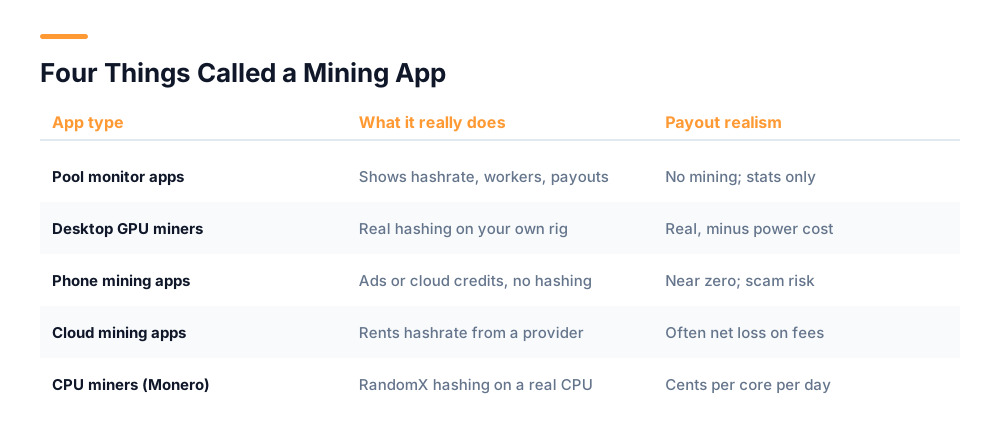
Four different products get called a mining app
The phrase covers at least four unrelated things, with completely different risk profiles. Working out which one you are looking at takes under a minute and eliminates most of the confusion in the category.
Genuine on-device hashing
A small number of apps really do run a hashing algorithm on your phone's CPU, usually RandomX for Monero, since that algorithm was deliberately designed to run well on general-purpose processors. These are technically honest and practically pointless, for reasons the next section works through in numbers. They are also mostly distributed outside the official stores, because both stores prohibit them.
Cloud mining contracts
Here the app is a storefront. You pay for a share of hashing capacity that supposedly exists in a datacentre somewhere, and the app shows you a balance accruing. Some operations are real; a great many are not, and the model has been a reliable wrapper for Ponzi structures for a decade because the hardware is unverifiable by design. If an app asks you to deposit money before it mines anything, you are not evaluating a mining app, you are evaluating an investment contract from a company you cannot audit.
Reward and tap-to-claim apps
The largest category by install count. Nothing is hashed anywhere. You tap a button every so often, watch an advert, and a counter goes up. The counter represents a claim on a future token, a loyalty point, or in some cases nothing at all. This is an advertising business with mining vocabulary bolted on. That does not automatically make it dishonest — but the app should say so plainly, and most do not.
Wallets with a mining button
An ordinary wallet app with a promotional feature attached, usually a daily bonus or a staking-style reward presented as mining. The wallet part may be perfectly competent. The mining part is marketing, and the distinction matters because you are now storing keys in an app whose incentive is engagement.
| On-device hashing | Cloud contract | Tap-to-claim | Wallet with bonus | |
|---|---|---|---|---|
| Does your phone compute anything | Yes | No | No | No |
| Money required up front | No | Yes, always | No | No |
| Main cost to you | Battery, heat, electricity | The deposit | Attention and data | Key exposure |
| Realistic output | Cents per month at best | Whatever the operator chooses to show | An unpriced internal balance | Small promotional credit |
| Allowed in the official stores | No | Sometimes | Usually | Usually |
| Worst-case failure | A hot, degraded battery | Total loss of the deposit | Wasted months | Drained wallet |
The arithmetic that caps every app in the category
Mining rewards are shared out in proportion to how much of the network's total computation you contribute. So the only number that matters is your share of the whole, and on a phone that share is very small in a way that is hard to intuit until you write it down.
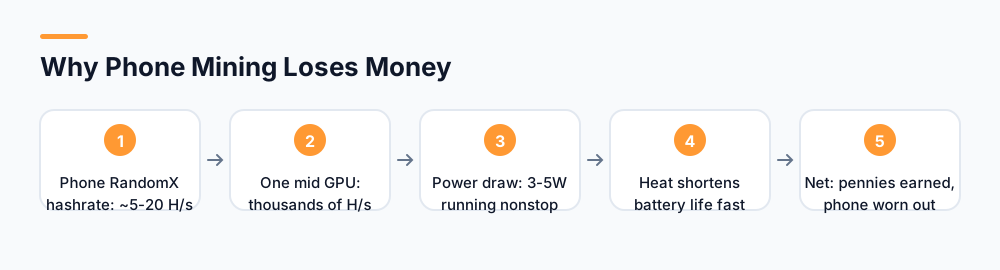
Take Bitcoin first, because it is what most people mean. The network runs at roughly 800 exahashes per second — that is 800 followed by eighteen zeros, every second. A modern phone CPU might manage 5 megahashes per second before thermal throttling, which it will hit within minutes. Your share of the network is therefore around 0.0000000000006 percent. The network issues about 450 BTC per day in block rewards. Multiply it out and your phone's daily entitlement is roughly three trillionths of a bitcoin. At a six-figure bitcoin price, that is a few ten-millionths of a cent per day. Running continuously, your phone would take on the order of a century to accumulate one cent, and the phone will not last a century.
Monero is the fairest possible case, because RandomX is designed to resist specialised hardware and keep CPUs competitive. A good phone sustains perhaps 500 to 1,000 hashes per second once throttling settles in. Network hashrate in the low billions of hashes per second gives you a share of roughly 0.000025 percent. With emission around 430 XMR per day across the network, that works out to something like 0.0001 XMR daily — a cent or two per day at typical prices, so perhaps forty cents a month if you never use the phone for anything else.
Now subtract the costs. A phone pinned at full CPU draws somewhere around 4 to 6 watts at the wall including charging losses. Call it 0.12 kWh per day. At the US average residential rate of roughly 17 cents per kWh, that is about two cents of electricity per day — which is to say the electricity costs about as much as the Monero is worth, before counting the battery. This is the entire result, and it does not improve with a better app.
The test any claim has to pass
If an app implies dollars per day from a phone, ask what share of the network that phone holds and what the network issues daily. Those two numbers are public, the multiplication takes thirty seconds, and no amount of app design changes the answer.
We have worked through the full profitability calculation elsewhere, including pool fees, withdrawal minimums and the cost of the handset itself, and the conclusion does not move. Treat any ranking that puts an earnings figure in its comparison table as advertising rather than measurement.
Why the stores themselves ban on-device mining
There is a reason the genuinely-hashing apps are hard to find in the places you would normally look. Apple's App Store Review Guidelines state under section 2.4.2 that apps, including third-party adverts displayed within them, may not run unrelated background processes such as cryptocurrency mining; apps that manage mining happening elsewhere are permitted. Google Play takes the same line, prohibiting apps that mine cryptocurrency on the device while allowing apps that remotely manage mining hardware.
This is not regulators protecting an incumbent. It is a hardware judgement: sustained full-CPU load on a sealed device with no active cooling produces heat the chassis is not designed to shed, and the stores would rather not field the warranty complaints. The practical consequence for you is that an app promising real on-device hashing is usually distributed as a direct download, which removes the review layer that catches the worst permission abuses — and that trade is a bad one for an output measured in cents.
What actually separates a decent app from a bad one
Since output is not a differentiator, these are the criteria that are. An app failing any of the first four is not worth installing whatever its rating says.
- It never asks for your recovery phrase or private key. There is no legitimate reason for a mining app to hold spending authority over anything.
- It never asks for money. No activation fee, no upgrade required to withdraw, no deposit to "unlock" a higher rate.
- It states plainly whether your device computes anything. If the marketing says mining and the technical documentation says allocation, points or rewards, the documentation is the truthful one.
- It says what the thing you are accumulating is, whether it has a market price, and what happens to your balance if the project stops.
- Its permissions match its function. A mining app has no business with your contacts, your SMS, your call log or your precise location.
- It is distributed through an official store, where review and takedown exist, and the developer identity is visible.
- It does not depend on recruitment. If the published path to a meaningful balance runs through referrals, you are in a recruitment scheme wearing mining vocabulary.
- It discloses battery and thermal behaviour honestly instead of claiming a background process has no cost.
- It has documentation you can read in full before installing anything — a whitepaper, a distribution schedule, a changelog.
Run that list against the top five results of any roundup and most eliminate themselves on the second or third item. What survives tends to be a handful of transparent apps producing very little, which is the correct outcome, because very little is what the mathematics allows.
The "free mining crypto" promise, and what free costs
Free mining crypto is the phrase the whole category is built on, and it is true in the narrow sense that most of these apps do not charge you money. But nothing with a server bill is free to operate, so it is worth asking who pays and with what.
| What "free" usually means | What it costs you in practice |
|---|---|
| Advert-funded claim button | 30 to 60 seconds of attention per claim, plus the ad network's tracking |
| Referral-boosted rate | Your contacts, and your credibility with them |
| Background hashing with no fee | Battery cycles, heat, and about two cents of electricity a day |
| Free tier with a paid upgrade | A funnel; the free tier exists to establish the habit |
| Data-funded app | Device identifiers and usage telemetry sold on to brokers |
| Pre-launch token allocation | Nothing, but also no price — the balance may never be worth anything |
None of those are automatically scams. An advert-funded app that says it is advert-funded is a fair exchange. The problem is the apps that take the attention, the referrals and the battery while describing the result in the language of income. Our broader piece on where free crypto mining revenue actually comes from traces each of these funding models to its source.
The cost nobody puts in the comparison table
Lithium-ion cells degrade with charge cycles and with heat, and sustained CPU load delivers both at once. Apple rates an iPhone battery to retain up to 80% of original capacity at 500 complete charge cycles under normal conditions. An app running the processor hard will burn through a full cycle in well under a day, so a phone that would have taken two or three years to reach that point can get there in one.
Heat compounds it. Battery University's data on lithium-ion ageing shows capacity loss accelerating sharply with elevated cell temperature — a cell held warm loses materially more capacity per year than one kept cool, independent of cycling. A phone mining in a pocket is a cell held warm. Against forty cents a month of Monero, a replacement battery at $70 to $100 is not a rounding error; it is several decades of output.
There is a measurable version of this test you can run yourself in a week, and our write-up on whether mining drains your phone battery sets out the method: baseline your screen-on time and battery health reading, run the app, and compare. An app that is genuinely light on the device will survive that test. An app that is quietly hashing will not.
Crypto wallet security is where the real risk sits
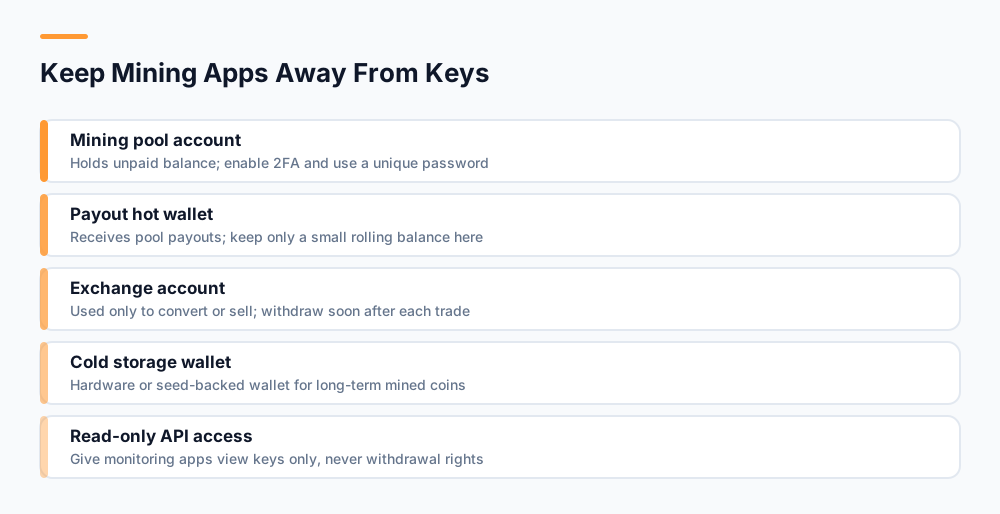
Almost nobody is harmed by a mining app mining badly. People are harmed when a mining app gets near their keys. So crypto wallet security deserves more of your attention than the hashrate claim ever does, and the rules are short enough to memorise.
- Your recovery phrase goes into your wallet app and nowhere else — never into a mining app, a support chat, a verification form or a browser extension.
- A mining app only ever needs a receiving address to send you something. An address cannot be used to spend your funds.
- If an app asks you to connect a wallet and then sign a transaction, read what you are signing. A token approval grants spending authority; it is not a login.
- Keep the wallet holding anything of value separate from the wallet you connect to experimental apps. A second wallet with nothing in it costs nothing to create.
- Enable the device-level protections: screen lock, biometric unlock on the wallet, and an OS that still receives security updates.
- Write the recovery phrase on paper and store it offline. A screenshot in your photo roll is synced to a cloud account protected by a password someone may already have.
The single most common theft pattern in this category is a form asking for twelve or twenty-four words to "verify" or "sync" your balance. That is not verification, it is handover, and the funds leave within minutes. Our explainer on what a recovery passphrase is covers why those words are equivalent to the funds themselves, and the practices we apply to the UNC app are documented on our security page.
No legitimate app ever needs your seed words
Receiving crypto requires only a public address. Any app, site or support agent requesting a recovery phrase is attempting theft, and there is no explanation that makes it otherwise.
Choosing a crypto coin wallet app to go with it
If anything you accumulate is ever going to leave an app, it needs somewhere to land, which means picking a crypto coin wallet app. The choice is simpler than the market makes it look, and it turns on one question: who holds the keys.
A self-custodial wallet generates and stores keys on your device. You control the funds entirely, and you also carry the entire consequence of losing the recovery phrase — there is no reset link. A custodial wallet, which includes exchange apps and payment apps with a crypto balance, holds the keys for you. That gives you account recovery and a support desk, at the cost of identity verification, withdrawal limits, and the possibility of the account being frozen for reasons outside your control.
| Self-custodial wallet | Custodial app | |
|---|---|---|
| Who holds the keys | You | The company |
| Recovery if you lose access | Only your seed phrase | Support and ID checks |
| Identity verification required | No | Yes, almost always |
| Can the balance be frozen | No | Yes |
| Good for small experimental amounts | Yes | Often not worth the friction |
| Main risk to manage | Losing the phrase | Trusting the company |
For amounts coming out of mining apps — which is to say very small amounts — a self-custodial wallet is usually the better fit, because there is no minimum balance, no account to close and no verification queue. Be aware that network fees do not scale down: moving two dollars of a token on a busy chain can cost more than the two dollars, so dust often stays where it is regardless of which wallet you chose.
Red flags that end the evaluation immediately
- Any request for a recovery phrase, private key or exchange password.
- A payment required before you can withdraw — activation, network fee, tax, verification, upgrade. Free means free of fees too.
- Guaranteed daily returns, or any earnings figure stated as a certainty.
- A balance that climbs quickly while the withdrawal button stays disabled or the minimum keeps moving.
- A direct APK download with permissions unrelated to the app's function.
- Support that contacts you first through a messaging app, particularly after you post a problem publicly.
- Hashrate claims for Bitcoin from a phone, which the arithmetic rules out entirely.
- A roadmap that is mostly listing announcements and price talk rather than engineering.
The advance-fee pattern on that list — a large balance released only after you pay something — is the most reported mechanism in consumer crypto fraud, and the FTC has tracked billions in reported losses to crypto-related scams built on exactly that shape. The specific wrapper changes; the demand for a payment before a payout never does.
So which is the best crypto mining app?
If the question means which app will put the most money in your pocket, the honest answer is none of them, and the second-best answer is that the difference between first and last place is a few cents a month against a battery worth dollars. There is no ranking to be made on output because the output is not there to rank.
If the question means which app is worth having on your phone, the answer is the one that is clearest about what it is. An app that says it allocates points rather than mining bitcoin, that names the thing you are accumulating and whether it has a price, that asks for no money and no keys, and that publishes documentation you can read before installing — that app is better than a glossier one making claims the mathematics forbids, regardless of star ratings.
Ranked app lists sort by referral bounty. Permissions, documentation and the absence of a seed-phrase prompt sort by honesty. Only one of those is a review.
We should apply that standard to ourselves rather than leave it implied. UNC is a mobile app with a published distribution schedule, and we have written separately about what a mobile crypto mining app can and cannot do on a handset. The UNC token has no listed price and no exchange listing, which means nobody — us included — can tell you what an allocation is worth, and we do not promise earnings, returns or future value. If that changes, it will be announced in the open, not in a comparison table.
The two documents worth reading before installing anything of ours are the explanation of how UNC works, which sets out what the app does on your device and how allocation is scheduled, and the whitepaper, which covers the network design in full. Both are readable without an account, and if either one fails the checklist above, you should say so.
The reason to be interested in any of this is curiosity about how distribution, consensus and networks function — the same reason it is worth receiving one real on-chain payment once, just to see what an address, a confirmation and a network fee look like. That is a genuinely useful afternoon. Expecting a revenue stream from it is where people get hurt.
Frequently asked questions
What is the best crypto mining app in 2026?
There is no app that produces meaningful cryptocurrency on a phone, so there is nothing to rank by output. The best app is whichever one is most transparent: it states plainly whether your device computes anything, names what you are accumulating and whether it has a market price, requests no payment and no recovery phrase, asks only for permissions it needs, and publishes documentation you can read before installing.
How much can a phone actually mine per day?
For Bitcoin, roughly three trillionths of a coin a day — far less than a cent per century of continuous running, because a phone holds an almost immeasurably small share of an 800 exahash network. For Monero, which is CPU-friendly, a flagship phone might produce one or two cents a day, which is about what the electricity to run it costs. Neither figure improves with a better app.
Is free mining crypto on a phone actually free?
Free of charge, usually. Not free of cost. Advert-funded apps take your attention and your device identifiers, referral-boosted apps take your contacts, and anything genuinely hashing takes battery cycles and heat — roughly two cents of electricity a day plus accelerated capacity loss. A battery replacement costs more than years of output. Free is accurate about the price tag and misleading about the exchange.
Are crypto mining apps safe to install?
The mining itself rarely harms anyone; the risk is elsewhere. Install only from official stores, where review and developer identity exist. Check that requested permissions match the function — a mining app has no use for contacts, SMS or precise location. And never enter a recovery phrase or approve a wallet signature, since sending you funds requires nothing but a public address.
Why do the app stores ban mining on your phone?
Apple's review guidelines prohibit apps running unrelated background processes such as cryptocurrency mining, and Google Play prohibits on-device mining while allowing apps that remotely manage mining hardware elsewhere. The reasoning is thermal: sustained full-CPU load on a sealed, passively cooled device produces heat the chassis cannot shed, which degrades the battery and generates warranty complaints neither company wants.
What kind of crypto coin wallet app should I use with a mining app?
For small experimental amounts, a self-custodial wallet is usually the better fit: no minimum balance, no identity verification, no account that can be frozen. The trade is that losing the recovery phrase means losing the funds permanently. Whichever you choose, keep a separate wallet holding nothing of value for connecting to new or unproven apps.
Start mining with UNC
UNC distributes tokens to verified participants — no hardware, no subscription, no battery drain. Read the whitepaper for the distribution model, or check network activity in the explorer.
Get UNC on Google Play