Getting Started
Crypto Coin Airdrop: How They Work and What They Actually Pay
A crypto coin airdrop sends tokens to wallet addresses that never paid for them. A handful have paid out four and five figures; the overwhelming majority pay less than the gas spent qualifying, and a whole category of them exists purely to drain the wallet that claims. Here is the mechanism, the arithmetic, and the checks that separate the three.
A crypto coin airdrop is a distribution: a project sends its token to a list of wallet addresses, and the people holding those addresses did not pay for it. That part is simple. Everything contentious lives in the two questions underneath — why a project would give away something it could sell, and what the thing being given away is actually worth on the day it lands in your wallet.
For the overwhelming majority of distributions, the honest answer to the second question is "less than the guides imply, and sometimes nothing at all". A small number of airdrops have paid early users four and five figures, those are the ones everybody has heard of, and the survivorship bias they generate powers an entire industry of hunting guides, alert channels and paid newsletters. Meanwhile a separate category of thing calling itself an airdrop is not a distribution at all — it is a theft with a claim button on the front.
This article covers the mechanism step by step, puts real figures on both the famous outliers and the ordinary cases, works through what qualifying actually costs, and sets out the checks that tell the three categories apart. Airdrops almost always distribute tokens rather than coins, and if that distinction is new, our explainer on the difference between a coin and a token is worth five minutes first, because it determines where the asset lives and who can freeze it.
What a crypto coin airdrop is, mechanically
Strip away the marketing and an airdrop is a list and a contract. The project decides which addresses qualify, writes that list into a smart contract, and lets anyone on the list withdraw their allocation. The steps are nearly always these, in this order.
- The project sets eligibility criteria — held a particular token, used a particular application before a particular date, bridged funds, voted, or completed a set of tasks.
- It takes a snapshot: a record of the blockchain state at one specific block height, after which nothing you do changes your eligibility.
- It filters the snapshot. Addresses that look like one person operating hundreds of wallets are usually stripped out, along with contract addresses and known exchange wallets.
- It publishes a checker where you connect or paste an address and see your allocation.
- It deploys a claim contract containing the final list, usually as a Merkle tree so the whole list need not sit on-chain.
- You call the claim function and pay the network fee. The tokens move from the contract to your address.
- Unclaimed allocations either sit indefinitely or expire into the treasury after a deadline, which is stated in the terms and frequently missed.
Two details in that sequence matter more than the rest. The snapshot is retroactive, so by the time an airdrop is announced, the behaviour it rewards is already in the past — which is why "how to qualify for the next airdrop" is always speculation. And the claim step costs money: you pay gas to receive something free. On a congested network at a bad moment, that fee has exceeded the value of the allocation often enough that unclaimed airdrops are a well-known phenomenon.
Receiving does not require claiming
Some airdrops are pushed directly to your address with no action from you — the project pays the gas. Others require a claim transaction. Tokens that simply appear in your wallet with no announcement are a different thing entirely, and are covered in the scams section below.
Why a project gives away something it could sell
The instinct that something free must have a catch is reasonable, but the catch is rarely hidden. Issuing a token costs a project almost nothing — it is a number in a contract — while the things it wants are scarce: users, liquidity, holders spread widely enough to call the network decentralised, and attention. An airdrop converts the cheap thing into the expensive things.
- Bootstrapping usage. People who hold a governance token have a reason to come back and use the protocol, which is worth more than a banner ad costing the same.
- Distribution for its own sake. A network controlled by five addresses is not credibly decentralised, and widening the holder base is often framed as a governance requirement.
- Regulatory positioning. A token given away is not a token sold, which is a materially different posture in several jurisdictions — though the comfort this provides is frequently overstated by the projects relying on it.
- Competitive defence. When a rival announces a token, the unlisted protocol next door suddenly has a recruitment problem, and an airdrop is the standard answer.
- Rewarding genuine early users. The original and best version of the idea: the people who used something before it worked properly get a share of what it became.
- Pure marketing. A free crypto airdrop generates coverage, searches and wallet installs at a cost denominated in a token the project printed.
The token is the cheapest thing the project owns. What it is buying with that token — your attention, your liquidity, your address on a holder list — is the part worth pricing.
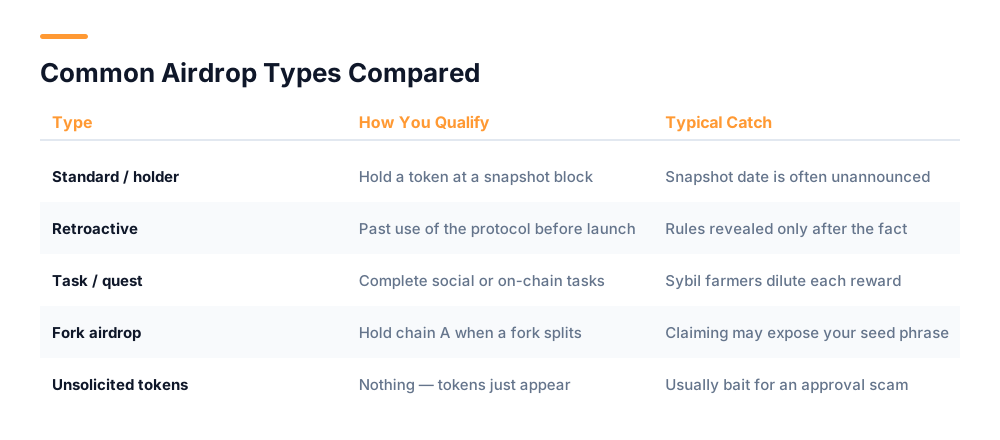
Five things get called an airdrop
The word covers five genuinely different events with different risk profiles. Sorting a given announcement into the right row tells you more than any hype thread will.
| Type | How you qualify | Typical value | Main risk |
|---|---|---|---|
| Retroactive usage | You used the protocol before a snapshot nobody announced | Anything from dust to four figures | You cannot plan for it; by announcement it is decided |
| Holder snapshot | You held a specific token at a specific block | Usually proportional and small | Buying in to qualify is speculation on a rumour |
| Task or quest | You complete social tasks, bridges, swaps or testnet actions | Low; heavily diluted by farmers | Costs real gas and time upfront for an unknown payout |
| Fork or migration | You held a coin when a chain split or a token redenominated | Varies wildly; often illiquid | The new asset may never trade anywhere |
| Unsolicited tokens | You did nothing; tokens simply appeared | Zero, by design | Interacting with them is the attack |
What airdrops have actually paid
Two distributions do most of the work in shaping expectations, so it is worth stating their figures precisely rather than gesturing at them.
In September 2020, Uniswap distributed 400 UNI to every address that had used the protocol before a snapshot taken on 1 September — roughly 250,000 addresses. At the price in the days after launch, that was in the region of $1,000 to $1,200. At the token's May 2021 high of around $45, the same 400 UNI was worth about $18,000. Nobody qualifying for it had done anything to pursue it; the behaviour being rewarded had happened months or years earlier, for its own reasons.
In March 2023, the Arbitrum Foundation distributed roughly 1.162 billion ARB to around 625,000 eligible addresses — an average of about 1,860 tokens each, though the distribution was tiered, so the median address received considerably less than the average. At the opening price of roughly $1.20 to $1.40, a typical allocation sat somewhere in the high hundreds of dollars. Within two years ARB traded well below that opening price, which is the ordinary pattern: an airdrop is a supply event, and a large share of recipients sell immediately.
Those are the headline cases. The unremarkable majority look nothing like them. A typical task-based distribution in a crowded field pays tens of dollars to a wallet that spent a comparable amount on gas, and a meaningful share of airdropped tokens never achieve enough exchange liquidity for the quoted price to survive contact with a sell order. A $200 allocation in a pool with $40,000 of depth is not $200.
What airdrop farming costs before it pays anything
Airdrop farming is the practice of using protocols that have not yet issued a token, in the hope of qualifying for one later. It is a real strategy and some people have done well from it. It is also one of the few activities in crypto where the cost side is precisely knowable in advance and the revenue side is entirely unknown, which is an unusual way round for an investment to be.
Here is an ordinary season of farming a single unreleased protocol, with figures that are deliberately conservative — on a mainnet rather than a cheap rollup, every row multiplies by ten or more.
| Activity | Realistic cost | What it actually buys |
|---|---|---|
| Bridge funds in and back out | $8–$25 in fees and spread | A bridging transaction in your history |
| 30 swaps over three months | $9–$30 in gas, plus slippage on each | Volume and transaction count |
| Liquidity provision for 90 days | Impermanent loss, often 1–5% of the position | A duration metric that may not be weighted |
| Governance votes and NFT mints | $5–$20 | Boxes ticked against unpublished criteria |
| Idle capital parked to look legitimate | Opportunity cost on $500–$5,000 | Nothing measurable |
| Claim transaction, if it ever happens | $2–$40 depending on congestion | The tokens, finally |
Add the rows and a single farmed protocol costs somewhere between $30 and $120 plus the capital tied up, against a payout that is unknown, unscheduled and conditional on the project issuing a token at all. Many never do. Of those that do, sybil filtering routinely excludes wallets whose behaviour looks mechanical — and farming behaviour looks mechanical by construction, because it is. Projects have published lists of excluded addresses running to the tens of thousands.
None of this makes farming irrational for someone who would have used the protocols anyway. It makes it a poor plan for someone who would not. The distinction is the same one that applies to every low-yield activity in this space, and our honest guide to earning money from your phone works through why effort-per-dollar is the number that actually decides these questions.
How to value an allocation before you claim it
The number a checker shows you is a quantity of tokens, not an amount of money. Converting one into the other takes about ten minutes and five checks.
- Confirm the token actually trades. If the only "price" comes from the project's own announcement, there is no price — there is a hope.
- Check the depth, not the quote. Open the main liquidity pool and see what selling your full allocation would do to the price. A thin pool turns a headline figure into a fraction of itself.
- Read the unlock schedule. If your allocation vests over 12 or 24 months, you are holding a claim on a future price, not a current one.
- Subtract the claim cost. Gas at the moment of the claim, plus any swap fee if you intend to convert.
- Note the claim deadline. Expiring airdrops are common and the token returns to the treasury afterwards.
- Price the tax. In the US, the IRS treats airdropped tokens as ordinary income at fair market value when you gain dominion and control — which can mean owing tax on a value that has since collapsed.
The tax point deserves emphasis because it is where people get genuinely hurt. Revenue Ruling 2019-24 establishes the dominion-and-control principle for airdropped cryptocurrency, and the practical consequence is that a token received at $8 and held to $0.40 can leave you with an income tax liability calculated on the $8. This is not advice and the detail varies by circumstance, but it is the reason experienced recipients deal with an allocation deliberately rather than leaving it to drift. If you are receiving an airdrop through a platform that verified your identity, our explainer on what KYC means in crypto covers who is reporting what to whom.
Crypto airdrop scams and how they actually work
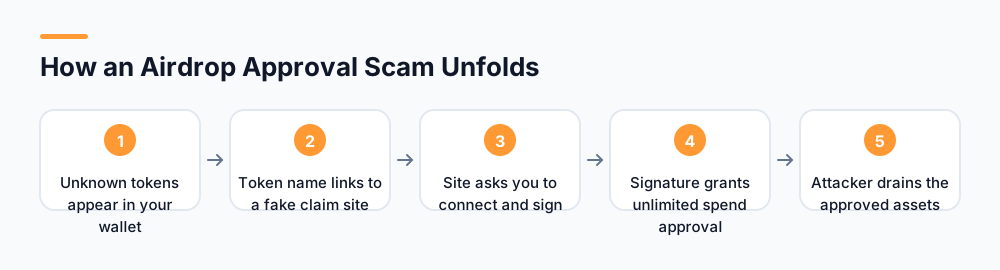
This is the part worth reading even if the rest is familiar. Crypto airdrop scams are not mostly fake tokens with no value — that would merely be disappointing. The profitable versions take what is already in your wallet, and the airdrop is the lure that gets you to a page where you sign something.
Approval phishing — the expensive one
You connect a wallet to claim, and the signature request is not a claim at all: it is a token approval granting an unlimited spending allowance over an asset you already hold, or a permit signature doing the same thing with no transaction and no gas. Approve it and the attacker drains that token at their leisure, sometimes weeks later. Connecting a wallet is harmless on its own; signing is where authority transfers. Read what each request authorises — wallets display it, and almost nobody reads it — and periodically review and revoke old approvals through a block explorer's approval checker.
Dusted tokens with a poisoned contract
Unknown tokens appear in your wallet, often named after a real project, often with an eye-catching fake dollar value attached. The token contract is written so that selling or transferring it routes you to a malicious site, or so that an approval granted to trade it extends to something else. The correct response is to ignore them permanently. Hiding the token in your wallet interface is fine; interacting with it is not.
Fee and verification demands
A site tells you that you qualify for a large allocation, then requires a "gas deposit", an "activation fee" or a verification payment before releasing it. This is the oldest script in the industry wearing a new costume, and it is the same mechanism we documented in our breakdown of giveaway scams: the balance shown to you was never real, and the fee is the entire product. No legitimate distribution ever requires you to send funds to receive funds. You pay your own network fee, to the network, from your own wallet — never to the project.
Seed phrase harvesting
A claim page asks you to "import" or "sync" your wallet by entering twelve or twenty-four words. There is no version of this that is legitimate, under any branding, for any amount. Sending you tokens requires a destination address and nothing else. If the role of those words is unclear, our guide to what a crypto recovery passphrase is explains why they are the account itself rather than a password for it.
Use a claim wallet
Claim every airdrop from a fresh wallet holding nothing but the gas required. If the signature turns out to be malicious, the attacker gains spending authority over an empty address. This single habit neutralises most of the category.
A checklist for any airdrop announcement
- Find the announcement on the project's own domain or verified account. Never navigate from a search advert, a direct message or a reply under a popular post.
- Compare the claim contract address against the one in the official announcement, character by character at both ends.
- Check whether the eligibility snapshot is already past. If a site tells you to perform actions now to qualify for a snapshot already taken, it is lying.
- Use a wallet containing only gas. Not your main one, not the one holding anything you would miss.
- Read the signature request. A claim should transfer tokens to you, not grant an allowance over tokens you hold.
- Confirm no payment is requested, in any form, under any name.
- Confirm no recovery words are requested, under any explanation.
- Check liquidity depth before assuming the quoted value is achievable.
- Note the claim deadline and the vesting schedule.
- Record the date and fair market value for tax purposes at the moment you take control.
Steps six and seven end the evaluation by themselves. The others are judgement; those two are not, and they are the same two that end the evaluation for faucets, mining apps and anything else in this space promising something for nothing.
So is chasing a crypto coin airdrop worth it?
If you already use decentralised applications because you find them useful, keep a clean record of that usage and claim carefully when something arrives. That is the version of this that has historically paid, and it paid precisely because the behaviour was not performed in pursuit of a reward.
If you are considering starting from nothing in order to farm distributions, price it properly first: $30 to $120 per protocol, capital tied up for months, an unknown probability of any token at all, a real probability of being filtered out as a sybil, and a tax treatment that can bill you for a value you never realised. People do win at this. The median participant does not, and the guides promising otherwise are usually funded by referral links to the bridges and exchanges they recommend.
Where UNC sits, stated plainly rather than implied: UNC runs a published allocation schedule, not an airdrop campaign. There is no snapshot to game, no claim page to connect a wallet to, and no circumstance in which we will ask you for a fee or for recovery words. UNC has no listed price and no exchange listing, which means nobody — us included — can tell you what an allocation is worth, and we do not promise earnings, returns or future value. The page on how UNC works sets out the schedule and what the app does and does not touch on your device.
If you prefer the structural detail to the summary, the UNC whitepaper documents the network design and distribution model in full, and all of it is readable before you install anything — which is a reasonable standard to hold any token distribution to, airdrop or otherwise.
Frequently asked questions
What is a crypto coin airdrop?
It is a distribution in which a project sends its token to a list of wallet addresses that did not pay for it. The project takes a snapshot of blockchain state at a specific block, decides which addresses qualify, and deploys a contract that lets those addresses claim an allocation. Qualification is usually retroactive — based on activity that already happened — which is why it cannot reliably be planned for after an announcement.
How much is a typical airdrop worth?
Far less than the famous cases suggest. Uniswap's 400 UNI in September 2020 was worth roughly $1,000 at launch and about $18,000 at the 2021 peak; Arbitrum's March 2023 distribution averaged around 1,860 ARB per address, worth high hundreds of dollars at the opening price. Ordinary task-based airdrops frequently pay tens of dollars to wallets that spent a comparable amount on gas, and many airdropped tokens never achieve enough liquidity for the quoted price to survive a sell order.
Are crypto airdrops free?
The tokens are free; the process rarely is. Most airdrops require a claim transaction, so you pay a network fee to receive something. Task-based airdrops require weeks of on-chain activity costing real money in gas and slippage. And in the US, airdropped tokens are generally treated as ordinary income at fair market value when you gain dominion and control, which can create a tax bill on a value the token no longer has.
How do crypto airdrop scams actually steal money?
Mostly through approval phishing. You connect a wallet to a fake claim page and the signature request is not a claim but a token approval granting unlimited spending authority over an asset you already hold — sometimes drained weeks later. Other variants demand an activation or gas fee before releasing a fictitious balance, place poisoned tokens in your wallet that route you to malicious contracts when you try to sell them, or ask for your recovery phrase outright. Claiming from a wallet holding nothing but gas defeats most of them.
Is airdrop farming profitable?
It is for some people and not for most. A single farmed protocol typically costs $30 to $120 in bridging, swaps, votes and the eventual claim, plus capital tied up for months, against a payout that is unknown, unscheduled and conditional on a token being issued at all. Sybil filtering routinely excludes wallets whose behaviour looks mechanical, which farming behaviour does by construction. It makes sense for people already using the protocols and poor sense for people who are not.
Does UNC run airdrops?
No. UNC distributes according to a published allocation schedule rather than snapshot-based airdrop campaigns, so there is no claim page, no wallet connection prompt and no snapshot to farm. UNC will never request a fee or your recovery words. The token has no listed price and no exchange listing, so no one can state what an allocation is worth, and we make no promises about earnings, returns or future value.
Start mining with UNC
UNC distributes tokens to verified participants — no hardware, no subscription, no battery drain. Read the whitepaper for the distribution model, or check network activity in the explorer.
Get UNC on Google Play