Staying Safe
Crypto Faucet Games: What They Are and What They Cost
A crypto faucet game gives you a free stake and then invites you to gamble it. The free part is real and the gambling part is real, and the second one is designed to recover the first many times over. Here is the arithmetic of the house edge, the four formats you will run into, and the point at which a faucet game stops being a bad bet and becomes outright theft.
Crypto faucet games are the commercially successful corner of the faucet world. A plain faucet pays you a fraction of a cent for looking at an advert and makes its operator a fraction of a cent in return, which is a thin business. Attach a dice roll to that free claim and the economics change completely — not because the claim gets larger, but because a small proportion of people who receive a free stake will eventually fund an account with money of their own.
That is the whole model, and it is worth stating plainly before anything else: the faucet is the marketing budget and the game is the product. Nothing about that is hidden, exactly. It is just rarely spelled out in the terms that let you evaluate it properly, which is arithmetic rather than adjectives.
This guide covers what these sites actually are, the house-edge maths that decides the outcome long before luck does, the four formats you will meet, the point where a faucet game crosses from a bad bet into fraud, and how all of this compares to the mining apps people often lump in with it. If you have not read how the underlying drip works, our explainer on what a crypto coin faucet is covers the plumbing that sits behind the free claim.
What a crypto faucet game actually is
The structure is almost always the same. You land on a site offering a free claim — typically a few hundred satoshis, or the equivalent dust in another asset — available once every five, fifteen or sixty minutes. Beside that claim button is a game. Roll a dice above a number. Pick heads or tails. Spin a wheel. The free balance is immediately wagerable, and the site makes that fact prominent.
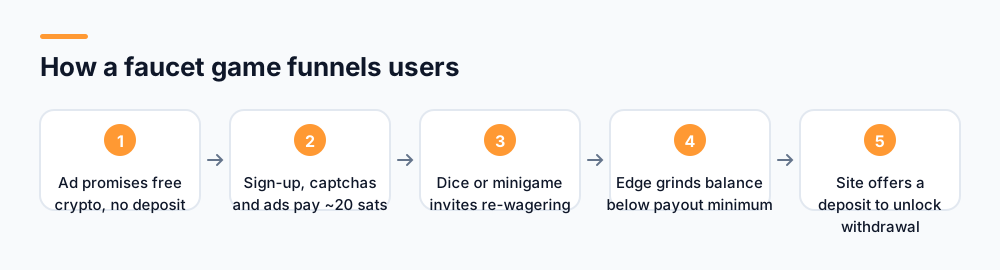
The claim itself is genuinely free and the balance is genuinely yours in the site's database. What you have not got is a withdrawal, because the withdrawal minimum sits weeks of claims away. The game is offered as the shortcut: wager the dust, multiply it, reach the minimum today instead of next month. That is the pitch, and it is the only part of the operation that is really being sold.
- A free claim on a timer, small enough that collecting it manually is never worth your hour.
- A withdrawal minimum set far enough away that patience alone rarely reaches it.
- A game with a published or implied house edge, usually between 1% and 5%.
- A deposit button, which is the only route to a stake large enough for the game to feel meaningful.
- A referral scheme paying a share of what people you recruit lose, not of what they win.
- Frequently a "provably fair" page, which proves the rolls were not tampered with — not that the odds favour you.
Provably fair deserves a moment, because it is the most misunderstood badge on these sites. It is a real cryptographic technique: the operator commits to a server seed in advance, you supply a client seed, and afterwards you can verify the result was not chosen after you bet. It is a genuine protection against one specific cheat. It says nothing whatsoever about the house edge, which is declared openly and works entirely within the rules. A provably fair game with a 1% edge takes your money slowly and honestly. Our earlier piece on the faucet game model walks through that distinction in more depth.
The house edge, with actual numbers
A house edge of 1% means that for every unit you wager, you get back 0.99 units on average. Not 99% of your deposit — 99% of everything you stake, every time you stake it. That second part is what people miss, and it is the entire reason the model works. Money on a gambling site is not lost once; it is recycled through the edge repeatedly until there is nothing left to recycle.
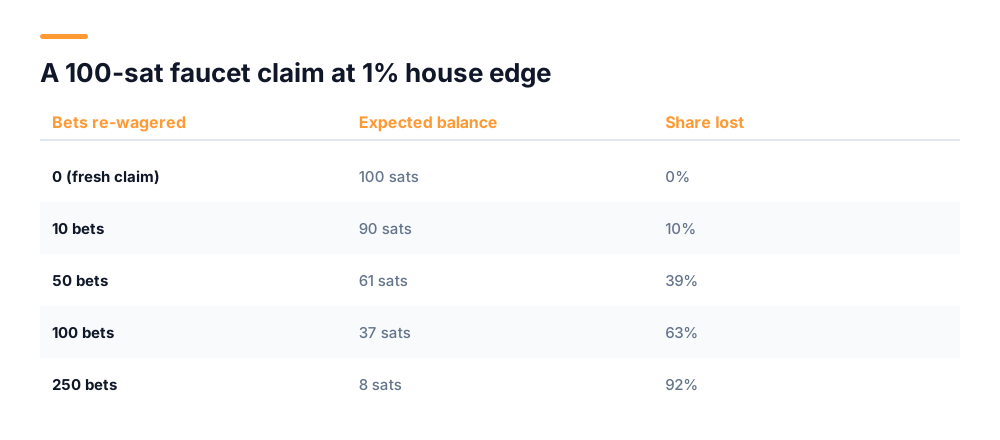
Suppose a faucet game hands you 100 satoshis and you decide to grow it into something withdrawable. Each time you put your whole balance through the game, you keep 99% of it on average. Here is where that leaves you.
| Times you wager the whole balance | Share of the free stake remaining, on average | On a 100 satoshi claim |
|---|---|---|
| 1 | 99% | 99 sats |
| 10 | 90.4% | 90 sats |
| 50 | 60.5% | 61 sats |
| 100 | 36.6% | 37 sats |
| 250 | 8.1% | 8 sats |
| 500 | 0.7% | Under 1 sat |
Five hundred rolls sounds like a lot until you watch someone play a dice game, where a roll takes about two seconds. Five hundred wagers is under twenty minutes of idle clicking. The free stake is not taken from you in a dramatic loss; it evaporates through arithmetic while you are still deciding whether you are up or down.
The double-or-nothing framing is worth its own example because it is the one faucet games push hardest. Ten consecutive wins at a fair coin flip would turn 100 sats into 102,400 sats, which is a real amount. The site sets your win probability at 49.5% rather than 50%, so the chance of ten in a row is about 0.09%, or one attempt in roughly 1,130. Multiply the payout by the probability and you recover about 90% of your stake on average — a 10% loss dressed up as a jackpot. The jackpot is real. So is the fact that you will pay for it 1,130 times over to see it once.
Bonus offers follow the same logic in reverse. "Deposit $20, get $20 free, 40x wagering" means you must stake $1,600 before withdrawing. At a 1% edge, the expected cost of generating that turnover is about $16 — which is most of the bonus, handed back before you are permitted to touch it. The bonus is not a gift; it is an instruction to wager forty times your deposit.
The four formats you will actually meet
Dice, limbo and multiplier games
The classic. You choose a target multiplier, the site rolls, and you win if the roll clears it. The edge is fixed and published, often 1%. These are the most honest games in the category in the narrow sense that the odds are stated and verifiable — and the most efficient at removing a balance, because a round takes two seconds and nothing stops you playing thousands of them.
Wheels, lotteries and prize draws
A free daily spin with a headline prize of one whole Bitcoin. The prize exists, in the sense that somebody somewhere may have won it once and the site will show you their username. The realistic outcome is a handful of satoshis, and the purpose of the wheel is to give you a reason to open the site every day. Attention, not payout, is what is being harvested.
Mining simulators and idle games
These look like games about building a mining farm: buy a rig, it produces coins per hour, upgrade it, buy more. No mining occurs. It is a spreadsheet with pictures of hardware, where early upgrades are cheap and productive and later ones require either an implausible grind or a deposit. Some pay out small amounts to early users to establish credibility; a meaningful number simply stop paying once deposits exceed withdrawals, which is a Ponzi structure with a cartoon interface.
Tap-to-earn and play-to-earn apps
The newest branch. Tap a screen, accumulate points, and wait for a token that may or may not ever be issued. Some of these have distributed real tokens; most have distributed nothing, and the points are a database entry with no obligation attached. Where no deposit is requested, the cost to you is time and attention rather than money — but the ones that do eventually request a deposit, a gas fee, or a wallet signature belong in the scam section below.
| Format | Where the edge sits | What it wants | Likely outcome |
|---|---|---|---|
| Dice / multiplier | Published, 1–5% per wager | Volume of bets, then a deposit | Free stake gone in minutes |
| Wheel / lottery | Prize value far below spin cost to operator | A daily visit and ad impressions | A few satoshis, indefinitely |
| Mining simulator | Upgrade curve tuned to require deposits | Deposits framed as equipment | Payouts stop when inflow does |
| Tap-to-earn | No obligation to ever issue a token | Attention, referrals, sometimes a signature | Points that may never convert |
Why giving away money is the cheap part
It is tempting to assume a site giving away cryptocurrency must be losing on those payouts. It is not, and the numbers are not close. A free claim of 100 satoshis costs the operator well under a cent. Acquiring a funded gambling customer through advertising costs, depending on the market, somewhere in the range of tens to low hundreds of dollars. If a faucet claim costs half a cent and one in every few thousand claimers eventually deposits, the faucet is the cheapest acquisition channel available.
That is also why the free claim is deliberately too small to withdraw. A claim you could cash out would attract people who take the money and leave. A claim that can only realistically be used inside the game keeps the value on the platform, where the edge can work on it. Every design decision — the timer, the minimum, the instant wagerability, the referral cut paid on losses — points the same way.
- The claim is free because free claims are cheaper than adverts.
- The minimum is high because a withdrawable claim defeats the purpose.
- The game is instant because deliberation reduces bet volume.
- The referral scheme pays on losses because winners are not the business.
- The daily bonus exists because habit is worth more than any single deposit.
When a faucet game stops being a bad bet and becomes a scam
There are two separate problems here and conflating them makes both harder to see. The first is a game with a legitimate but unfavourable edge, run by an operator who pays out. You lose, slowly, exactly as advertised. The second is a site where the balance was never real, no withdrawal was ever going to be processed, and the game is a stage set. The second category is far more common at the faucet end of the market, because the customers are new and the stakes look too small to investigate.
- A fee demanded to release a withdrawal — network fee, verification fee, tax prepayment. Real withdrawals deduct the fee; they do not require an inbound payment first.
- A balance that grows implausibly fast while the withdrawal button stays disabled.
- A wallet connect prompt that asks you to sign a token approval. That grants spending authority over your assets and has nothing to do with receiving a prize.
- Any request for a recovery phrase, private key or exchange password.
- An APK or direct download outside the official app stores, particularly one asking for broad device permissions.
- Support that only exists inside a messaging app, staffed by someone who contacted you first.
- A "manager" or "analyst" offering to play on your behalf or to guarantee a result.
The single most useful verification step costs two minutes. Find the site's payout address and look at its outbound transaction history in a block explorer. A platform that pays will show a steady stream of outgoing payments to many different addresses. A platform that does not will show deposits arriving and almost nothing leaving. If you have never done this, our walkthrough on reading a blockchain explorer covers which columns matter and how to tell inbound from outbound.
Where UK players stand specifically
Search crypto scam uk and you will land quickly on Action Fraud and the FCA warning list, both of which are worth checking before you deposit anywhere. There is a further point that applies specifically to faucet games: almost none of these sites hold a UK Gambling Commission licence. They are typically registered offshore, which means no GAMSTOP self-exclusion, no deposit limits, no independent complaints adjudicator and no route to recover funds from a platform that decides not to pay. Marketing a crypto casino to British consumers without a licence is itself unlawful, but enforcement against an anonymous offshore operator is slow and often futile. A licensed bookmaker taking your money is regulated; a faucet dice site taking it is not.
The route from a dating app to a trading platform
One pattern deserves separate treatment because it overlaps heavily with this category and does far more financial damage than any dice roll. A crypto romance scam begins as a relationship — weeks or months of ordinary conversation on a dating app or a mistaken-number text — and ends with an investment platform the other person introduces casually as something they use themselves. That platform looks like a trading dashboard or, increasingly, a gamified one with a faucet-style free credit and a predictable-looking game. Small withdrawals succeed early, which is the mechanism that builds trust. Large ones trigger a tax, a fee, or an account freeze.
The tell is not the interface, which is often polished. It is that the opportunity arrived through a person rather than a search, and that the person becomes helpful at exactly the moment money is involved. Nobody who met you online has a genuine reason to help you use a specific platform. The pay-to-withdraw demand at the end is the same mechanism described in our piece on crypto giveaway scams, and the request for a wallet signature or a seed phrase is covered in our note on what a recovery passphrase is and why nothing legitimate asks for it.
A fee to release a withdrawal is always the scam
No legitimate platform requires you to send money in before it will send money out. Transaction fees come out of the amount being sent. If a balance can only be unlocked by a payment, the balance is a number on a screen and the payment is the product.
How this compares to a crypto mining app
Faucet games and mobile mining get grouped together constantly, usually in the same listicle, and the grouping obscures a real structural difference. A faucet game is a gambling product wrapped around a free stake, and its expected value to you is negative by design. A crypto mining app is not a gambling product — but that is not the same as saying it is lucrative, and anybody telling you otherwise is selling something.
We would rather be direct about our own category than imply an exception. Phone-based mining does not produce meaningful money; the hardware is not suited to it and the arithmetic does not work at any scale a handset can reach. Our breakdown of whether mobile mining is profitable runs the numbers rather than gesturing at them, and the answer is no. What differs between apps in this space is not earnings but honesty: whether the app tells you what it does to your device, whether it demands a deposit, and whether it makes claims about future value that nobody is in a position to make.
| Faucet game | Plain ad-funded faucet | Mobile mining app | |
|---|---|---|---|
| Expected value to you | Negative by design | Fractions of a cent per claim | Not income; an allocation with no set price |
| Deposit ever required | Yes — that is the business | Never legitimately | Never legitimately |
| What it earns from | Your losses | Advert impressions | Varies; read the whitepaper |
| Main risk | Losing deposits, or a site that never pays | Site closes holding your balance | Wasting time on a token that may stay worthless |
For completeness about us specifically: UNC has no claim button, no dice roll, no wheel, and nothing to wager. Allocation follows a published schedule, and how UNC works sets out that schedule alongside exactly what the app does on your handset. The token has no listed price and no exchange listing, which means nobody — including us — can tell you what an allocation is worth, and we do not promise earnings, returns or future value. If you would rather read the structure than the summary, the UNC whitepaper is public and you can read all of it before installing anything.
What to do instead, if the curiosity is genuine
There is a legitimate reason people end up on these sites, and it is not usually greed. It is wanting to hold a small amount of cryptocurrency without buying any, to see how the thing works. That is a reasonable goal and there are better routes to it.
- Use a testnet faucet from your chosen network's official documentation. The tokens are worthless on purpose, which is exactly why those faucets are free, generous and unencumbered by games.
- If you want a real on-chain transaction, make one small withdrawal from a plain ad-funded faucet with a verifiable payout history, and stop there. You will learn what an address looks like, how confirmation feels, and why a network fee can exceed the amount you are moving.
- Set up a self-custodial wallet and write the recovery phrase on paper. That single exercise is worth more than any amount of faucet claiming.
- Look up any project you are curious about in a block explorer before you give it your time, not after.
- If you want to gamble, do it knowingly, with a licensed operator, with money you have decided to lose — not by accident, through a free stake on a site with no licence and no complaints procedure.
The free claim is not a gift and the game is not the reward. The claim is the advertising spend and the game is how it gets recovered.
Nothing in this article requires you to trust our characterisation of any particular site. The house edge is published on most of them; the payout history is on a public ledger; the licence status is a search away. The one habit worth keeping is checking those three things before you spend an evening on anything, because every part of this category is designed to make the evening feel shorter than it is.
Frequently asked questions
Are crypto faucet games legit?
Some are, in the narrow sense that they publish their house edge and pay out withdrawals. That does not make them profitable for you — a 1% edge applied to a few hundred wagers removes almost all of a free stake on average. Many others never pay at all, and the free claim exists purely to build a balance that gets locked behind a withdrawal fee. Check the payout address in a block explorer before assuming either.
Can you actually win money from a crypto faucet game?
Individual sessions can end up ahead, because variance is real. Over any meaningful number of bets the house edge dominates, and the free stake is deliberately too small to withdraw without either extraordinary luck or a deposit. Treat any win as a short-term outcome rather than a sign the game can be beaten, because the edge is arithmetic rather than skill.
Are crypto casinos and faucet games legal in the UK?
Marketing gambling to UK consumers requires a Gambling Commission licence, and the vast majority of crypto faucet game sites are unlicensed offshore operators. Practically, that means no GAMSTOP self-exclusion, no deposit limits, no independent complaints adjudicator and no route to recover funds from an operator that refuses to pay. Searching for crypto scam uk will bring up Action Fraud and the FCA warning list, both of which are worth checking first.
How do faucet games connect to romance scams?
They share an interface. A crypto romance scam typically introduces a fake investment or gamified trading platform after weeks of relationship-building, and that platform often uses faucet-style free credits and easy early wins. Small withdrawals succeed to establish trust; larger ones trigger a fee, a tax or a frozen account. The warning sign is that the opportunity arrived through a person rather than through your own search.
Is a crypto mining app better than a faucet game?
They are different things rather than better and worse. A faucet game has a negative expected value by design because it is gambling. A mobile mining app is not gambling, but it is also not a way to make meaningful money — phone hardware cannot mine profitably at any scale. The useful comparison is honesty: whether the app requires a deposit, what it tells you about device usage, and whether it makes claims about value that nobody can support.
What is the biggest red flag on a faucet game site?
A fee demanded before a withdrawal can be processed. Legitimate withdrawals deduct network fees from the amount being sent; they never require an inbound payment first. The second biggest is any wallet connect prompt asking you to sign a token approval, which grants spending authority over your assets rather than receiving anything, and the third is any request for a seed phrase.
Start mining with UNC
UNC distributes tokens to verified participants — no hardware, no subscription, no battery drain. Read the whitepaper for the distribution model, or check network activity in the explorer.
Get UNC on Google Play